Summarize this article with:
- Test accuracy on your own images, not only public benchmarks. Camera angle, lighting, object size, and domain-specific classes can change results significantly.
- Check the full production fit. Compare latency, image and video support, input formats, pricing model, rate limits, and GDPR or EU data residency requirements.
- Free tiers are useful for testing, but they have limits. Benchmark request volume, response time, and cost before choosing a provider for production.
- Keep more than one provider available. Eden AI lets you compare object detection APIs through one integration and use fallback to improve reliability and control costs.
The best object detection APIs in 2026 include Amazon Rekognition, Google Cloud Vision, Microsoft Azure, Clarifai, api4ai, and SentiSight.ai. The right choice depends on your images, accuracy requirements, latency targets, video support, pricing, and data residency needs.
Newer models such as RF-DETR and the YOLO family have made inference faster and more cost-efficient, which has pushed providers to update their object detection tools, deployment options, and pricing structures. We compare model coverage, image and video support, response formats, free tiers, pricing models, and integration effort.
The table below compares the main options, their strengths, free access, and ideal use cases.
What is an object detection API?
An object detection API analyzes an image or video to identify what objects are present and where each one appears. It returns a label for every detected object, a confidence score, and bounding box coordinates that define the object’s position in the frame.
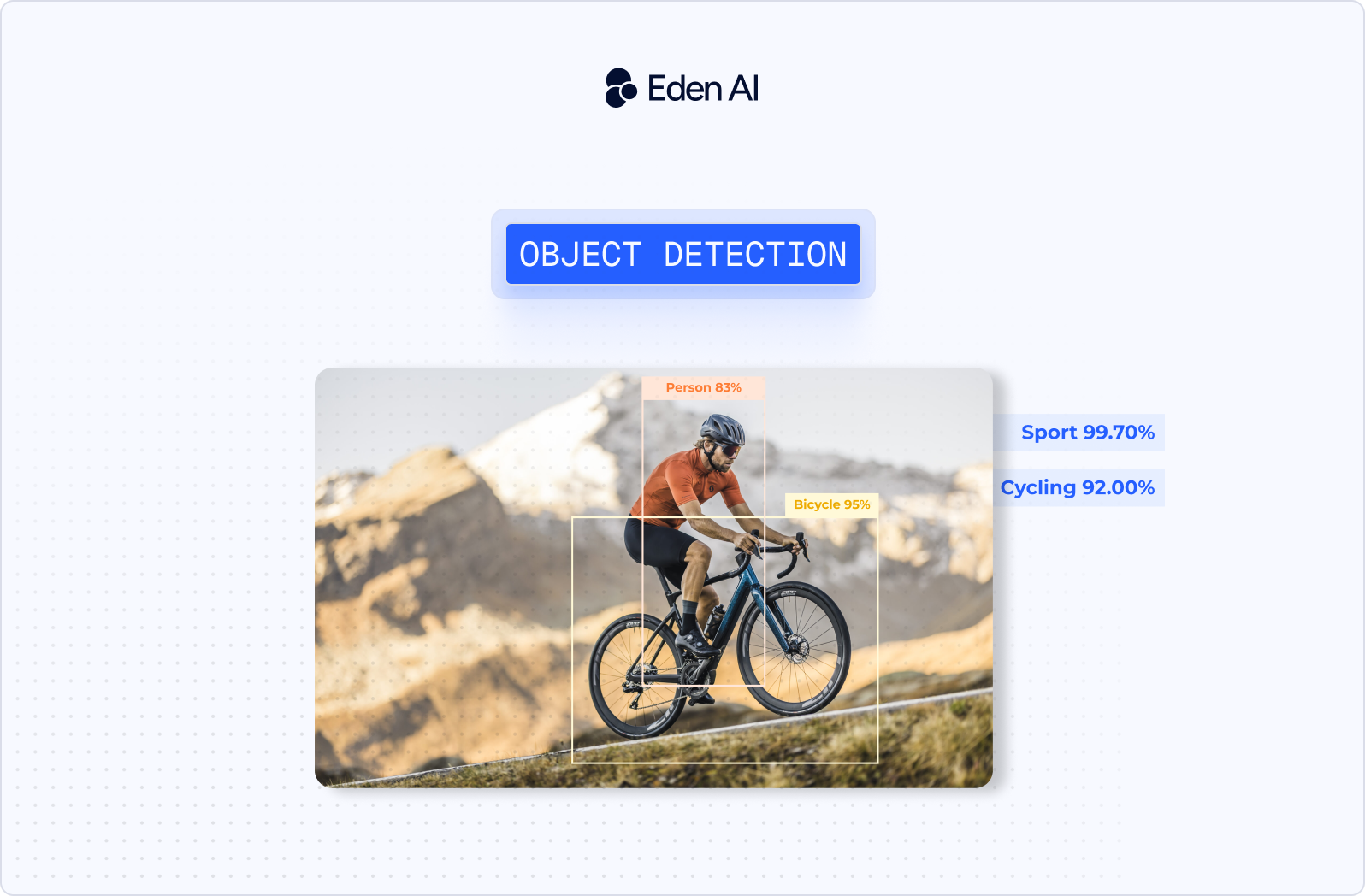
You send the API an image file, image URL, or video input. The service runs an object detection model, then returns structured JSON that your application can use for search, moderation, analytics, automation, or visual inspection. This is a practical way to detect objects in an image without training and hosting your own model.
A typical response looks like this:
{
  "objects": [
    {
      "label": "car",
      "confidence": 0.94,
      "bounding_box": {
        "x_min": 118,
        "y_min": 76,
        "x_max": 462,
        "y_max": 301
      }
    }
  ]
}
Coordinate formats vary by provider. Some use pixel values, while others return normalized values between 0 and 1.
Object detection vs. image recognition
Image recognition assigns one or more labels to the entire image. Object detection identifies individual objects and places a bounding box around each instance.
The best object detection models in 2026
The model behind an object detection API affects accuracy, latency, hardware requirements, and the types of objects you can detect. A provider may offer a simple endpoint, but the underlying architecture still determines how well it performs on small objects, crowded scenes, or real-time video.
RF-DETR leads supervised object detection research with 54.7% mAP on COCO and 60.6% on RF100-VL, with latency below 5 ms. RF-DETR 2XL is also reported as the first real-time detector to exceed 60 AP, making it relevant for workloads that need both high accuracy and low response times.
The YOLO family, including YOLO11, YOLOv12, and YOLO26, remains widely used because it is fast, practical, and supported across many deployment environments. YOLOv12-M reaches about 52.5% mAP at roughly 4.86 ms, according to published model results.
RT-DETR and RTMDet target real-time inference while maintaining competitive detection quality. RTMDet reaches around 52.8% AP at more than 300 FPS in reported benchmarks, which makes it suitable for high-throughput video and edge deployments.
Zero-shot models, such as YOLO-World and GroundingDINO, can detect objects from text prompts without labeled training data for every class. They are useful when your categories change often or when you need to test a new detection task before preparing a dataset.
Cloud providers package these model advances into managed APIs. You get faster inference and newer detection capabilities without training models, managing GPUs, or maintaining inference infrastructure.
Top object detection APIs in 2026
The best object detection APIs in 2026 are Amazon Rekognition, Google Cloud Vision, Microsoft Azure, Clarifai, api4ai, and SentiSight.ai. These providers differ in model customization, supported media, cloud integration, pricing structure, and the amount of infrastructure you need to manage.
Amazon Rekognition
Amazon Rekognition is AWS’s managed computer vision service for analyzing images and video. It is designed for teams already using AWS services such as S3, Lambda, and CloudWatch.
Strengths
- Supports image and video analysis.
- Detects objects, scenes, activities, faces, and unsafe content.
- Integrates directly with the AWS ecosystem.
- Custom Labels supports domain-specific detection models.
Limitations
- Pricing and configuration can become complex across several Rekognition features.
- Custom model training requires labeled data and additional setup.
- It may create cloud dependency for teams outside AWS.
Pricing
Pricing is pay-as-you-go and varies by API operation. Eligible new AWS accounts may receive limited free usage during the first 12 months, so check the provider for current limits.
Best for: Applications already hosted on AWS that need image or video detection.
Skip it if: You want a cloud-neutral setup or a simpler pricing structure.
api4ai
api4ai provides hosted computer vision APIs for tasks such as object detection, product recognition, and image classification. It targets developers who want a focused API without managing inference infrastructure.
Strengths
- Simple REST API for image-based detection.
- Can detect and count multiple objects.
- Offers customization services for domain-specific categories.
- Suitable for operational and industrial workflows.
Limitations
- The standard model may not cover specialized objects.
- Public information about benchmarks and model architecture is limited.
- Custom deployments may require provider involvement.
Pricing
Standard and custom pricing depend on the selected API and workload. Check the provider for current free-trial terms and production pricing.
Best for: Inventory counting, visual inspection, and focused image-processing workflows.
Skip it if: You need detailed public benchmarks, broad video support, or full control over model training.
Clarifai
Clarifai is an AI platform offering pretrained and third-party models for computer vision and other AI tasks. It is aimed at teams that want to combine models, build workflows, or deploy custom vision systems.
Strengths
- Provides access to a broad model catalog.
- Supports custom model training and configurable workflows.
- Can combine detection with classification and segmentation.
- Offers cloud and private deployment options.
Limitations
- The platform includes more features than some basic detection projects need.
- Pricing can depend on model, compute, and deployment configuration.
- Comparing model quality may require substantial testing.
Pricing
Clarifai uses usage-based and enterprise pricing models. Check the provider for current free-tier allowances and per-model inference costs.
Best for: Teams building multi-step computer vision workflows or evaluating several models.
Skip it if: You only need a basic object detection endpoint with minimal configuration.
Google Cloud Vision
Google Cloud Vision provides pretrained APIs for image analysis, including Object Localization. It is intended for developers who need general-purpose detection without training or hosting a model.
Strengths
- Returns labels, confidence scores, and normalized bounding coordinates.
- Integrates with Google Cloud storage, identity, and monitoring tools.
- Requires little setup for common object categories.
- Uses a documented REST API and client libraries.
Limitations
- Object Localization is limited to the categories supported by the pretrained model.
- Custom object detection may require a separate Google Cloud product.
- It focuses mainly on images rather than full video workflows.
Pricing
Pricing is based on the number of processed units. The first 1,000 Object Localization units per month have previously been listed as free, but check the provider for current terms.
Best for: General image detection in applications already using Google Cloud.
Skip it if: You need specialized object classes or advanced video tracking.
Microsoft Azure
Microsoft Azure provides object detection through Azure AI Vision and custom training options through related vision services. It is designed for teams building within the Microsoft cloud ecosystem.
Strengths
- Returns object labels, confidence scores, and bounding boxes.
- Integrates with Azure storage, identity, and monitoring.
- Supports pretrained and custom detection workflows.
- Suitable for enterprise governance and cloud-based deployment.
Limitations
- Microsoft’s computer vision products and names have changed over time.
- Features and availability may vary by region.
- Custom model development requires labeled training data.
Pricing
Azure offers usage-based pricing, with free and standard tiers available for some services. Check the provider for the current product, regional availability, and request limits.
Best for: Organizations already using Azure that need pretrained or custom object detection.
Skip it if: You want a cloud-independent service or need a simpler product structure.
SentiSight.ai
SentiSight.ai is a computer vision platform for labeling data, training models, and running predictions through a web interface or REST API. It is intended for teams that need custom object detection without building their own training pipeline.
Strengths
- Includes image annotation and model training tools.
- Supports custom object categories.
- Offers hosted inference through an API.
- Trained models can be deployed offline under separate terms.
Limitations
- Custom models require enough representative labeled images.
- Offline deployment may involve an additional license.
- It has a smaller ecosystem than major cloud providers.
Pricing
SentiSight.ai uses pay-as-you-go pricing and has offered signup and monthly credits. Check the provider for current prediction prices, training costs, and credit limits.
Best for: Custom detection projects that need labeling, training, and inference in one platform.
Skip it if: You only need a pretrained detector for common objects or deep hyperscaler integration.
How to choose an object detection API
Choose an object detection API based on how it performs with your own images, traffic patterns, and compliance requirements. Public benchmarks are useful, but they do not show how a model handles your camera angles, object sizes, lighting, or domain-specific classes.
Use this checklist:
- Accuracy on your data: Test precision, recall, missed detections, and false positives on a representative dataset, not only COCO scores.
- Latency: Measure end-to-end response time, including upload, inference, and network delay.
- Image vs. video support: Confirm whether the provider supports still images, recorded video, live streams, or asynchronous processing.
- Supported input formats: Check accepted file types, image size limits, video codecs, URLs, and base64 payloads.
- Pricing model: Compare per-image, per-minute, compute-based, subscription, and custom-model training costs.
- Data residency and GDPR: Review processing locations, retention policies, subprocessors, and whether an EU endpoint is available.
A specialized engine can be a better choice when you need a focused object detection software product, custom training, offline deployment, or support for a narrow use case. A hyperscaler is often easier when your storage, identity, monitoring, and billing already run in the same cloud.
Test several providers on real production samples before committing. Keeping a secondary provider as a fallback can improve reliability and reduce cost when prices, latency, or availability change.
Object detection use cases
Retail
Object detection can count products, identify empty shelf spaces, and track whether items are placed in the correct section. A supermarket can process aisle camera images every hour to flag missing stock and send a replenishment task to store staff.
Transportation
Detection models can identify cars, trucks, buses, cyclists, and pedestrians across road cameras or video streams. A city traffic system can measure vehicle counts by lane and adjust signal timing when congestion builds at a junction.
Security and surveillance
Object detection can flag people, vehicles, bags, or restricted-area entry without requiring constant manual monitoring. A warehouse can generate an alert when a person enters a loading zone outside scheduled operating hours.
Agriculture
Farmers can use aerial or ground-level images to locate crops, weeds, pests, and damaged plants. A drone survey can identify sections of a field affected by locusts or leaf disease so treatment targets only those areas.
Healthcare
Detection models can locate structures or suspected abnormalities in X-rays, scans, and pathology images. A radiology workflow can mark possible lung nodules for clinician review, while keeping the final diagnosis with a qualified professional.
Manufacturing
Cameras can detect missing components, surface damage, incorrect assembly, or packaging defects on production lines. An automotive plant can reject a panel when the system finds a dent or an incorrectly placed fastener.
Robotics
Robots use detection to understand obstacles, tools, products, and people around them. A warehouse robot can identify a pallet, avoid a worker, and align itself with the correct storage position.
How to integrate object detection with Eden AI
Eden AI gives you one API for several object detection providers. Each engine returns the same standardized JSON structure, so you do not need to rewrite your parsing logic when you compare or switch providers.
You can also configure fallback to send a request to another provider if the primary engine fails. Usage appears on one bill, instead of separate invoices and accounts for every computer vision service.
import requests

response = requests.post(
    "https://api.edenai.run/v3/universal-ai",
    headers={
        "Authorization": "Bearer YOUR_API_KEY",
        "Content-Type": "application/json",
    },
    json={
        # Switch providers by changing this model string
        "model": "image/object_detection/amazon",
        "input": {
            "file": "YOUR_FILE_UUID_OR_PUBLIC_URL"
        },
    },
)

response.raise_for_status()
print(response.json())
The object detection endpoint accepts a file ID or direct file URL and returns labels, confidence scores, and bounding box coordinates in a common format.
Get your Eden AI API key, then read the object detection documentation to send your first request.

.jpg)