Summarize this article with:
- A plagiarism detection API is a programmatic interface that takes a piece of text as input, compares it against a database of web content, academic papers, or indexed documents, and returns a similarity...
- Unlike browser-based plagiarism checkers, plagiarism APIs are designed to integrate directly into your application so you can run checks automatically at scale: on form submissions, document uploads,...
- The accuracy, database coverage, and supported languages vary significantly between providers - which is why comparing them before committing matters.
- Commercial plagiarism APIs solve the support, scalability, and accuracy gaps of open-source tools - at a cost per check.
- Winston AI uses state-of-the-art NLP (natural language processing) to run comprehensive plagiarism checks across the internet and curated document databases.
Building a product that checks for copied content or evaluating your options before you do means navigating a noisy landscape: unmaintained GitHub repos, commercial APIs with opaque pricing, and providers that vary wildly in accuracy.
This guide cuts through that. We cover:
- The top free and open-source plagiarism detection models you can self-host
- The best commercial plagiarism detection APIs available today
- A side-by-side pricing comparison so you know what you're committing to
- How to switch between providers without rewriting your integration
Whether you're building an EdTech platform, a content verification tool, or an AI writing assistant, you'll leave with a clear picture of which option fits your use case 6 and how to ship faster.
What Is a Plagiarism Detection API?
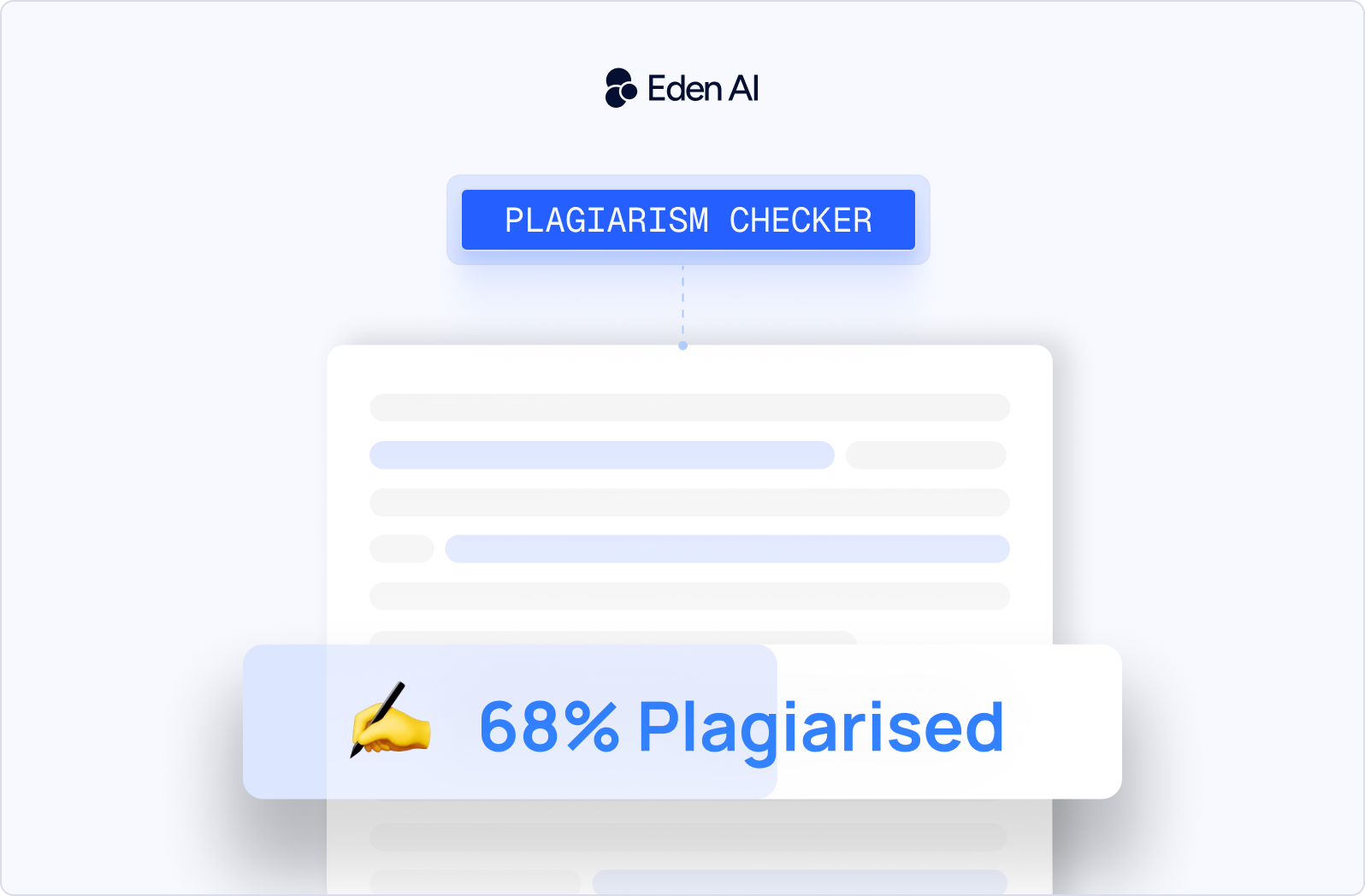
A plagiarism detection API is a programmatic interface that takes a piece of text as input, compares it against a database of web content, academic papers, or indexed documents, and returns a similarity score along with the sources that match.
Unlike browser-based plagiarism checkers, plagiarism APIs are designed to integrate directly into your application so you can run checks automatically at scale: on form submissions, document uploads, content pipelines, or user-generated content.
What a typical API response includes:
- An overall plagiarism score (percentage of matched content)
- A list of matching sources with URLs
- Highlighted text spans that triggered a match
- Language of the analyzed text
The accuracy, database coverage, and supported languages vary significantly between providers - which is why comparing them before committing matters.
Who Needs a Plagiarism Detection API?
Plagiarism detection isn't just for universities. Here are the most common use cases developers and product teams are building for:
- EdTech platforms - Automatically screen student essay and code submissions before instructors review them. Flag potential plagiarism without manual checking.
- Content and SEO agencies - Verify that freelancer-submitted articles are original before publishing. Catch accidental duplicate content before Google does.
- Publishers and media companies - Scan incoming contributions against published archives to protect editorial integrity.
- AI writing tools - Detect when AI generated output closely mirrors existing web content, reducing legal and reputational risk for users.
- Legal and compliance teams - Validate that contracts, reports, or IP documents haven't been copied from external sources.
- Code review and developer education platforms - Identify when submitted code has been copied from Stack Overflow, GitHub, or other submissions - even when variable names are changed.
Each use case has different requirements around accuracy, throughput, language support, and price per check - which shapes which API fits best.
Top Free Open-Source Plagiarism Detection Models
If you want full control over your data, don't want to pay per check, or need to run on-premises, open-source is the logical starting point. Here are the five most widely used open-source plagiarism detection tools.
1. Plagiarism-Checker
Plagiarism-Checker is a lightweight, general-purpose open-source model for detecting plagiarism in plain text. Good as a starting point for prototyping or internal tools where accuracy requirements are moderate. Not maintained at the level of commercial alternatives, and lacks a built-in database - you need to supply your reference corpus.
Best for: Proof-of-concept builds, internal tooling
Limitations: No hosted database, basic accuracy
2. Dolos
Dolos is built specifically for source code plagiarism detection, making it one of the most useful open-source tools for EdTech platforms and programming courses. It's designed to catch copied code even when variable names, spacing, or structure have been modified. Dolos includes interactive visualizations that help educators understand similarity clusters across a full class submission set - not just individual pairwise comparisons.
Best for: Programming courses, code submission review
Limitations: Text-only plagiarism (prose, articles) is out of scope
3. ItsJustACoincidenceProfessor
ItsJustACoincidenceProfessor is another source code-focused tool, it applies the Wagner-Fischer algorithm for string similarity measurement. It's precise at detecting syntactic similarity, making it useful for spotting copied code that hasn't been meaningfully refactored. The project is community-maintained. Expect limited documentation and no official support channel.
Best for: Technical plagiarism in code, academic settings
Limitations: Community-only support, limited docs
4. HookeJs
HookeJs is an open-source plagiarism detector built in Node.js. If your stack is JavaScript/Node, HookeJs integrates more naturally than Python-based alternatives. The feature set is minimal - it's primarily a detection layer, not a full platform.
Best for: Node.js environments, lightweight integrations
Limitations: Minimal features, sparse documentation
5. Plagium
Plagium is an open-source plagiarism detector that uses Google Search as its detection backend - meaning it checks text against publicly indexed web content by running search queries against the submitted text. This makes it reasonably effective for detecting content that has been published publicly online. However, it's subject to Google's rate limits and terms of service, which creates reliability issues in production environments.
Best for: Web content plagiarism, quick checks
Limitations: Rate-limited by Google, ToS concerns at scale, no academic database
Limitations of Open-Source Plagiarism Detection Tools
Open-source plagiarism tools are free to download - but running them in production is a different calculation. Here's what teams consistently run into:
1. Not truly cost-free at scale
Hosting, compute, and storage costs for maintaining your own detection infrastructure add up quickly, especially if you're running high volumes of checks.
2. No official support
When something breaks in production at 2am, you're relying on community forums and GitHub issues - not a support SLA.
3. Limited or outdated documentation
Many of these projects are maintained by individuals or small teams. Documentation often lags behind the codebase, making integration slower than it looks.
4. Security vulnerabilities
Open-source projects can go months without security patches. In applications handling user-submitted content, this is a genuine risk.
5. Scalability ceiling
Most open-source plagiarism tools aren't designed for high-throughput production workloads. Optimizing them for scale requires significant engineering investment.
6. No multilingual coverage
Commercial APIs typically support 10–50+ languages. Most open-source alternatives are English-only or require significant customization to handle multilingual content.
If any of these constraints affect your project, a managed API is a faster and lower-risk path.
Top Commercial Plagiarism Detection APIs
Commercial plagiarism APIs solve the support, scalability, and accuracy gaps of open-source tools - at a cost per check. Here are the two providers currently available through Eden AI.
OriginalityAI
OriginalityAI is built by a team with deep roots in content marketing and AI detection. It combines plagiarism checking with AI content detection - useful if your use case involves both human-copied content and LLM-generated text.
The API checks submitted content against a large corpus of indexed web content and returns a plagiarism score with source citations. It also scores text for AI-generation probability, which makes it a strong choice for content agencies and publishers navigating the AI writing landscape.
Strengths:
- Dual detection: plagiarism + AI-generated content
- Built for content marketing workflows
- Website-level scanning available
- Strong accuracy on web content
Best for: Content agencies, publishers, AI writing tools
Winston AI
Winston AI uses state-of-the-art NLP (natural language processing) to run comprehensive plagiarism checks across the internet and curated document databases. It supports multiple languages and returns detailed, structured reports - making it suitable for multilingual platforms and academic contexts.
Its database includes both publicly indexed web content and a broader document corpus, which improves coverage compared to search-only approaches.
Strengths:
- Multilingual support
- Deep database coverage (web + documents)
- Detailed source reporting
- Strong NLP-based detection
Best for: Academic platforms, multilingual products, enterprise content pipelines
Plagiarism Detection API Pricing Comparison
Pricing models vary between providers. Most commercial APIs charge per word, per check, or per credit. Volumes and discount tiers change frequently - check each provider's current pricing page before committing.
Eden AI advantage: Instead of integrating each provider separately, Eden AI gives you access to all commercial providers through one API key - with standardized response formatting and centralized billing.
How to Choose the Right Plagiarism Detection API
The right choice depends on your specific requirements. Use this framework:
Choose open-source if:
- Data privacy is non-negotiable (you can't send content to third parties)
- You're in a prototyping phase and cost is the primary constraint
- Your use case is narrow (e.g., code-only, English-only)
- You have engineering capacity to maintain the infrastructure
Choose a commercial API if:
- You need production-grade reliability and uptime guarantees
- You require multilingual support
- Accuracy is critical (academic integrity, legal contexts)
- You want official support and documented SLAs
- You're running high volumes and need predictable performance
Key questions to evaluate any API:
- What database does it check against? (web, academic, documents)
- What languages does it support?
- What are the rate limits?
- How is pricing structured: per word, per check, per credit?
- Does it return source citations or just a score?
- Is it GDPR-compliant?
Access Multiple Plagiarism Detection Providers Through One API
The problem with integrating directly with each commercial provider: every API has a different format, authentication flow, response structure, and billing system. Switching providers - or running A/B comparisons -means rewriting integration code. Eden AI solves this with a single unified API.
You write the integration once. Then you can:
- Switch between OriginalityAI and Winston AI with one parameter change
- Compare accuracy across providers on the same text
- Monitor all usage and billing from one dashboard
- Filter providers by GDPR compliance requirements
- Add new providers as Eden AI integrates them - with zero code changes

Conclusion
Choosing the right plagiarism detection API comes down to your scale, accuracy requirements, and how much infrastructure you want to own. Open-source tools give you control and zero API costs - but come with real production trade-offs. Commercial APIs solve those trade-offs, but lock you into a single provider's pricing and format.
Eden AI gives you the middle path: access to the best commercial plagiarism detection providers through a single API, with standardized responses, unified billing, and the ability to switch or compare providers without touching your integration code.

.jpg)