Summarize this article with:
We tested the leading image moderation APIs to see which ones perform best in production conditions. The comparison focuses on three dimensions: accuracy, latency, and cost per 1,000 images. This guide gives you a ranked comparison of the top options, including free tier choices and self-hosted open-source models for teams that want more control over deployment and data.
Image moderation detects and classifies unsafe or policy-sensitive visual content such as nudity, violence, or explicit imagery. We also compare where each provider fits best, from low-cost batch processing to real-time moderation. Start with the comparison table below.
Best Image Moderation APIs at a Glance
Use this table to narrow the shortlist before comparing each image moderation API in detail. Best For identifies the strongest use case, while Core Moderation Coverage summarizes the content categories and moderation scope. Multimodal shows which input types each API supports, and Customization / Control indicates how much policy or workflow configuration is available. Starting price gives the lowest stated entry price where available, while Custom indicates vendor-specific pricing and verification markers identify figures that still need confirmation.
What is an Image Moderation API?
An Image Moderation API is a tool that uses artificial intelligence to automatically analyze images and detect inappropriate, unsafe, or unwanted content, such as nudity, violence, hate symbols, or illegal activities, based on predefined rules or machine learning models.
Instead of reviewing images manually, developers can integrate an image moderation API into their applications to scan, classify, and filter images in real time. The API typically returns structured results (like labels, confidence scores, or risk levels), allowing platforms to decide whether to block, flag, blur, or approve the content.
How We Tested Image Moderation APIs
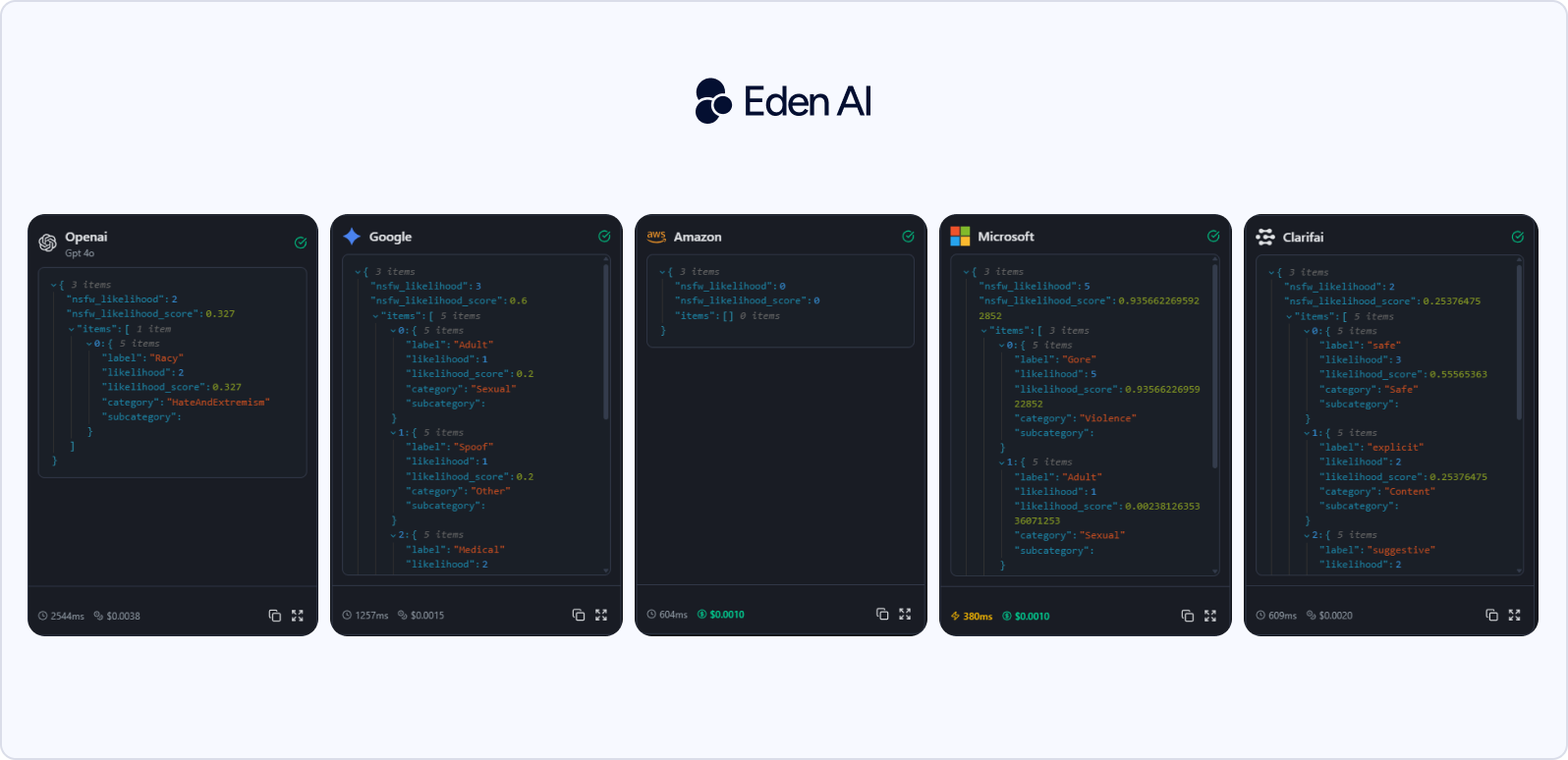
We first evaluated image moderation APIs through tests on Eden AI, comparing latency, cost, and output quality, including accuracy and data depth. Then we selected the best image moderation APIs by analyzing how they perform in realistic scenarios, not just based on documentation. Each API was evaluated across essential factors such as accuracy of detection, false positives/negatives, response time, and cost efficiency at scale.
We also assessed developer experience, API consistency, and flexibility, including the ability to handle edge cases like memes, text-in-image content, or borderline explicit images. This methodology allows us to highlight the APIs that deliver reliable results in production.
The 10 Best Image Moderation APIs in 2026
Azure AI Content Safety
Azure AI Content Safety covers text, images, and mixed-media safety workflows, with four monitored harm categories: hate, sexual, violence, and self-harm. It also supports configurable severity thresholds and custom categories for teams that need policy control inside the Microsoft ecosystem.
Pros:
- Automated filtering across core harm categories
- Configurable severity thresholds and custom categories
Cons:
- Enterprise setup can be heavier than specialist APIs
Best For: Large apps, marketplaces, education products, enterprise copilots, or internal AI assistants already using Azure, Microsoft Foundry, or Azure OpenAI.
Pricing: Pay-as-you-go, billed by the number of text records and number of images analyzed.
Google Cloud Vision SafeSearch
Google Cloud Vision SafeSearch is a lightweight image moderation API built around five likelihood-based categories: adult, spoof, medical, violence, and racy. It fits teams that need a straightforward moderation signal rather than a large policy or trust-and-safety system.
Pros:
- Simple API and likelihood-based output
- Integrates directly with other Google Cloud services
Cons:
- Limited customization compared with specialist moderation platforms
Best For: Consumer apps, marketplaces, media sites, forums, and internal tools that need baseline image moderation, particularly when the rest of the stack already runs on GCP.
Pricing: Free for the first 1,000 units/month, then $1.50 per 1,000 units from 1,001 to 5,000,000, and $0.60 per 1,000 units above that.
AWS Rekognition
AWS Rekognition supports both synchronous image moderation and asynchronous video moderation. AWS also offers Custom Moderation and Amazon Augmented AI for teams that need tailored moderation rules or human review workflows.
Pros:
- Supports both image and video moderation
- Integrates with broader AWS workflows and human review
Cons:
- JSON output can require extra policy logic to interpret
Best For: UGC platforms, video products, marketplaces, and social applications running at AWS scale, especially when video moderation or human review may be added later.
Pricing: A free tier for new customers, including 1,000 images/month for Rekognition Image during the free tier period and 60 free minutes/month of video analysis.
Hive Moderation
Hive Moderation is a specialist moderation platform covering visual content, text, audio, GIFs, video, and live streams. Its focus is broad media moderation rather than image filtering alone, which makes it relevant for products handling several content formats through the same safety workflow.
Pros:
- Specialized moderation coverage
- Broad multi-format moderation with +25 model classes
Cons:
- Higher usage limits require a more sales-led procurement process
Best For: Social platforms, dating apps, creator products, livestreaming services, and trust-and-safety-heavy marketplaces that need multi-format moderation from the start.
Pricing: $3.00 / 1,000 requests for Visual Moderation. Developer plan with $50+ free credits, 100 req/day cap; higher limits via sales.
OpenAI Moderation API
OpenAI Moderation API provides a lightweight moderation layer for text and images with little additional integration work. The current moderation endpoint supports both input types through omni-moderation-latest, making it practical for applications that already send content through OpenAI APIs.
Pros:
- Fast integration for existing OpenAI applications
- Supports both text and image moderation
Cons:
- Teams still need to build application-specific policy and enforcement logic
Best For: Companies already using OpenAI that want a first safety layer for uploads, profile photos, generated images, or combined text-and-image flows without adding a separate trust-and-safety platform.
Pricing: Free to use.
Alice (formerly ActiveFence)
Alice, formerly ActiveFence, rebranded from ActiveFence in 2026. It is an enterprise trust-and-safety platform rather than a standalone image moderation endpoint, with capabilities spanning adversarial intelligence, guardrails, continuous testing, platform abuse, and production monitoring.
Pros:
- Covers broader trust, safety, and abuse workflows
- Designed for operational policy and security programs
Cons:
- Too heavy for teams that only need basic NSFW filtering
Best For: Large platforms, regulated enterprises, and companies running AI assistants or agents where safety, compliance, abuse prevention, and adversarial testing extend beyond image classification.
Pricing: Custom pricing.
Sightengine
Sightengine is a developer-focused moderation API covering nudity, hate, violence, drugs, weapons, self-harm, commercial text, children, OCR, QR codes, and other categories. Its 110+ to 120+ moderation classes give teams broad category coverage without requiring a larger enterprise trust-and-safety platform.
Pros:
- 110+ to 120+ moderation classes
- Supports images, video, and live-stream-related workflows
- Quick API setup for dedicated moderation use cases
Cons:
- Customers still need to define thresholds and enforcement policies themselves
Best For: Dating apps, communities, creator platforms, ad products, and marketplaces that want broad specialist moderation coverage through a developer-oriented API.
Pricing: Starter $29/month for 10,000 operations plus $0.002 per extra op; Pro $99/month for 40,000 operations plus $0.002 per extra op.
Imagga
Imagga combines content moderation with image and video recognition, tagging, search, OCR, and an AI-plus-human moderation option. It fits teams that want moderation as one part of a broader visual processing stack rather than as an isolated safety endpoint.
Pros:
- Combines moderation with tagging, OCR, and search
- Straightforward API integration with technical support available
Cons:
- The broader computer-vision product scope can add unnecessary surface area for teams needing moderation only
Best For: DAM systems, media products, commerce platforms, and photo-heavy applications that need moderation alongside other image-analysis capabilities.
Pricing: Free $0/month with 100 API requests, Indie $79/month with 70,000 API requests, Pro $349/month with 300,000 API requests.
Clarifai
Clarifai supports image moderation as part of a wider computer-vision and multimodal platform, including custom classifiers, model orchestration, workflows, and hybrid deployments. It is better suited to teams that want to build tailored moderation pipelines than to teams looking for a narrow fixed-category endpoint.
Pros:
- Supports custom image and video recognition workflows
- Offers custom classifiers, model orchestration, and deployment options
Cons:
- Pricing and platform complexity can be harder to justify for small moderation-only workloads
Best For: Larger product and AI teams that need custom classifiers, training, workflow composition, private deployment, or broader multimodal functionality.
Pricing: Pay As You Go or Request-level pricing from $0.0012/request.
PicPurify
PicPurify is a focused image moderation API built around explicit category checks such as porn, nudity, violence, drugs, weapons, hate symbols, and obscene gestures. Its task-based structure is a good fit when developers want direct moderation outputs without a broader AI platform around them.
Pros:
- Focused category-based moderation API
- Built for scalable automated filtering with clear task-based calls
Cons:
- Narrower product scope than platforms combining moderation with broader vision or trust-and-safety tooling
Best For: UGC products that want an affordable, category-based API focused on explicit content, gore, drugs, weapons, or hate-symbol filtering.
Pricing: Free with 2,000 units, Starter $19/month for 10,000 units, Pro $49/month for 30,000 units, Ultra $99/month for 70,000 units, Mega $249/month for 200,000 units, Supra $499/month for 450,000 units.
Best Free Image Moderation APIs
A free image moderation API can mean an ongoing free plan, a temporary trial, or a fixed amount of credits. When comparing a free image moderation API, check both the allowance and the duration, because some offers renew every month while others expire after an introductory period.
For ongoing low-volume production, OpenAI omni-moderation is the strongest free option in this list because usage is free and not capped by a stated monthly image allowance. Google Cloud Vision SafeSearch includes 1,000 units per month, while Azure AI Content Safety includes 5,000 images per month. Sightengine provides 2,000 operations per month, capped at 500 per day, Clarifai includes 1,000 operations per month, and Imagga includes 100 requests per month.
PicPurify provides 2,000 units as credits on its free offer. ModerateContent is also free, but runs on shared servers with best-effort uptime rather than a fixed monthly request allowance. These options can work for prototypes or low-volume workloads, but their request limits and service conditions matter for production use.
AWS Rekognition is the main evaluation-only option here. Its free allowance includes 1,000 images per month during the trial period, so developers should not treat that allowance as a permanent production tier.
Open-Source and Self-Hosted Image Moderation Models
Self-hosted moderation is the right route when images cannot leave your infrastructure. Data residency rules, GDPR requirements, healthcare data controls, or defense environments can rule out sending user uploads to a third-party image moderation API. Check the license before the benchmark. Three of the four common options carry terms that create their own compliance problems.
Falconsai NSFW image detection (Falconsai/nsfw_image_detection) is a Vision Transformer classifier for binary NSFW classification, released under Apache 2.0. At roughly 4.6 million downloads a month it is the default choice for self-hosted filtering, and its license is the only one here with no strings attached.
NudeNet detects nudity with a finer class breakdown than a binary classifier. The repository is actively maintained, though the current weights release dates to mid-2024. It is licensed AGPL-3.0: if you serve it over a network, the license's network clause may require you to release the source of the surrounding application. Get that reviewed by counsel before building on it.
ShieldGemma 2 is Google's 4B-parameter moderation model built on Gemma 3, covering sexually explicit content, violence and gore, and dangerous content across both natural and generated images. On its paper's policy set it benchmarks ahead of LlavaGuard, GPT-4o mini, and base Gemma 3. It is the strongest model here, with a caveat that matters for this audience: access is gated, it ships under the Gemma Terms of Use rather than an open-source license, and Google reserves the right to restrict usage remotely. If you moved to self-hosting to remove vendor control, read those terms first.
Self-hosting means you own GPU infrastructure, model updates, inference scaling, and threshold tuning. You also lose the vendor SLA and managed operations of a hosted API. This route is more work, not less, and the license terms above mean it is not automatically the safer compliance choice either.
Image Moderation API Pricing Compared
Image moderation API pricing generally follows three models. Per-request or per-unit pricing charges for actual usage. Monthly plans bundle a fixed allowance and may charge overage above it. Enterprise products use custom pricing based on volume, features, and commercial terms. The unit matters because an image, request, operation, and provider-specific unit are not necessarily equivalent.
At scale, cost depends first on request volume and how often moderation runs. Moderating every upload costs more than sampling selected content. Video can change the economics again because providers may price video separately from images or apply different usage units.
How to Choose an Image Moderation API
Start with your volume
How many images will you moderate each month? Under 10,000 images per month, free tiers and entry plans from OpenAI, Google SafeSearch, Sightengine, PicPurify, Imagga, or Clarifai can keep costs low. At millions of images per day, focus on volume pricing and throughput. AWS Rekognition, Google SafeSearch, Hive, and enterprise plans from specialist providers become more relevant.
Decide whether images can leave your infrastructure
Can user images be sent to a third-party API? If yes, managed services such as Azure AI Content Safety, Google SafeSearch, AWS Rekognition, or Sightengine remove most hosting work. If data residency, GDPR, healthcare, or defense requirements prevent external processing, use a self-hosted model such as ShieldGemma 2, NudeNet, Falconsai NSFW detection, or LlavaGuard. See the Open-Source and Self-Hosted Image Moderation Models section below.
Check whether you need video, not just images
Will the same moderation system need to process video? Google SafeSearch and OpenAI are better fits when the requirement is primarily image moderation. AWS Rekognition supports image and asynchronous video moderation, while Hive covers images, video, GIFs, audio, and live streams. Sightengine also supports video and live-stream-related workflows. Compare video pricing separately because providers may use different billing units.
Decide if you need human review
What happens when the model cannot make a confident policy decision? If automated classification is enough, PicPurify, Sightengine, Google SafeSearch, or OpenAI keep the workflow relatively direct. If borderline content must reach a person, WebPurify combines automated detection with live human moderation. AWS Rekognition with Amazon Augmented AI supports human-in-the-loop review inside an AWS-based moderation workflow.

.jpg)