Summarize this article with:
- Best for e-commerce product matching: Ximilar. Its visual search is built specifically around product catalogues rather than adapted to them, and you pay only for inference — training, deployment, and idle time cost nothing, which matters when you are re-indexing a catalogue that changes weekly.
- Best for fashion and apparel: Ximilar. It maintains dedicated fashion and home-decor taxonomies, which is the difference between "these two images are visually similar" and "these two garments are the same cut in a different colourway."
- Best for duplicate and copyright detection: TinEye MatchEngine. Perceptual hashing beats embeddings when the question is is this the same image, cropped or recoloured rather than is this a similar-looking thing. Different problem, different tool.
- Best for full control over models and ranking: a CLIP-family model plus a vector database. Pair SigLIP 2 embeddings with Qdrant or Pinecone. Most work, most flexibility, no ceiling on tuning.
- Best free tier for prototyping: Nyckel. A thousand invokes a month is enough to validate whether similarity search solves your problem before you write a purchase order.
- Best for comparing providers without integrating each one: Eden AI. One endpoint, several similarity providers behind it, with fallback routing if one degrades.
Most comparisons of image similarity APIs list four vendors and describe each in two sentences. That is not enough to make a build-or-buy decision. Below is the full landscape - turnkey APIs, hyperscaler vision services, and vector databases - with pricing models, free tiers, and the specific situations where each one is the right answer and the wrong one.
The comparison table
Prices checked August 2026. Verify before committing, several vendors revise per-operation rates without announcement.
What is an image similarity search API?
An image similarity search API takes a query image, converts it into a numerical representation of its visual content, and returns the images in an indexed collection whose representations sit closest to it.
The representation is usually an embedding, a vector produced by a neural network that encodes colour, texture, shape, and increasingly semantic content, so that a photograph of a tan leather armchair lands near other tan leather armchairs even when no metadata says so.
That last point is the reason these APIs exist. Keyword search can only find what somebody has already labelled. Similarity search finds things nobody labelled, which is why it works on user-generated photos, legacy archives, and catalogues where the product data is inconsistent.
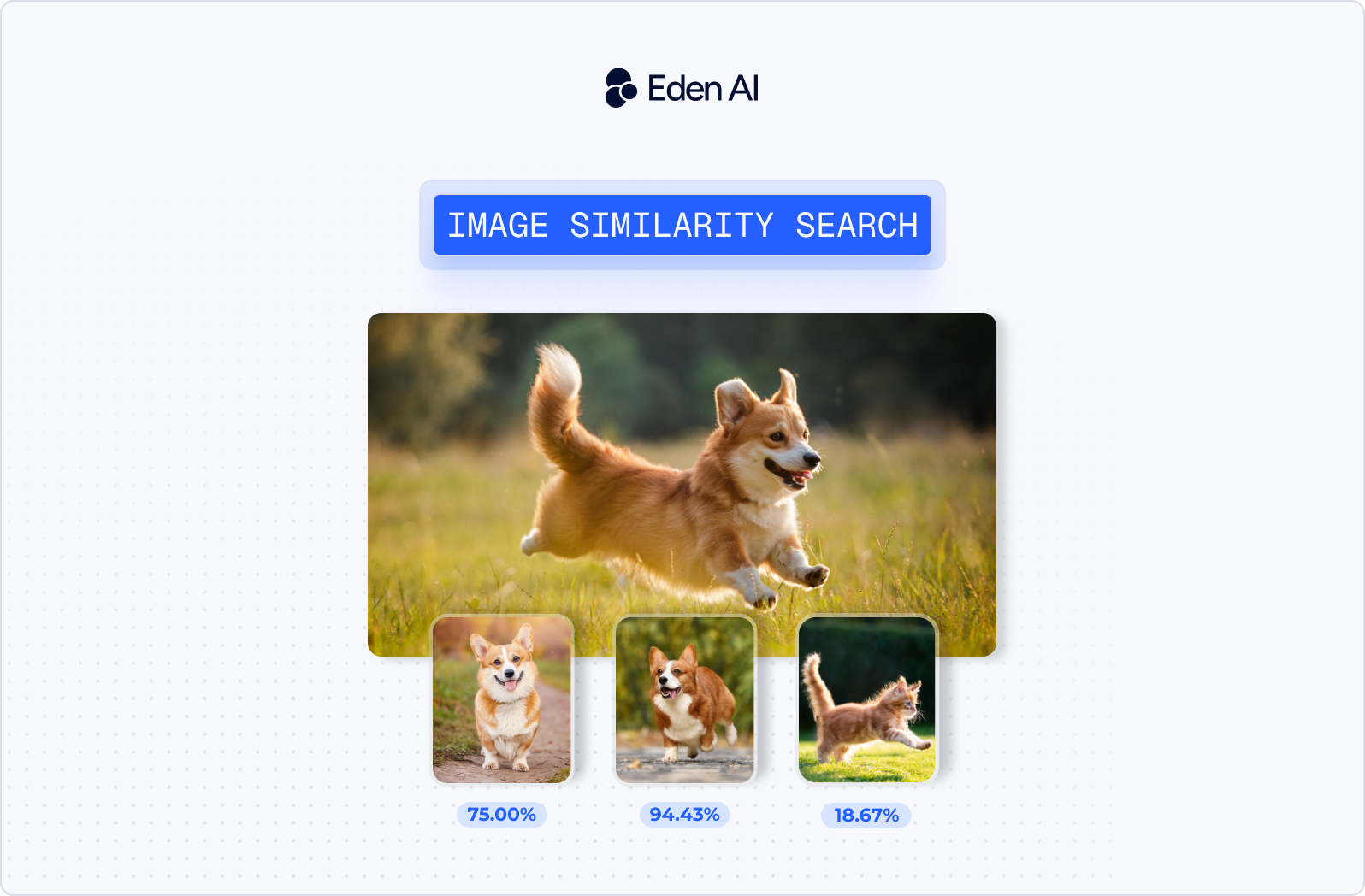
Image similarity vs reverse image search vs image comparison
These three get used interchangeably and they are not the same thing. Choosing the wrong one is the most common reason a project stalls.
The distinction is one-to-many retrieval against a private index, one-to-many retrieval against a public index, and one-to-one scoring. Different endpoints, different pricing shapes, different vendors.
How the three image similarity search approaches differ
Turnkey similarity APIs
You upload images to the provider, they build and host the index, you query it. No model selection, no infrastructure, no vector database. SentiSight, Nyckel, Ximilar, and Clarifai all work this way.
The trade is control. You cannot swap the embedding model, tune the distance metric, or reweight results by business logic. For most teams that is the right trade, you ship in days rather than months, and you find out whether visual similarity actually improves your conversion rate before investing in a pipeline.
Watch storage-side pricing. Nyckel charges per stored sample per month alongside per-search fees, so a large static index has a standing cost even at low query volume. SentiSight bills disk space separately above its free 5 GB allowance. A five-million-image catalogue prices very differently from a fifty-thousand-image one under these models, and the per-search rate alone will mislead you.
Hyperscaler vision services
If your infrastructure already lives on one cloud, the native option removes a vendor relationship and keeps data in-region.
Two things to check before you assume this is easy. Google Cloud Vision Product Search has moved into maintenance mode, with Vision Warehouse positioned as the path forward, so new builds should evaluate Warehouse rather than following older Product Search tutorials. And AWS Rekognition does face and object matching well but does not do open-vocabulary text-to-image search, so "find me the blue suede boots" is not a query it answers. Azure AI Vision's multimodal embeddings do support text-to-image retrieval.
Embeddings plus a vector database
You generate embeddings yourself and store them in a vector database - Pinecone, Qdrant, Weaviate, Milvus, or Marqo - then query by nearest neighbour.
On the model side, CLIP popularised this approach but is no longer the default. SigLIP and SigLIP 2 have largely replaced it for zero-shot image-text retrieval, with better multilingual coverage and variable-resolution support. EVA-CLIP and provider-specific models are used where benchmarks justify them.
This is the most work and the only approach with no ceiling. You can fine-tune on your own catalogue, apply hybrid search that combines vectors with structured filters, rerank by margin or stock level, and change models without migrating vendors. Choose it when similarity quality is a competitive feature rather than a convenience, or when you need on-premise deployment. Marqo sits between the tiers - it generates embeddings inline, so you skip the separate model step while keeping vector-database flexibility.
The 14 best image similarity search APIs in 2026
Grouped by approach, alphabetical within each group. This is not a ranked list; the right choice depends on catalogue size, control requirements, and where your data has to live.
Turnkey similarity APIs
Clarifai
A broader computer-vision platform whose visual search sits alongside classification, detection, and custom model training. Similarity is computed from deep learning embeddings, and you can train custom models on your own labelled data, which is useful when generic embeddings underperform on specialised imagery like medical scans or industrial parts.
Best for: teams who want similarity search and custom classification from one vendor.
Limitation: the breadth means more platform to learn than a single-purpose API, and per-operation pricing needs modelling against your actual mix of calls.
Mixpeek
A multimodal retrieval platform covering image and video in one index, using embedding-based search rather than hashing. The video capability is the differentiator: if you need to find visually similar frames across a footage library alongside stills, running one system instead of two is a real saving.
Best for: mixed image and video libraries.
Limitation: a newer entrant, so weigh roadmap risk for long-lived production systems.
Nyckel
Upload a gallery, then query it with either an image or a free-text string. No training step. It supports galleries into the tens of millions of images at roughly 300–500 ms query latency, which is inside the budget for on-site search. Pricing starts at $0.005 per search with an additional $0.0005 per stored sample per month, and the free tier gives 1,000 invokes a month.
Best for: fast setup where you want both image and text queries against the same index.
Limitation: the per-sample storage charge makes very large, low-traffic indexes relatively expensive.
SentiSight.ai
A REST API returning visually similar images ranked by similarity score, with no GPU provisioning and no training required. It distinguishes 1vN search (one query against the collection) from NvN search (batch, priced at N times the unit rate), which makes bulk deduplication cost predictable. Pay-as-you-go at €0.001 per 1vN search, dropping to €0.0008 above 100,000, plus €20 of credit on signup and €5 free every month. Built by Neurotechnology in Lithuania, so data stays in the EU.
Best for: dataset deduplication and cost-sensitive REST integration with EU residency.
Limitation: text-to-image querying is limited compared with Nyckel or Ximilar.
Ximilar
Visual search built for product and fashion imagery, with maintained taxonomies for fashion, home decor, and collectibles. Billing is credit-based: training, deployment, and idle time are free, and you pay only for inference, with 3,000 credits a month on the free plan and non-expiring credit packs for load spikes. A Czech company, so EU data residency is straightforward.
Best for: e-commerce and fashion catalogues.
Limitation: the credit model requires estimating your call mix up front; use their calculator rather than guessing.
Specialist engines
TinEye MatchEngine
Matches images against your private collection using perceptual hashing rather than embeddings. It reliably identifies the same image after cropping, resizing, or recolouring, which embeddings handle less precisely. It does not find similar-looking different things, which is the point - this is duplicate and provenance detection, not recommendation.
Subscription tiers run from $200/month for 5,000 images and 1,000 searches to $1,500/month for 500,000 images and 150,000 searches, with enterprise plans reaching 500 million images.
Best for: copyright enforcement, duplicate detection, image provenance.
Limitation: the wrong tool for semantic similarity, and the entry price is high for prototyping.
Hyperscaler vision services
AWS Rekognition: Face and object matching within the AWS ecosystem, billed per image processed with a 12-month free tier. Strong for face search and object detection; not a text-to-image search engine.
Azure AI Vision: Multimodal embeddings supporting both image and text queries against an image index, billed per transaction. The most complete hyperscaler option for general visual similarity.
Google Cloud Vision Warehouse: Managed embedding storage and retrieval on GCP. Evaluate this rather than Vision Product Search, which has entered maintenance mode.
Vector databases and search engines
Marqo: Generates embeddings inline and stores them, so you get end-to-end search without running a separate model service. The middle path between turnkey and fully custom.
Milvus / Zilliz: Open-source vector database with a managed cloud offering. Strong at very large scale and popular where self-hosting is a requirement.
Pinecone: The most mature managed vector database, with serverless deployment, metadata filtering, and namespaces. Lowest operational overhead if you are happy owning the embedding model. Billed on read/write units and storage.
Qdrant: Open source, available self-hosted or managed, with a free managed cluster for evaluation. Good default when you want the option to move on-premise later.
Weaviate: Ships built-in vectorizer modules, so it can generate embeddings for you, and supports hybrid search combining vectors with keyword matching. Useful when filters and text relevance matter alongside visual similarity.
Image comparison API vs image similarity API: which do you need?
These solve different problems and the pricing consequences are significant.
An image comparison API answers a one-to-one question: given image A and image B, how alike are they? There is no index. You send two images, you get a score. Use it for verifying that an uploaded photo matches a reference, quality control against a master image, or checking whether a new upload duplicates an existing one. Cost scales with the number of comparisons, and there is no storage component.
An image similarity search API answers a one-to-many question: given image A, which images in my collection of five million are most like it? This requires an index, which means an ingestion cost, a standing storage cost, and a query cost. Product recommendations, visual site search, and archive discovery all need this.
The practical test: if you know in advance which two images you are comparing, you want comparison. If you are searching a collection, you want similarity search, and you should model storage as carefully as queries, because at catalogue scale storage often dominates the bill.
Providers split accordingly. TinEye MatchEngine and the face-comparison side of AWS Rekognition lean toward matching and verification. Ximilar, Nyckel, SentiSight, and any vector-database build are retrieval systems. A few, including SentiSight with its 1vN and NvN modes, handle both, worth knowing if you need pairwise checks and catalogue search from one integration.
Visual similarity for e-commerce and product catalogues
E-commerce is where visual similarity earns money, and where generic benchmarks mislead most.
Catalogue size changes the answer
Under roughly 100,000 SKUs, a turnkey API is almost always right - Ximilar or Nyckel will outperform a hand-built pipeline you have had two weeks to tune. Between 100,000 and a few million, storage pricing becomes the deciding factor and you should price the per-sample or per-GB components explicitly. Above that, a vector database with your own embeddings usually wins on cost and on your ability to tune ranking.
Cold start on new SKUs is the constraint nobody plans for
A fashion retailer adding two thousand products a week needs embeddings generated and indexed before those products can be recommended. Ask every vendor how long ingestion takes and whether indexing is incremental or requires a rebuild. Ximilar's free training and idle time matter here; so does Nyckel's incremental gallery model.
Fashion needs taxonomy, not just embeddings
Generic visual similarity will return a black dress for a black dress, and also a black coat. Distinguishing cut, sleeve length, and pattern from colour requires either a fashion-specific model or fine-tuning. Ximilar's maintained fashion taxonomy is the shortest path; a fine-tuned SigLIP 2 model on your own catalogue is the highest ceiling.
Latency has a hard budget
If similarity results appear on a product page, you have roughly 100–200 ms before the layout shifts visibly. Nyckel's published 300–500 ms is fine for an asynchronous "you may also like" panel loaded after paint, and too slow for blocking server-side render. Decide where in the page lifecycle results appear before you choose.
How to choose: accuracy, latency, pricing and compliance
Accuracy is only measurable on your own images
Vendor benchmarks use public datasets that resemble nobody's catalogue. Build an evaluation set of 200–500 query images with known correct matches, run it through every shortlisted provider, and measure recall@10 and precision@5. Two afternoons of work will tell you more than every comparison article including this one.
Latency needs a p95, not an average
Ask for the 95th percentile at your expected query volume and index size, since averages hide the tail that users actually notice. Confirm which region serves your requests.
Price the whole shape, not the unit rate
Three components move independently: ingestion, storage, and query. A provider that looks cheap per search can cost more annually than one at twice the rate, if storage is billed per sample per month. Model twelve months at your projected catalogue size and query volume.
Compliance is often the deciding constraint
If you process EU personal data, and product photography containing people qualifies, you need to know where images are stored and processed. SentiSight (Lithuania) and Ximilar (Czech Republic) are EU-based. Hyperscalers offer region pinning. Ask specifically whether your images are retained for model training, and get the answer in the contract.
Check vendor health
Similarity search is a small market and consolidation happens. Look at changelog activity, documentation freshness, and support responsiveness before committing a core feature to a single provider.

.jpg)