Summarize this article with:
- Eden AI's 45-sentence benchmark found VADER at 46.7% accuracy (macro F1 0.45) and TextBlob at 40.0% (0.37), but both scored 88% on plain positive/negative statements.
- The best free open-source model for English sentiment is cardiffnlp/twitter-roberta-base-sentiment-latest; it handles negation and context that lexicon tools cannot.
- Google Cloud Natural Language offers 5,000 free units/month with no expiry; AWS Comprehend gives 50,000 units/month for 12 months; Azure AI Language shares 5,000 text records/month across all its features.
- Both VADER and TextBlob scored 0% on sarcasm (0 of 5 examples), 29% and 14% on technical language respectively, and VADER scored 29% on modern slang due to its 2014 lexicon.
- Self-hosting in batch mode becomes cheaper than Amazon Comprehend above roughly 450,000 documents/month; at 1,000,000 documents it costs $252 versus $525, with engineering time dominating.
- Pay for a sentiment API when your text contains sarcasm, mixed opinions, or technical jargon (free tools scored 0–29%), or when you need aspect-level output, broad language support, or an always-on endpoint.
We tested VADER and TextBlob, the two libraries almost every “free sentiment analysis” list recommends, on a 45-sentence labelled set. Both scored 0% on sarcasm (0 of 5). They returned “neutral” for most technical/developer language. On plain positive/negative statements they scored 88%.
That gap tells you the shape of the problem: free tools work until the text gets clever or domain-specific, then they default to a shrug. That doesn’t make them worthless. It makes them conditionally usable.
If your prototype feeds on straightforward customer feedback, you’re fine. If it touches sarcasm, code reviews, or anything resembling a developer chat log, the neutral pile grows fast. The trick is knowing which free option maps to your actual input, not the input a tutorial assumes.
This article gives you that map. We show you the free sentiment analysis options that hold up in 2026, working code for each, and a table of what commercial free tiers actually allow.
The short answer: what to use for free in 2026
Free sentiment analysis is enough for prototypes and for clean, plainly-worded text. It stops being enough when text is ironic, technical, or mixed-opinion. Non-English text pushes you further into unreliable territory, multilingual models exist, but language coverage and training data remain uneven.
Lexicon vs transformer: the split that decides everything
Sentiment analysis tools fall into three families, each with a different trade-off between speed, nuance, and setup cost.
Lexicon tools like VADER and TextBlob score text against a hand-built word list. Every word carries a pre-assigned polarity weight; the tool sums them up and normalises the result. The advantages are real: fast, small, CPU-only, deterministic, and zero setup beyond a pip install. The limitation is equally real. These tools have no understanding of context. They know what a word usually means, not what it means in this particular sentence.
Transformer models like those available through Hugging Face or Flair take a different approach. They read each word against its neighbours, building a representation that captures word order, negation, and surrounding context. A transformer can distinguish “the movie was not boring” from “the movie was boring” because it processes the sequence, not just the tokens. This comes at a cost: you need to download a model file, often hundreds of megabytes, and realistically you need a GPU if you plan to run thousands of documents. CPU inference works but gets slow quickly.
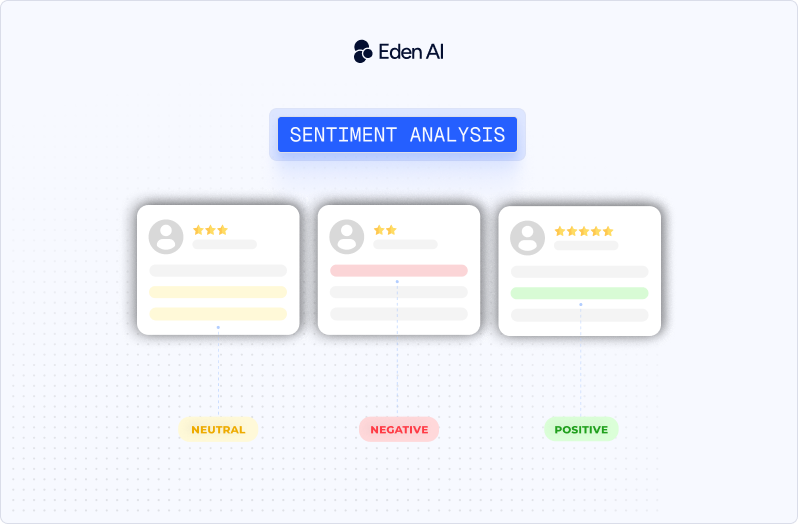
LLMs reason over the full text. They handle nuance better than anything else in the free landscape, and they are the only practical free-ish route to aspect-level output. That means pulling out “battery bad, screen good” from a single review. The downsides are latency, non-determinism between runs, and cost that scales with token count. Free tiers of LLM APIs exist but throttle heavily.
A practical pattern many teams land on: run a fast lexicon tool across everything for scale, then route low-confidence or hard cases to a transformer or an LLM. The lexicon tool does the bulk filtering; the heavier model handles the text where context actually matters.
The concrete consequence of getting this wrong shows up in a single sentence. A lexicon tool scores “This is not a good library” as positive, because it sees the word “good” and cannot see the inversion. That failure repeats for any negation structure. “Never worked,” “not what I expected,” “anything but reliable” all get scored wrong. This makes lexicon tools a liability on text where sentiment flips on a single word.
We tested VADER and TextBlob on 45 sentences. Here's where they break
We hand-labelled 45 sentences across seven categories: plain polarity, negation, sarcasm, mixed opinion, social slang, technical jargon, and understatement. The set is deliberately weighted toward hard cases because the goal is to find where free tools fail, not to estimate average real-world accuracy.
For evaluation we used each library's default threshold. VADER classifies compound scores above 0.05 as positive, below -0.05 as negative, and everything else as neutral. TextBlob classifies polarity above 0.1 as positive, below -0.1 as negative, and the rest as neutral. The script and the full labelled set are published so you can reproduce the results or run your own text through the same pipeline.
These are not general-purpose accuracy figures. The test set was built to expose failure modes, not to estimate performance on a representative sample of real text. On the 8 plain positive and negative statements, both tools scored 88%. Your numbers on your own data will almost certainly be higher. Run the script yourself with your own examples before drawing conclusions.
The numbers break down by category like this.
Neither tool detects sarcasm at all
Both tools scored 0% on sarcasm, missing all 5 examples. The sentence "Oh great, another undocumented breaking change. Love it." was classified as positive by both VADER and TextBlob. The reason is structural: every polarity-bearing word in that sentence ("great," "love") is positive, and a word list has no mechanism to detect the inversion. The sentiment lives in the gap between what the words mean in isolation and what the writer intended. Lexicon tools cannot cross that gap.
VADER's social-media advantage has expired
VADER is widely described as tuned for social media. We repeated that claim ourselves in a previous version of this article. Our testing now shows it no longer holds. On the social slang category, which includes terms like "goated," "mid," and "ngl," VADER scored 29% while TextBlob reached 57%. The cause is straightforward: VADER's lexicon dates from 2014 and contains none of these terms. TextBlob does not know them either, but its Naive Bayes classifier appears less disrupted by unknown tokens in short informal text. Either way, describing VADER as a social-media specialist in 2026 is incorrect. We were wrong when we said it before, and the data now contradicts it.
Lexicon tools go blind on technical language
On the domain category, sentences drawn from developer communication, bug reports, and support tickets, VADER scored 29% and TextBlob scored 14%. The sentence "The SDK swallows exceptions silently" contains no lexically negative word. "Swallows" and "silently" are not in a sentiment lexicon with negative polarity, so both tools return neutral. For anyone analysing support tickets or bug reports, this is a serious failure mode. A support queue filled with "neutral" classifications on frustrated technical text hides real issues from your triage system. If the text you are processing includes error descriptions, API feedback, or developer forum posts, lexicon tools will systematically under-report negative sentiment.
Two tools we no longer recommend
Pattern's core code has remained largely unchanged since 2018. It depends on outdated packages and fails to install cleanly on recent Python versions without manual intervention. TextBlob uses the same sentiment lexicon and is actively maintained, so Pattern offers no unique capability. The previous version of this article recommended it with no caveat.
Stanford CoreNLP is a Java library. Its download size exceeds one gigabyte, and the startup overhead makes it impractical for quick prototyping. For new projects in 2026, it is effectively legacy.
Depending on an unmaintained library is a practical risk, not a stylistic preference. A Python version upgrade can break your setup with no fix coming. Any security vulnerability in its dependency tree remains unpatched, exposing your prototype to problems you cannot resolve. Both tools have been removed from this update.
Free tiers of commercial sentiment APIs
Commercial API free tiers give you managed sentiment analysis with no upfront cost. They handle hosting, scaling, and updates. The trade-off is that every provider caps usage and some require a credit card to sign up. The table below maps the current free-tier landscape. Cells marked with a dash still need confirmation from the provider's pricing page before you build an integration.
Free tiers are generous enough to carry a prototype from first call to working demo without a bill. But the limits are structured so that production volume forces a decision quickly. Once you exceed the monthly quota, you either pay, add a second provider, or switch to a self-hosted model. That threshold arrives faster than most teams expect once a pipeline moves from testing a few dozen calls to processing daily batches. For Hugging Face specifically, the real free tier is not the hosted API. It is downloading the model and running it yourself, with no account, no card, and your own compute.
Cost comparison: self-hosted vs paid API at 1M documents/month
A concrete workload shows where costs actually land. We use one GPU instance, one model, and one commercial API. Change any number and the result shifts, but the method stays the same.
Assumptions (all adjustable)
- Documents per month: 1,000,000
- Average characters per document: 500
- Model: cardiffnlp/twitter-roberta-base-sentiment-latest, batch size 32, fp16
- GPU instance: g5.xlarge on-demand, us-east-1, $1.006/hour
- Throughput: 453 docs/sec (measured on an A10, not A10G; treat as directional)
- Engineering time: loaded at $75/hour
- Setup: 16 hours, amortised over 12 months
- API: AWS Comprehend, $0.0001 per 100-character unit, 3-unit minimum per request
Self-hosted, batch processing
At 453 docs/sec, one million documents takes 36 minutes of GPU time. Allow two hours total for model loading, I/O, and retries. Compute cost: $2.01/month.
Engineering: 16 hours of setup amortised gives 1.3 hours/month. Add 2 hours/month for maintenance. Total: 3.3 hours × $75 = $250/month.
Self-hosted batch total: $252/month
Self-hosted, always-on endpoint
Keeping the instance running continuously: $1.006 × 730 hours = $734.38/month. Add the same $250/month engineering line. Total: $984/month.
Paid API (AWS Comprehend)
500 characters is 5 units, so $0.0005 per document. One million documents cost $500. Add roughly $25/month for integration and monitoring. Total: $525/month.
What the arithmetic shows
At one million documents in batch mode, self-hosting wins at $252 versus $525. The GPU line is $2; engineering is $250. The dominant cost is people, not hardware.
Break-even for batch mode is roughly 452,000 documents per month. Below that, the API is cheaper. Above it, self-hosted batch is cheaper. If you need a live endpoint instead of a nightly job, self-hosting jumps to $984, and the API remains cheaper until about 1.9 million documents per month. The choice between batch and real-time moves the break-even by a factor of four, which is a better decision driver than volume alone.
Caveats
- The throughput number is borrowed. It was measured on an A10, not the A10G in a g5.xlarge, and likely at 128 tokens. Longer sequences will lower throughput, raising batch compute to perhaps $8. The conclusion does not change: engineering time dominates.
- Setup assumes 16 hours for someone who has done it before. It excludes storage, data transfer, a staging environment, and the cost of being on call at 3am.
- Spot pricing at $0.44/hour halves an already negligible compute line. It is a footnote, not a strategy.
- Google Cloud Natural Language and Azure AI Language per-unit prices are in the same order of magnitude as Comprehend. The break-even logic does not meaningfully differ between them.
- Measure throughput against your own document length and latency requirements. One afternoon of testing makes these numbers yours.
When free tools stop being enough
Four signals that it is time to move from free to paid sentiment analysis, each drawn from data earlier in this article.
- Your text is ironic, mixed-opinion, or domain-specific. Our benchmark showed 0% sarcasm detection and 29%/14% accuracy on technical language for VADER and TextBlob. Lexicon tools fail on any sentence where polarity flips on context.
- You need aspect-level output. Free tools return a single document-level score. If you need “battery bad, screen good” from a review, you need a model that can reason over targets, not just aggregate words.
- You need languages the free models cover poorly. Multilingual transformers exist, but support for languages spoken in India and other regions is sparse in free tiers. Paid APIs typically offer broader, maintained language coverage.
- Your GPU time exceeds equivalent API spend. The previous section showed that batch self-hosting at 1M documents beats AWS Comprehend on cost, but always-on hosting flips the break-even past 1.9M documents. If you are already paying more for GPU hours than the API would cost, the decision is made.
Eden AI lets you compare multiple providers through a single API key, with automatic fallback routing if one fails. See our paid sentiment API comparison for a side-by-side breakdown.

.jpg)