Summarize this article with:
- Choose the technology based on the workload: NMT APIs are better for real-time, high-volume and cost-sensitive translation; LLMs are better for nuanced, contextual, technical or brand-sensitive content.
- The leading providers solve different priorities: DeepL leads for European-language quality, Google Cloud for 135+ language coverage, and Microsoft Azure for cost efficiency at about $10 per million characters.
- LLMs now lead on translation quality, particularly for marketing, legal and long-form content, but they are generally 3–7× more expensive and 10–20× slower than traditional NMT APIs.
- At scale, NMT remains the economical default: above roughly 10 million characters per month, character-based translation APIs are usually more predictable and cost-effective than token-priced LLMs.
- A multi-provider strategy reduces vendor risk: Eden AI provides access to 10 translation providers through one API, enabling provider switching, automatic fallback, centralized cost monitoring and GDPR-based routing without rebuilding integrations.
The best translation APIs in 2026 are DeepL for high-quality European language translation, Google Cloud Translation for broad coverage across 135+ languages, and Microsoft Azure Translator for low-cost translation at $10 per 1M characters.
In 2026, LLM APIs such as GPT-4o and Claude now outperform dedicated machine translation engines for nuanced, context-heavy, or brand-sensitive content, while NMT APIs still lead for speed, predictable pricing, and large-scale localization workloads.
Eden AI lets developers access 10 translation providers through one API key with automatic fallback, without managing separate contracts.
LLM pricing is token-based; per-1M-character equivalents are estimates. See the Pricing section for a full breakdown.
What Is an AI Translation API?
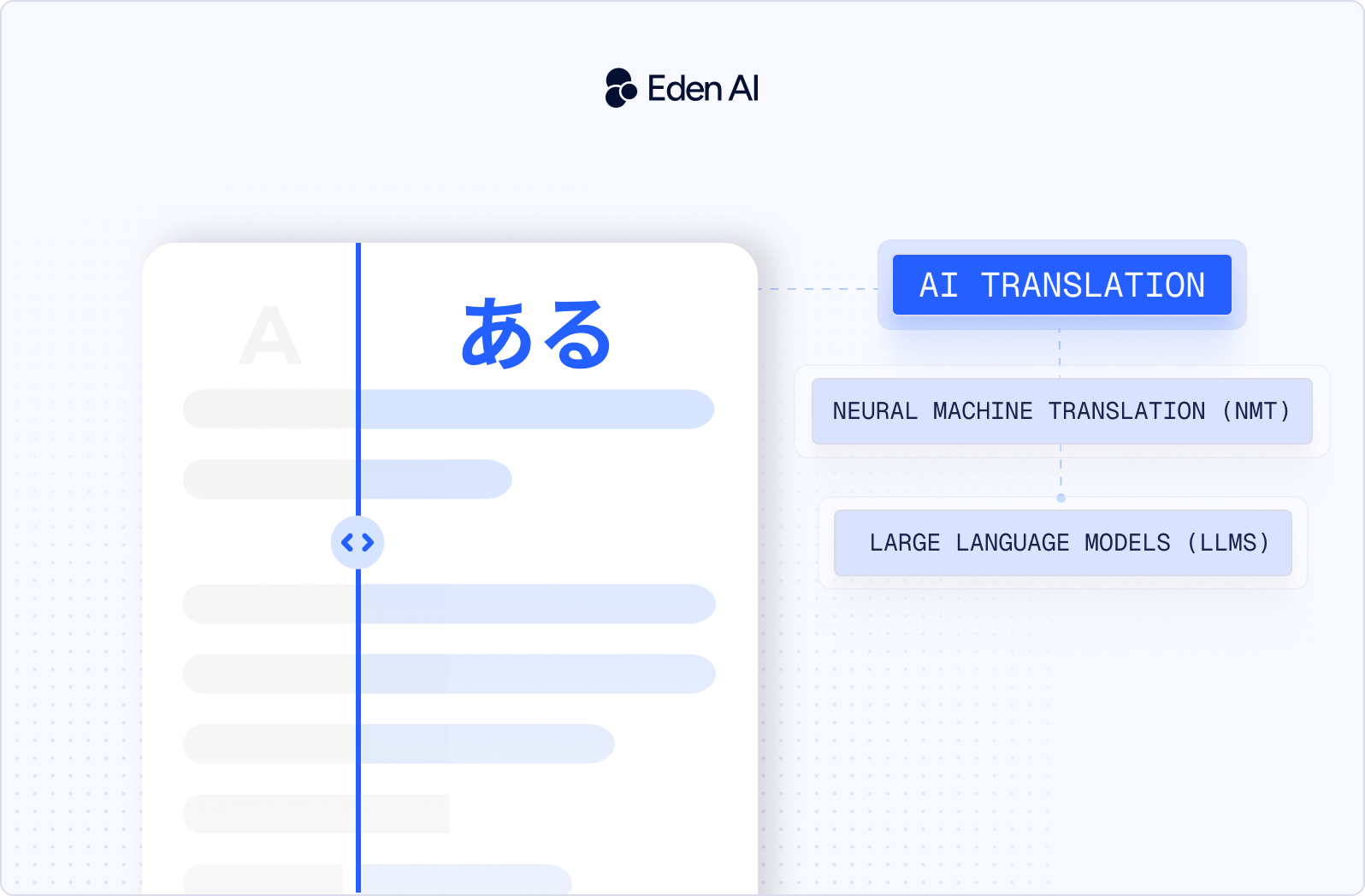
An AI translation API is a hosted service that accepts source text and a target language, then returns translated text through an API response.
Most translation APIs also support language detection, batch requests, and custom glossaries for controlling domain-specific terms. Modern translation APIs use either Neural Machine Translation (NMT) models or large language models (LLMs) under the hood.
Developers use translation APIs instead of local libraries because they scale without model hosting, infrastructure maintenance, or manual quality updates. Pricing is usually pay-per-use, which fits variable workloads. For example, a SaaS product supporting 20 languages can call a translation API every time a user submits new content.
NMT vs LLM Translation APIs: Which Should You Use?
Neural Machine Translation APIs for Speed, Cost, Consistency
Neural Machine Translation APIs use transformer-based models trained exclusively on parallel corpora, meaning source-to-target sentence pairs optimized for translation throughput.
Their main advantage is operational predictability: the same input usually returns the same output, latency can stay below 100ms at scale, and pricing is billed per character rather than per token. NMT systems are less effective for idiomatic, creative, or heavily contextual content because they usually translate at sentence or segment level.
Use NMT for real-time UI translation, high-volume batch jobs, and cost-sensitive pipelines above 10M characters per month. Common examples include Google Cloud Translation, DeepL, Azure Translator, and Amazon Translate.
LLM-Based Translation APIs for Quality, Context, Creative Content
LLM-based translation APIs use general-purpose language models for translation through prompt instructions rather than dedicated translation engines.
Their output is probabilistic, so the same input can produce different translations, and latency is higher, usually around 500ms to 2s. Pricing is token-based, but quality improves on idiomatic, nuanced, brand-sensitive, and domain-specific content.
LLMs can also use context across full paragraphs instead of translating sentence by sentence. LLMs now represent 89% of top performers across language pair evaluations, up from 55% the prior year.
Use them for marketing copy, legal documents, creative content, and low-volume workflows where quality matters more than cost. Examples include GPT-4o, Claude, Gemini, and DeepSeek.
The 10 Best AI Translation APIs Reviewed
DeepL API - Best Quality for European Languages
DeepL API is the strongest choice when translation quality matters most for European languages, especially German, French, Spanish, Italian, Dutch, and Polish.
DeepL API provides neural machine translation through a hosted REST API with support for 30+ languages, automatic language detection, formality control, and glossaries. It performs especially well for SaaS localization, support content, and business documents where fluent European-language output matters more than maximum language coverage.
Strengths
- Strong output quality across major European language pairs
- 500K characters per month included in the free API tier
- Glossary support for enforcing product names, terminology, and brand vocabulary
Weaknesses
- Smaller language coverage than Google Cloud, Azure, or ModernMT
- Higher paid API price than Azure and Amazon Translate
Best for: Product teams localizing European SaaS apps, help centers, and business content.
Pricing: $25 per 1M characters, with 500K characters per month free.
Google Cloud Translation API - Widest Language Coverage (135+)
Google Cloud Translation API is the best choice when language coverage and enterprise-scale infrastructure matter more than top quality on specific European language pairs.
Google Cloud Translation API provides hosted neural machine translation with automatic language detection, batch translation, glossary support, and AutoML custom model training. It supports 135+ languages, making it a strong fit for global products, marketplaces, and user-generated content platforms that need broad multilingual coverage from one provider.
Strengths
- Supports 135+ languages, one of the widest coverage sets among translation APIs
- AutoML Translation lets teams train custom models for domain-specific terminology
- Runs on Google Cloud infrastructure with enterprise SLA options
Weaknesses
- Output quality can lag behind DeepL on major European language pairs
- Pricing and feature access are split across Basic and Advanced editions
Best for: Global SaaS products, marketplaces, and platforms that need broad language coverage.
Pricing: $20 per 1M characters, with 500K characters per month free.
Microsoft Azure Translator - Best Value at $10/1M Characters
Microsoft Azure Translator is the most cost-efficient enterprise NMT API for teams that need predictable pricing, high throughput, and native Azure integration.
Microsoft Azure Translator provides neural machine translation through Azure AI Services, with automatic language detection, batch translation, document translation, and Custom Translator for domain-specific models. It supports 100+ languages and is especially strong for Azure-native products that need translation inside existing cloud, DevOps, or enterprise workflows.
Strengths
- Lowest listed NMT price in this comparison at $10 per 1M characters
- 2M characters per month included in the free tier
- Custom Translator supports domain-specific translation models
Weaknesses
- Output quality can trail DeepL on major European language pairs
- Less compelling for teams not already using Azure infrastructure
Best for: Azure-based SaaS products, enterprise apps, and high-volume translation pipelines.
Pricing: $10 per 1M characters, with 2M characters per month free.
Amazon Translate - Best for AWS-Native Stacks
Amazon Translate is the best translation API for teams already running on AWS that need scalable NMT inside existing cloud workflows.
Amazon Translate provides neural machine translation through a managed AWS API, with automatic language detection, batch translation, custom terminology, and real-time translation. It supports 75+ languages and works best when translation is part of a larger AWS architecture, such as processing support tickets, marketplace listings, or user-generated content through Lambda, S3, and Comprehend.
Strengths
- Strong fit for AWS-native pipelines using S3, Lambda, IAM, and CloudWatch
- 2M characters per month free for the first 12 months
- Custom terminology helps enforce product names and domain-specific vocabulary
Weaknesses
- Smaller language coverage than Google Cloud, ModernMT, or Azure
- Less attractive for teams outside the AWS ecosystem
Best for: AWS-based applications that need scalable real-time or batch translation.
Pricing: $15 per 1M characters, with 2M characters per month free for 12 months.
OpenAI GPT-4o (Translation) - Best for Nuanced and Marketing Content
OpenAI GPT-4o is the best translation option when tone, idiom, context, and brand voice matter more than latency or lowest cost.
OpenAI GPT-4o translates through prompt-based LLM inference rather than a dedicated NMT engine. It supports 100+ languages and performs especially well on marketing copy, product messaging, creative content, and customer-facing text where literal translation is not enough and the model needs to preserve intent across paragraphs.
Strengths
- Strong quality for creative, idiomatic, and brand-sensitive translation
- Handles context across long passages instead of isolated sentence segments
- System prompts let developers control tone, terminology, and style rules
Weaknesses
- Token-based pricing is harder to predict than per-character NMT pricing
- Usually 2–4x more expensive than NMT APIs, with higher latency for real-time use
Best for: Marketing localization, creative translation, and high-value customer-facing content.
Pricing: Approximately $40 per 1M characters equivalent, token-based, with no free tier.
Claude (Anthropic) - Best for Long-Form and Technical Documents
Claude is the strongest LLM translation option for long-form documents where context, terminology consistency, and technical precision matter more than speed.
Claude translates through prompt-based LLM inference, using general-purpose language models rather than a dedicated NMT engine. It supports 100+ languages and is especially useful for technical documentation, legal content, research material, and internal knowledge bases where the model must preserve meaning across long sections.
Strengths
- Strong context handling for long-form translation workflows
- Good fit for technical, legal, and domain-specific documents
- Prompt instructions can enforce tone, terminology, and formatting constraints
Weaknesses
- Token-based pricing is harder to forecast than per-character translation APIs
- Higher latency and cost make it unsuitable for real-time high-volume translation
Best for: Translating technical documentation, legal documents, and long-form business content.
Pricing: Approximately $45 per 1M characters equivalent, token-based, with no free tier.
ModernMT - Best for Adaptive MT with Translation Memory
ModernMT is the best translation API for teams that need adaptive machine translation that learns from corrections and translation memory in real time.
ModernMT provides adaptive neural machine translation through an API designed for professional localization workflows. It supports 200+ languages and integrates with translation memory systems, making it useful for companies with existing bilingual corpora, CAT tools, or localization teams that need terminology consistency across repeated projects.
Strengths
- Supports 200+ languages, the highest coverage in this comparison
- Adapts from translation memory and human corrections in real time
- Integrates with CAT tools including memoQ and SDL Trados
Weaknesses
- Custom pricing makes costs harder to forecast before vendor contact
- Less familiar to developers than Google Cloud, DeepL, Azure, or AWS
Best for: Localization teams using translation memory, CAT tools, and human review loops.
Pricing: Custom pricing, with trial access available.
IBM Watson Language Translator - Best for Enterprise Compliance
IBM Watson Language Translator is best for enterprise teams that need controlled deployment, compliance-oriented workflows, and translation inside the IBM Cloud ecosystem.
IBM Watson Language Translator provides neural machine translation through IBM Cloud, with language identification, document translation, custom models, and glossary-style terminology control. It supports 70+ languages and is strongest for regulated enterprises that need translation connected to existing IBM Cloud, governance, security, or internal document processing workflows.
Strengths
- Supports 70+ languages for enterprise translation use cases
- Custom models help adapt translation output to domain-specific terminology
- Fits IBM Cloud environments with enterprise security and governance controls
Weaknesses
- Language coverage is narrower than Google Cloud, Azure, or ModernMT
- Pricing is less transparent than standard per-character NMT APIs
Best for: Regulated enterprises using IBM Cloud for document processing and multilingual operations.
Pricing: Custom pricing, with 1M characters per month available in the free tier.
DeepSeek - Best for Chinese–English at Low Cost
DeepSeek is the strongest low-cost LLM option for Chinese-English translation when budget matters but contextual quality still needs to beat standard NMT.
DeepSeek translates through prompt-based LLM inference rather than a dedicated machine translation engine. It supports 100+ languages and is especially useful for Chinese-English content, technical text, product documentation, and internal workflows where teams want LLM-level context handling at a lower price than GPT-4o or Claude.
Strengths
- Low estimated cost at around $5 per 1M characters equivalent
- Strong fit for Chinese-English translation and technical content
- Handles context, terminology, and formatting through prompt instructions
Weaknesses
- Token-based pricing is less predictable than per-character NMT pricing
- Smaller enterprise ecosystem and weaker compliance tooling than OpenAI, Google, or Microsoft
Best for: Cost-sensitive Chinese-English translation, technical documents, and internal localization workflows.
Pricing: Approximately $5 per 1M characters equivalent, token-based, with no free tier.
Yandex Translate API - Best Coverage for Eastern European Languages
Yandex Translate API is the strongest option for Russian, Ukrainian, Turkish, Uzbek, and other CIS or Eastern European language pairs where broader providers can underperform.
Yandex Translate API provides neural machine translation through a hosted API with automatic language detection, dictionary support, and batch translation. It supports 90+ languages and is most useful for regional products, marketplaces, and content platforms focused on Eastern Europe, Central Asia, or Russian-language user-generated content.
Strengths
- Strong quality for Russian, Ukrainian, Turkish, Uzbek, and CIS language pairs
- Supports 90+ languages for regional and multilingual applications
- Generous free tier with 5M characters per month
Weaknesses
- Data residency and vendor-risk concerns for GDPR-regulated use cases
- Less suitable than DeepL or Google for Western European and Asian language pairs
Best for: Products targeting Eastern Europe, Central Asia, and Russian-speaking markets.
Pricing: $15 per 1M characters, with 5M characters per month free.
Translation API Pricing Compared (Per Million Characters, 2026)
Character vs Token Billing - How to Compare NMT and LLM Costs
NMT APIs usually price translation per character, while LLM APIs price usage per token. That makes direct comparison misleading unless character volume is converted into token volume.
A practical rule is that 1 million characters equals roughly 200,000–250,000 tokens for English text, since English averages about 4–5 characters per token. For non-Latin scripts such as Chinese or Arabic, the ratio changes because 1 character can map to 1–3 tokens.
For example, GPT-4o at $15 per 1M input tokens costs roughly $60–75 per million characters of translated content, before counting output tokens, making it 3–7x more expensive than most NMT APIs.
At low volumes under 1M characters per month, the cost difference is negligible; at scale above 50M characters per month, NMT APIs are almost always cheaper.
Free Tier Comparison
For production workloads above 2M chars/month, Microsoft Azure Translator offers the best cost-to-quality ratio among NMT APIs.
Translation Quality Benchmarks - BLEU and COMET Scores
BLEU is an automated translation metric that measures n-gram overlap between machine output and a reference translation, scored from 0 to 100. COMET is a neural evaluation metric that correlates better with human judgement than BLEU, scored from 0 to 1.
The 2026 benchmark pattern is clear: LLMs now represent 89% of top performers across language pair evaluations, up from 55% the prior year.
GPT-4o produces the highest overall translation quality across the most language pairs, especially when context, tone, and ambiguity matter. NMT APIs still remain competitive in high-resource, high-volume language pairs where speed and consistency are more important than nuanced phrasing.
How to Choose the Right Translation API for Your Project
Prioritizing Quality → DeepL or LLMs
DeepL is the best choice for European languages, while GPT-4o or Claude are better when quality is the primary constraint outside core European pairs. Use them when translation quality directly affects revenue, legal clarity, brand perception, or customer trust, and when the extra latency or cost is acceptable.
Prioritizing Language Coverage → Google Cloud Translation
Google Cloud Translation at 135+ languages is the safest choice when you need long-tail or low-resource language coverage. It is especially useful for global products where users can submit content in many languages. If you only need the top 20 languages, DeepL or Azure may deliver better quality or pricing with enough coverage.
Prioritizing Cost at Scale → Microsoft Azure Translator
Microsoft Azure Translator at $10 per 1M characters is the cheapest enterprise NMT API with no meaningful quality trade-off versus Google for most language pairs, excluding European pairs where DeepL usually wins. At 100M characters per month, Azure costs about $1,000, compared with $2,000 on Google and $2,500 on DeepL.
AWS or Azure Ecosystem → Amazon Translate or Azure Translator
If your stack is on AWS, Amazon Translate with native IAM, S3, Lambda, and CloudWatch integration removes auth overhead and data transfer complexity. The same logic applies to Azure Translator for teams already using Azure services. Outside the native ecosystem, those integration advantages disappear, so cost and translation quality should decide.
GDPR and Data Residency Requirements
For GDPR-regulated workloads, choose providers with EU data residency options, signed DPAs, and clear processing terms. Google Cloud, Microsoft Azure, and DeepL all provide EU-region options and enterprise data protection agreements.
Avoid Yandex for sensitive GDPR workloads, and avoid DeepSeek for EU or US regulated industries unless legal and security teams approve the data flow. Eden AI’s GDPR-compliant provider filtering lets you restrict translation API calls to EU-region providers only, across all connected APIs, from a single configuration.
Accessing All 10 Translation APIs Through a Single Integration
After comparing translation quality, language coverage, pricing, free tiers, and data residency, the next question is integration cost. Managing 10 separate API keys, 10 pricing contracts, 10 response formats, and 10 error-handling implementations adds engineering overhead that has nothing to do with your product.
- One API key: A single Eden AI key replaces all provider credentials across DeepL, Google Cloud, Azure, Amazon Translate, OpenAI, Claude, ModernMT, IBM Watson, DeepSeek, and Yandex. Switch providers by changing one parameter in your existing API call, with no refactoring.
import os
import requests

api_key = os.environ["EDENAI_API_KEY"]

response = requests.post(
    "https://api.edenai.run/v3/translation/automatic_translation",
    headers={"Authorization": f"Bearer {api_key}"},
    json={
        "providers": "deepl",
        "text": "Your subscription will renew automatically next month.",
        "target_language": "fr"
    }
)

result = response.json()
print(result["deepl"]["text"])
- Automatic fallback: Configure provider priority lists for production translation workloads. If DeepL is unavailable, rate-limited, or returns an error, the request falls back to Google automatically. Your application does not need custom retry logic for each provider.
- Cost monitoring: Track real-time translation spend across all 10 providers from one dashboard. This helps teams compare provider costs in production traffic, detect usage spikes, and set monthly caps per provider or per API key.
- GDPR filtering: Restrict translation calls to EU-region or GDPR-compliant providers with a single configuration flag. This removes provider-specific conditional logic from your code and makes routing rules easier to maintain for regulated workloads.

.jpg)