Summarize this article with:
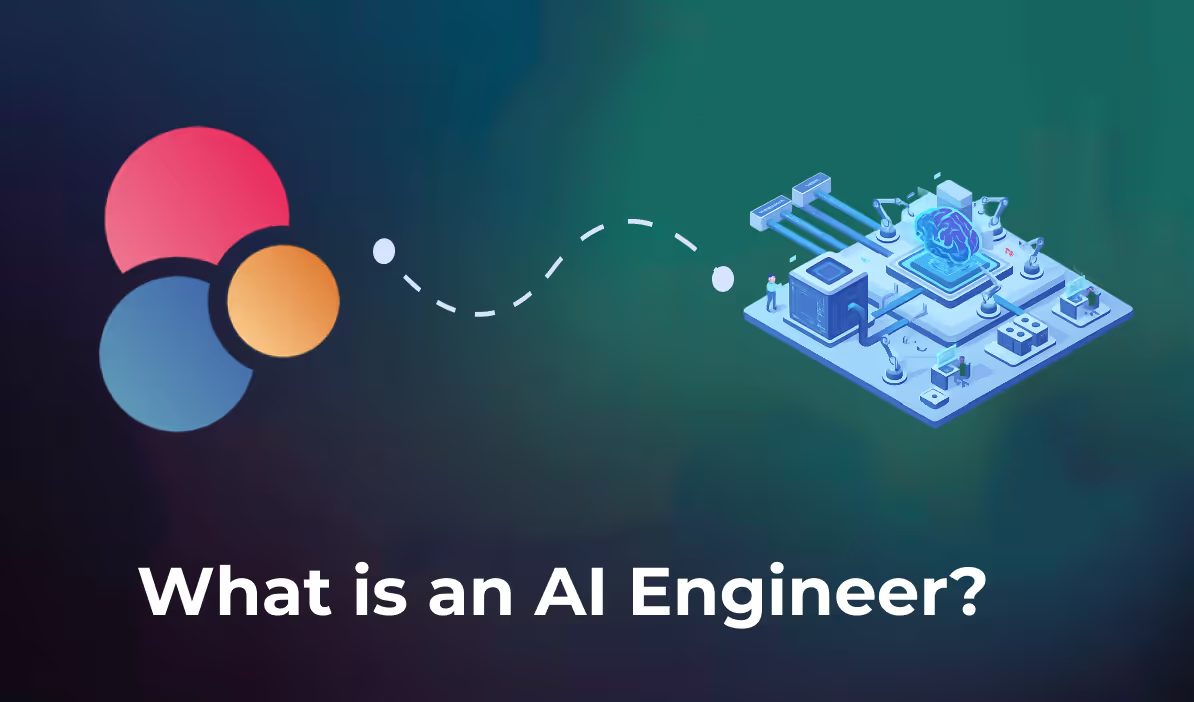
Defining what an AI engineer is requires looking beyond the algorithms and focusing on the systems that bring artificial intelligence to life. While data scientists explore data and machine learning engineers build models, the AI engineer is the software architect and builder who productionizes these models. They are responsible for creating the robust, scalable, and reliable software infrastructure that allows an AI model to deliver value within a real-world application.
Core Responsibilities
The day-to-day work of an AI engineer is grounded in software engineering principles applied to the unique challenges of machine learning systems. Their responsibilities span the entire AI lifecycle, from data to deployment.
- Building Data Pipelines: They design and implement automated pipelines for data ingestion, cleaning, transformation, and validation. These pipelines must be robust enough to handle large volumes of data for both model training and real-time inference.
- Model Development and Operationalization: While they may not always invent novel algorithms, they are responsible for training, fine-tuning, and evaluating models. Critically, they package these models into deployable artifacts, such as containerized microservices.
- Deployment and Infrastructure Management: AI engineers deploy models to production environments using CI/CD practices. They manage the underlying cloud infrastructure, leveraging tools like Kubernetes for orchestration and ensuring high availability and scalability.
- MLOps and Monitoring: They implement and manage the MLOps toolchain to automate the AI lifecycle. This includes setting up monitoring systems to track model performance, detect data or concept drift, and alert on system health issues.
- API Integration: They expose the AI model's functionality through well-defined APIs and work with application developers to integrate these services into user-facing products.
Key Skills and Technologies
An effective AI engineer possesses a hybrid skill set combining software development, DevOps, and machine learning knowledge.
AI Engineer vs. Data Scientist vs. Machine Learning Engineer
These roles are often used interchangeably, but they represent different areas of focus.
- Data Scientist: Primarily focused on analysis, experimentation, and statistical modeling to extract insights from data. Their output is often a report, a visualization, or a proof-of-concept model. The core question is: “What can we learn from the data?”
- Machine Learning Engineer: A specialized role that often overlaps with an AI Engineer but can be more focused on building and optimizing custom ML algorithms and training pipelines. They are deep experts in the modeling process itself.
- AI Engineer: A software engineer who specializes in AI systems. They are focused on the end-to-end engineering of production systems. Their primary concern is software quality, scalability, and reliability. The core question is: “How do we build a robust and scalable application powered by this model?”
In short, a data scientist finds the signal, an ML engineer optimizes the model, and an AI engineer builds the production-grade product around it.
How Eden AI Helps
For an AI engineer, managing the complexity of integrating, deploying, and monitoring AI services is a significant challenge. The development process often involves stitching together multiple specialized AI APIs from different providers, each with its own authentication, data format, and performance characteristics. Eden AI is designed to abstract this complexity and streamline the engineering workflow.
Instead of building and maintaining separate integrations for each provider, an AI engineer can use Eden AI’s multi-API integration to access a suite of AI models through a single, unified API. This dramatically reduces development time and maintenance overhead.
A core task for an AI engineer is selecting the optimal model for a given task. The Eden AI model comparison feature allows engineers to programmatically benchmark different models on their own data, evaluating them on performance, latency, and cost. This replaces manual evaluation with a data-driven process, ensuring the best tool is chosen for the job.
Once in production, operational excellence is key. Eden AI provides a centralized platform for cost monitoring and API monitoring, giving engineers a single pane of glass to observe their entire AI stack. Features like built-in failover logic and API caching enhance system resilience and reduce operational costs. Finally, handling credentials across multiple cloud providers is simplified and secured with multi-API key management, a critical component for production systems.
Conclusion
The AI engineer is a critical role that bridges the gap between theoretical machine learning and practical, value-driving applications. They are software engineers first, applying rigorous engineering principles to build, deploy, and maintain the complex systems that power modern AI. Their focus on scalability, reliability, and the end-to-end MLOps lifecycle is what makes it possible to move AI from the lab into the real world.