.png)
Summarize this article with:
- Best overall: Cohere Embed v4 - strongest all-round multimodal quality, 128K context, handles messy real-world documents without preprocessing.
- Best open-source: SigLIP 2 - the open-weights default for image-text similarity, with no licensing friction.
- Best for visual similarity (not text search): DINOv2/v3 - vision-only, and better than CLIP at the job most people wrongly hire CLIP for.
- Best for EU data residency: Any model routed through an EU endpoint - Mistral and Cohere both offer European deployment; Eden AI's EU endpoint keeps requests and data in Europe.
- Cheapest at scale: Self-hosted SigLIP 2 or JinaCLIP v2 above roughly 200–300M tokens/month.
Picking an image embedding model is a decision you live with. Vectors from one model are meaningless to another, so switching later means re-embedding your entire corpus - which is why a choice that looks like a quick API comparison is really an architectural commitment.
Two things changed in the last eighteen months. Purpose-built multimodal embedding models arrived as mature managed products, ending the era when the only realistic option was self-hosting CLIP. And the price spread widened dramatically: the models in this comparison range from $60 to roughly $757 to embed one million images, a 12× gap that published per-token pricing hides completely.
We compared 13 models - hosted APIs and open weights - on retrieval accuracy, dimensions and compressibility, real cost per million images, latency, and deployment constraints. Below you'll find the full comparison table, normalized pricing, what the benchmarks actually measure, and a decision framework for narrowing to a shortlist you can test on your own data.
What are image embedding models?
An image embedding model converts a picture into a list of numbers - a vector - that encodes what the image means rather than what pixels it contains. Two photos of the same red sneaker from different angles land close together in that vector space. A photo of a bicycle lands far away.
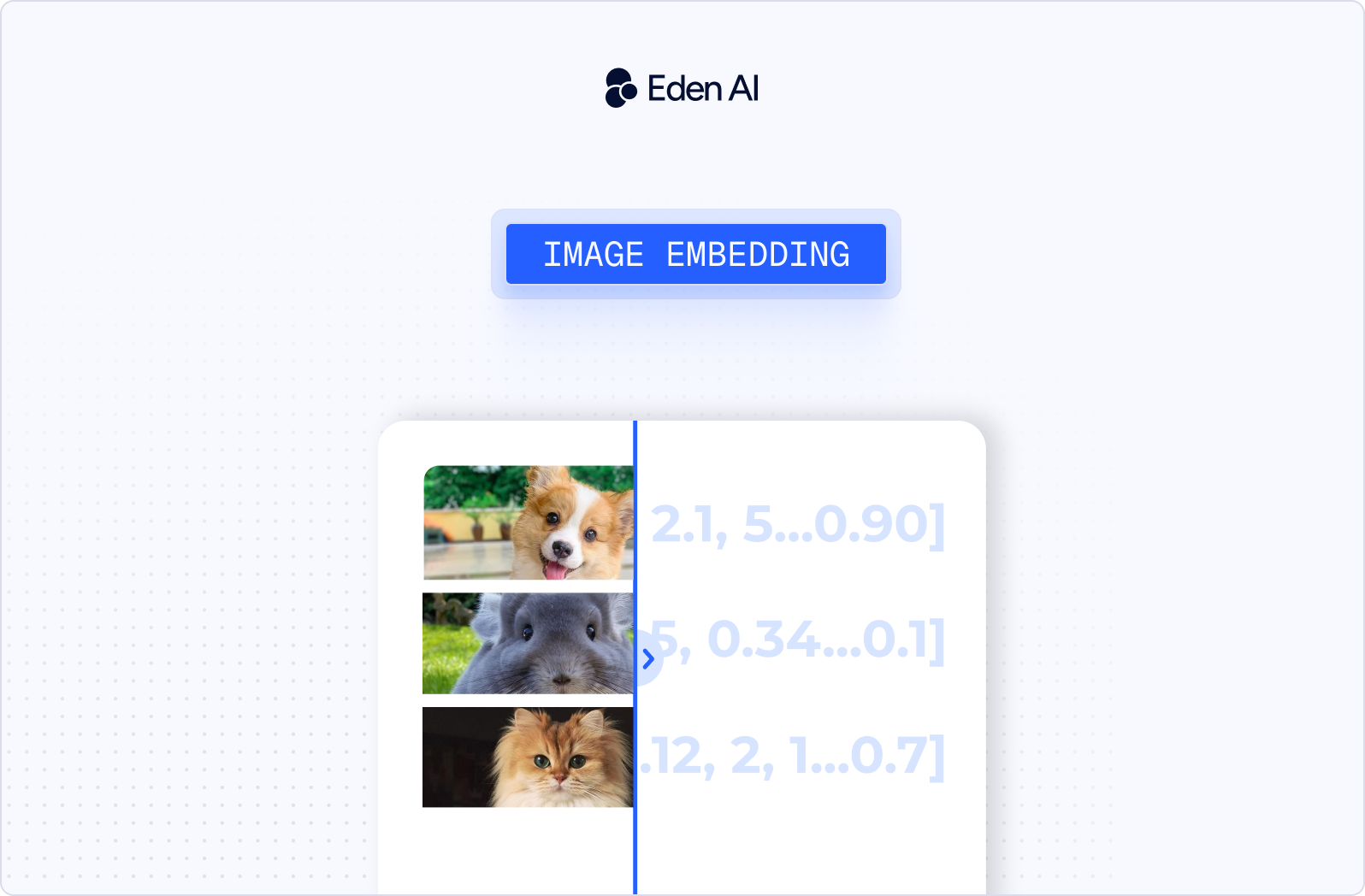
The vector's length is its dimensionality: 512, 1024, 1408, 2048, 4096. Higher dimensions can capture more nuance but cost more to store and search. Once images are vectors, similarity is just geometry - typically cosine similarity between two vectors - which is why embeddings power search, recommendation, deduplication and clustering with the same underlying operation.
The practical consequence: you index once, then query cheaply forever. The model you choose determines the quality ceiling of everything built on top of it, and switching later means re-embedding your entire corpus.
Cross-modal vs vision-only: which do you actually need?
This is the decision that most comparison articles skip, and getting it wrong is the most common expensive mistake in this category.
Cross-modal models (CLIP, SigLIP, Cohere Embed v4, Jina v4) train images and text into a shared vector space. A text query and an image can be compared directly. This is what you want for "find me photos of a red sneaker on grass": text in, images out.
Vision-only models (DINOv2, DINOv3) have no text tower at all. They're trained purely on visual self-supervision, and they consistently outperform CLIP-family models on pure image-to-image tasks: near-duplicate detection, visual deduplication, reverse image search, fine-grained product matching.
The trap is that cross-modal models are more famous, so teams reach for CLIP by default - then discover their visual similarity search returns semantically related but visually dissimilar results. CLIP knows a sneaker is a sneaker; it's less reliable at knowing this sneaker is the same as that one.
Rule of thumb: if a human types words to find pictures, use cross-modal. If a picture finds pictures, test vision-only first.
How we evaluated the best image embedding models in 2026
Five criteria, applied consistently:
- Cross-modal retrieval accuracy: text → image and image → text recall on standard benchmarks, plus performance on visually dense documents.
- Dimensions and compressibility: output size, and whether the model supports Matryoshka truncation or quantization to shrink storage without re-embedding.
- Cost: price per million image tokens, and the volume at which self-hosting becomes cheaper.
- Latency and footprint: inference speed and the hardware needed to run it.
- Deployment and licensing: API-only, open weights, commercial-license-required, and regional availability.
One caveat we'd apply to any list including this one: benchmark rankings are a starting point, not an answer. Retrieval quality is highly domain-dependent. Test the top two or three candidates on a sample of your own data before committing.
Does OpenAI have an image embeddings API?
No. As of 2026, OpenAI does not offer a hosted endpoint that turns images into embeddings.
This causes persistent confusion, so here is the precise situation:
- text-embedding-3-small and text-embedding-3-large are text-only. The large model outputs 3,072 dimensions at roughly $0.13 per million tokens. They will not accept an image input.
- CLIP is OpenAI research, not an OpenAI product. OpenAI published CLIP as open weights. There has never been a hosted CLIP embeddings endpoint on the OpenAI API. Anyone referring to "the OpenAI CLIP API" is describing something that doesn't exist.
- GPT-4o and successors accept images, but that's vision-language chat, not embeddings. They return text about an image, not a reusable vector you can index in a database.
What to use instead:
Best image embedding APIs in 2026
Cohere Embed v4
Cohere's Embed v4 is the strongest general-purpose option available as a managed service. It takes text, images, and mixed content in a single model, with a 128K token context window, far longer than most competitors, which means long documents often need no chunking at all.
Its differentiator is robustness on real business material: tables, charts, diagrams, code snippets and handwritten notes are processed natively, without a preprocessing pipeline to strip and reformat them first. It tolerates spelling errors and inconsistent formatting. Support spans 100+ languages, with tuning for finance, healthcare and manufacturing documents. Output supports Matryoshka truncation plus byte and binary quantization, so you can trade precision for storage cheaply.
Available direct, on Amazon Bedrock (since October 2025), on Azure AI Foundry, and via private deployment for regulated industries. Note that the self-hostable weights tier requires a separate commercial licence, the weights are not freely redistributable.
Choose this when you need one model for a mixed corpus of documents and images, especially multilingual or regulated, and you'd rather buy quality than tune it.
Google Vertex AI: multimodalembedding@001
Generates 1,408-dimensional vectors from images, text, or video. Solid, well-documented, and the natural choice if your stack already lives on Google Cloud, where it sits alongside Vertex AI Vector Search with no egress or auth friction. Less flexible than newer entrants, no Matryoshka truncation, and multilingual coverage is narrower than Cohere's.
Choose this when you're already on GCP and want the shortest path from image to indexed vector.
Voyage AI: voyage-multimodal-3
Voyage has built a reputation on retrieval quality per dollar, and multimodal-3 is a genuine contender on cross-modal accuracy.
One hard constraint worth knowing before you evaluate it: Voyage does not publish self-hostable weights for this model. If you try to deploy it with vLLM or an embedding server, there is nothing to load. It is API-only. That's fine for many teams, but it rules the model out entirely if data residency or air-gapped deployment is a requirement.
Choose this when retrieval accuracy is the priority and a managed API is acceptable.
Jina Embeddings v4
The most technically interesting model on this list. It's built on a Qwen2.5-VL-3B-Instruct backbone (3.8B parameters), processing text and images through a shared pathway, images become token sequences via a vision encoder, then both modalities pass through the same decoder. Three task-specific LoRA adapters handle retrieval, text-matching and code search without touching the frozen backbone.
Two output modes matter practically: single-vector embeddings at 2,048 dimensions, truncatable down to 128 via Matryoshka; and multi-vector embeddings at 128 dimensions per token for late-interaction retrieval, which performs notably better on visually rich documents.
It accepts text, images and PDFs directly, and it's available both as an API (with a free tier) and as open weights.
Choose this when you want API convenience now and the option to self-host later, or when your corpus is document-heavy.
Amazon Titan Multimodal Embeddings G1
Converts images and short English text into a shared space, supporting search by text, image, or a combination. Well-integrated with Bedrock and the wider AWS stack. The limitation to plan around: text input is capped at roughly 128 tokens. That's fine for product titles and short captions, and inadequate for anything resembling a document.
Choose this when you're on AWS, your text side is short-form, and Bedrock integration matters more than raw quality.
Azure AI Vision multimodal embeddings
Vectorizes both images and text queries into a shared multi-dimensional space. Competent and unremarkable: its case is Azure-native integration, particularly with Azure AI Search, rather than benchmark leadership.
Choose this when you're committed to Azure and want first-party support.
TwelveLabs Marengo
The option for teams whose "images" are actually frames. Marengo embeds video, audio and images into a shared space, and reached general availability on Amazon Bedrock in December 2025.
Choose this when your corpus is video, or mixed media where stills aren't the whole story.
Best open-source image embedding models in 2026
Self-hosting removes per-request cost and solves data residency, at the price of running GPU infrastructure. The crossover point is real but higher than most teams expect: below roughly 200–300 million tokens per month, an API is usually cheaper once you count engineering time and idle GPU capacity. Above it, the maths flips decisively.
SigLIP 2
The strongest open-weights model for image-text similarity as of 2026, and the sensible default if you're self-hosting a cross-modal model. Trains on a sigmoid loss rather than CLIP's contrastive softmax, which improves performance particularly at smaller batch sizes. Multilingual, permissively licensed, well-supported in the Hugging Face ecosystem.
CLIP (ViT-L/14)
Still the most widely deployed and most researched multimodal embedding model in existence. It's no longer state of the art, but it remains the baseline every other model is measured against, has the deepest ecosystem support, and is genuinely good enough for a large share of production use cases. English-centric.
JinaCLIP v2
Adds two things CLIP lacks: real multilingual support, and Matryoshka embeddings that shrink to 64 dimensions for dramatic storage savings. It also carries the longest context window of any CLIP-style model, which makes it viable for embedding whole documents alongside images without aggressive chunking.
Choose this over SigLIP 2 when your corpus has substantial non-English text.
ColPali / ColQwen2
A different architecture for a specific job: retrieval over visually rich documents. Instead of the traditional OCR → chunk → embed pipeline, ColPali embeds page images directly using late-interaction multi-vector retrieval, preserving layout, tables and figures that OCR destroys. If you're building RAG over PDFs, slide decks or scanned reports, this class of model is the current answer.
DINOv2 / DINOv3
Meta's self-supervised vision models. No text tower, these do not do text-to-image search. What they do is produce the highest-quality pure visual representations available in open weights, which makes them the correct choice for deduplication, near-duplicate detection, visual clustering and fine-grained product matching.
If your use case is "find visually similar images", benchmark this against CLIP before assuming CLIP wins. It often doesn't.
Nomic Embed Vision
Open licensing with a hosted option available, covering text and image modalities. Its case is straightforward: you want open weights for data-residency or cost reasons, but you don't want to stand up infrastructure on day one.
BGE-M3
Not an image model, but worth knowing in this context: it emits dense, sparse and ColBERT-style multi-vector representations from a single call, which removes the need to run two models for hybrid retrieval. Frequently paired with a vision model in production stacks.
ImageBind
Meta's six-modality model: vision, text, audio, depth, thermal and IMU in one space. Uniquely capable, and honestly positioned as a research and prototyping tool rather than a production retrieval model. Reach for it when you need a modality pairing nothing else supports.
Qwen3-VL / GME
Open-source cross-modal contenders that have closed much of the gap to closed-source APIs. In at least one independent 2026 benchmark, Qwen3-VL-2B outperformed several commercial APIs on cross-modal retrieval tasks, a useful reminder that "open-source" no longer implies "second tier."
What the benchmarks say: MTEB, MIEB and ViDoRe
Three benchmark families matter here, and they measure different things.
MTEB (Massive Text Embedding Benchmark) is the leaderboard most people cite. Its limitation for this topic is significant: the core MTEB suite is predominantly single-language text retrieval. It tells you very little about cross-modal performance, cross-lingual search, or how much quality you lose when truncating dimensions to save storage. A high MTEB score is not evidence of good image retrieval.
MIEB and the multimodal MTEB extensions attempt to fix this by evaluating image and image-text tasks directly. This is the leaderboard to check for cross-modal work. As of mid-2026, Cohere Embed v4 has been the strongest performer on multimodal MTEB evaluations, with SigLIP 2 leading the open-weights field.
ViDoRe (Visual Document Retrieval) is the benchmark that matters if your documents are visual: PDFs, slides, reports with tables and charts. It's the benchmark the ColPali family was built against, and it correlates far better with real multimodal RAG performance than either of the above.
Independent 2026 evaluations have also highlighted dimensions that no public leaderboard covers well: cross-lingual retrieval, long-document accuracy, and quality retention under dimension truncation. If any of those describe your workload, published scores will mislead you. Build a small evaluation set from your own data: 200 labelled pairs is enough to separate the top candidates.
Image embedding pricing compared
Pricing in this category is quoted per million tokens, not per image, which makes cost hard to estimate. The conversion is resolution-dependent: a 512×512 image converts to roughly 1,610 tokens on Cohere Embed v4.
Worked example: embedding 1 million product photos at 512×512
1,000,000 images × ~1,610 tokens = ~1.61 billion image tokens.
At Cohere's $0.47 per million image tokens, that's approximately $757 for the initial index.
Two things fall out of that. First, one-time indexing is usually affordable even at large scale - the number that surprises people is smaller than they feared. Second, the recurring cost is queries, not indexing, and queries are typically short text, priced far lower. Model your query volume, not your corpus size.
Third consideration: storage. A billion 1,536-dimension float32 vectors is roughly 6TB before indexing overhead. This is where Matryoshka truncation and binary quantization pay for themselves, and why models offering them (Cohere Embed v4, Jina v4, JinaCLIP v2) have a structural cost advantage that per-token pricing doesn't reveal.
Image embeddings for multimodal RAG and visual document search
The fastest-growing use of image embeddings in 2026 isn't image search, it's retrieval over documents that happen to be visual.
The traditional pipeline is OCR → chunk → embed text. It works, and it throws away everything that isn't a character: table structure, chart values, diagram relationships, spatial layout. For a financial report or a technical manual, that's most of the information.
The alternative is to embed page images directly. Late-interaction models like ColPali and ColQwen2 produce multi-vector representations of a rendered page, preserving layout and visual structure. Retrieval then matches a text query against those page vectors. Cohere Embed v4 addresses the same problem from the managed-API side, processing documents with tables, graphs and handwriting without a preprocessing stage.
Where the vectors live matters as much as which model produced them. Multi-vector late-interaction retrieval has different storage and query characteristics than single-vector search, and not every vector database handles it equally well. Qdrant, Milvus, Weaviate, Pinecone, pgvector and LanceDB all support dense vector search; support for multi-vector late interaction, hybrid dense-plus-sparse retrieval, and binary quantization varies considerably. Check that your database supports your retrieval strategy before you pick the model.
How to choose an image embedding model
Work through this in order, each answer eliminates options before you get to the harder questions.
1. What modalities do you need?
Image only → DINOv2/v3. Image + text → any cross-modal model. Add video or audio → Marengo. Visual documents → ColPali family or Cohere Embed v4.
2. Do you have a data-residency constraint?
If data cannot leave your infrastructure or your region: eliminate Voyage (no self-host weights) and check regional availability for the rest. Open weights or an EU-endpoint provider.
3. Self-host or API?
Below ~200–300M tokens/month, API. Above it, self-host. Below that threshold, self-hosting usually costs more once engineering time and idle GPU capacity are counted honestly.
4. What's your storage budget?
Large corpus → prioritise Matryoshka truncation and quantization support. This constrains the shortlist more than accuracy differences do at scale.
5. Then benchmark the surviving two or three on your own data.
200 labelled pairs from your actual corpus will tell you more than any leaderboard.
Image embeddings with Eden AI
Choosing a model is one decision. Being able to change it later is a different one, and since switching models means re-embedding your corpus, the cost of being locked into the wrong choice is high.
Eden AI provides a single API across multiple image and multimodal embedding providers, with a standardised JSON response format, so switching providers is a parameter change rather than an integration rewrite.
import requests

url = "https://api.edenai.run/v3/embeddings"
headers = {
    "Authorization": "Bearer <your-api-key>",
    "Content-Type": "application/json"
}
payload = {
    "model": "nebius/Qwen/Qwen3-Embedding-8B",
    "input": "The quick brown fox jumps over the lazy dog"
}

response = requests.post(url, headers=headers, json=payload)
data = response.json()
print(data["data"][0]["embedding"])
What that gives you in practice: centralised billing across providers, side-by-side comparison of accuracy, latency and cost on your own data, built-in fallback if a provider has an outage, and no data retention - with the option to filter to GDPR-compliant engines only. For European teams, the EU endpoint keeps requests and data within Europe.

.jpg)