Summarize this article with:
- EU data residency reduces GDPR transfer complexity: routing AI requests through EU infrastructure helps avoid extra documentation and risk assessment for non-EEA data transfers under GDPR Articles 44 to 49.
- The EU AI Act makes AI data governance more urgent in 2026: high-risk AI systems will need stronger traceability, documentation, and control over how data is processed.
- An EU AI endpoint is not just a European URL: developers must verify where inference runs, where logs are stored, whether zero data retention applies, and whether a DPA covers the provider.
- Eden AI centralizes EU-compliant AI routing: one API gives access to 500+ AI models with EU routing, zero data retention, DPA availability, SOC 2, and ISO 27001 support.
Your legal team flags a simple architecture problem: your product sends prompts, files, embeddings, or model outputs to an AI API, but the request may be processed or logged outside Europe. For a European company, that is no longer just a procurement detail. It affects GDPR risk, vendor due diligence, audit trails, and soon, AI governance under the EU AI Act.
The EU AI Act becomes broadly applicable on 2 August 2026, which means engineering teams have limited time to turn compliance from policy into infrastructure. Legal cannot solve this with a clause alone. You need to know where each AI request goes, which provider processes it, whether content is retained, and how to prove that customer data stays inside the EU.
That is where an EU AI endpoint matters. Instead of wiring every application directly to separate model providers, you route AI calls through a European gateway that enforces region, retention, and compliance controls by default.
This article shows exactly how to keep every AI request inside Europe using Eden AI’s dedicated EU endpoint, zero data retention, and one API for 500+ AI models.
Why Keeping AI Data in Europe Matters in 2026
GDPR risk: every non-EEA AI request can become a regulated transfer
When an AI API call contains personal data and is processed outside the EEA, it becomes an international data transfer under GDPR Articles 44 to 49. This can apply to a customer email, support ticket, invoice, CV, transcript, or any metadata that can identify a person.
The key issue is control. Since Schrems II, European companies cannot simply rely on a vendor contract and move on. They need to know where the data is sent, which provider processes it, which safeguards apply, and why the transfer is necessary. Each non-EEA AI provider adds documentation work, legal review, and transfer risk.
EU AI Act risk: AI data governance becomes harder to prove
The EU AI Act becomes fully applicable on 2 August 2026. For high-risk AI systems, especially Annex III deployments, companies need documented data governance, traceability, technical documentation, and clear controls over how AI data is handled.
This matters most for regulated use cases. Employment, education, credit scoring, healthcare, public services, and similar AI systems will need stronger evidence of how data is processed. Keeping AI requests and data in Europe makes these controls easier to explain, audit, and defend. The financial exposure is also significant, with the most serious EU AI Act violations reaching up to 7% of global annual turnover.
Procurement risk: EU data residency is becoming a sales requirement
Enterprise buyers increasingly ask where prompts are processed, where logs are stored, which subprocessors are involved, and whether a DPA is available before approving an AI vendor.
For SaaS companies selling in Europe, this can become a deal blocker. If you cannot prove EU data residency, security teams may reject the vendor before pricing, features, or performance are discussed. In 2026, keeping AI data in Europe is not just a compliance checkbox. It is becoming part of the architecture enterprise buyers expect.
What "EU AI Endpoint" Actually Means
An EU AI endpoint should mean more than a European-looking URL. For developers, the first question is technical residency: where does model inference actually run? If prompts, files, or embeddings are sent to servers in Frankfurt, Ireland, Paris, or another EU region, the processing location is clearer. If the request is routed through Europe but handled by infrastructure outside the EEA, the compliance value is weaker.
There is also contractual residency. A vendor may provide a DPA stating that customer data stays in the EU, but routing can still depend on configuration, subprocessors, model choice, or fallback behavior. The contract matters, but it does not replace technical proof of where requests are processed.
Zero data retention is a separate control. It means requests and responses are not stored at rest after processing. It does not automatically mean inference happened in Europe. A provider can offer ZDR on non-EU infrastructure, or EU processing without ZDR.
“Hosted in Europe” claims vary widely. Before choosing an AI API, check where inference runs, where logs are stored, and whether the DPA covers the vendor as a data processor.
Your Options: How to Route AI Requests to EU Infrastructure
Option 1: Configure EU regions directly with each provider
The first option is to use each model provider’s EU region setup directly.
OpenAI offers European data residency for eligible API customers when a new project is configured with Europe as the region. This should be treated as an explicit project-level setup, not the default behavior of every API key.
Azure OpenAI has a strong EU posture when deployed through EU regions or EU DataZone options under Microsoft’s EU Data Boundary.
AWS Bedrock also supports EU infrastructure, including eu-central-1 in Frankfurt, with Claude models available in European regions.
This route gives strong control if your team already runs on one cloud and only needs a small set of models. The tradeoff is operational overhead. Each provider means a separate setup, contract review, DPA, logging policy, and region configuration.
Option 2: Use Eden AI’s EU endpoint
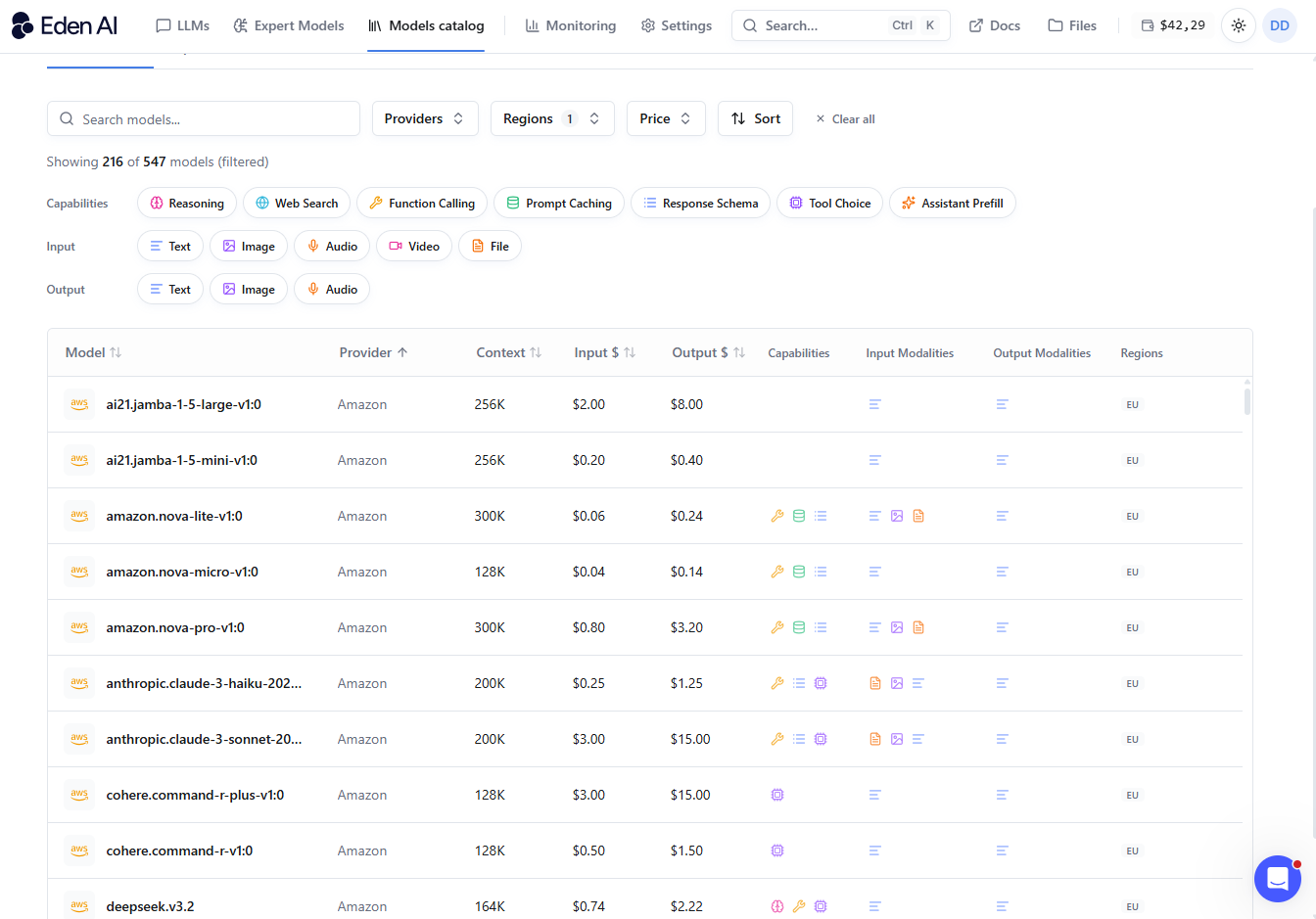
The second option is to use Eden AI’s EU endpoint. Instead of integrating each provider one by one, you use one API key to route requests across 500+ AI models through EU infrastructure.
Eden AI includes a DPA, SOC 2 and ISO 27001 certifications, zero data retention, and European hosting. For teams that need several providers, fallback logic, centralized billing, and one compliance baseline, this is usually the simpler architecture.
How to Use Eden AI's EU Endpoint
1. Create an Eden AI account
Go to edenai.co and create an account. Once your workspace is active, you can use Eden AI as a single gateway for LLMs and expert AI models instead of configuring each provider separately.
2. Grab your API key from the dashboard
Open the Eden AI dashboard and copy your API key. Store it as an environment variable, not directly in your application code.
3. Point your base URL to the EU endpoint
For Eden AI V3, the standard API base URL is https://api.edenai.run/v3. For EU routing, configure the EU endpoint at account level or through the routing parameter provided in the Eden AI documentation. If your setup uses a dedicated EU hostname, replace the base URL with https://api.eu.edenai.run/v3.
4. Make a test call
Use the OpenAI-compatible chat format to test the integration:
import os
from openai import OpenAI

client = OpenAI(
    api_key=YOUR_API_KEY,
    base_url= 'https://api.eu.edenai.run/v3'
)

response = client.chat.completions.create(
    model="google/gemini-3.5-flash",
    messages=[
        {"role": "user", "content": "Summarize why EU data residency matters for AI APIs."}
    ],
)

print(response.choices[0].message.content)
5. Verify EU routing
After the test call, check the Eden AI dashboard or response metadata to confirm that the request was processed through EU routing. Depending on your account setup, confirmation may appear in response headers, provider routing logs, or regional processing details in the dashboard.
By default, Eden AI provides GDPR-ready documentation, including a DPA, and supports zero data retention for prompts, uploaded files, and model outputs. Eden AI is also SOC 2 and ISO 27001 certified, which helps security and procurement teams validate the integration faster.
EU AI Endpoint Checklist for Developers
- Confirm that model inference runs in an EU or EEA region, not only through an EU-facing API URL.
- Sign a DPA with the AI provider and verify that they act as a data processor for your use case.
- Verify zero data retention for prompts, files, embeddings, outputs, and intermediate processing data.
- Check whether request logs, error logs, analytics logs, and abuse-monitoring logs stay inside the EU.
- Confirm that the exact models you use are available in the EU region, including fallback models.
- Document the transfer basis under GDPR Articles 44 to 49 if any data leaves the EEA.
- Test the production configuration to prove that requests are actually routed to EU infrastructure.
- Review all subprocessors involved in inference, storage, logging, monitoring, and support.
- Check whether your AI use case falls under the EU AI Act, especially Annex III high-risk categories.
- Store evidence for audits, including endpoint configuration, DPA, retention policy, regional logs, and model routing settings.

.jpg)

![[AUTO-DRAFT] OpenAI Quietly Cut Codex Context Window by 27 Percent: Why Provider-Specific Limits Are Not a Contract](https://cdn.prod.website-files.com/61e7d259b7746e3f63f0b6be/6a74828e12326e8199f45718_6a74828c58976902eb769454_openai-quietly-cut-codex-context-window-by-27-percent-why-provider-specific--openai.png)