Summarize this article with:
- Topic extraction helps identify the main subjects, concepts, and entities in text automatically, making it useful for support ticket classification, customer feedback analysis, document processing, and content organization.
- The best tool depends on your deployment needs: APIs are easier to integrate, cloud NLU platforms are better for scale, LLMs offer flexible custom schemas, and open-source models are better for local or privacy-sensitive use cases.
- Eden AI is useful when you want to test, compare, or switch between multiple topic extraction providers without rewriting your integration each time.
- LLM-based extraction is becoming a strong option in 2026 because it can return structured outputs, adapt to custom categories, and handle more complex or abstract topics.
- Open-source options like GLiNER and spaCy are best when you need more control, but they require your team to manage deployment, scaling, evaluation, and maintenance.
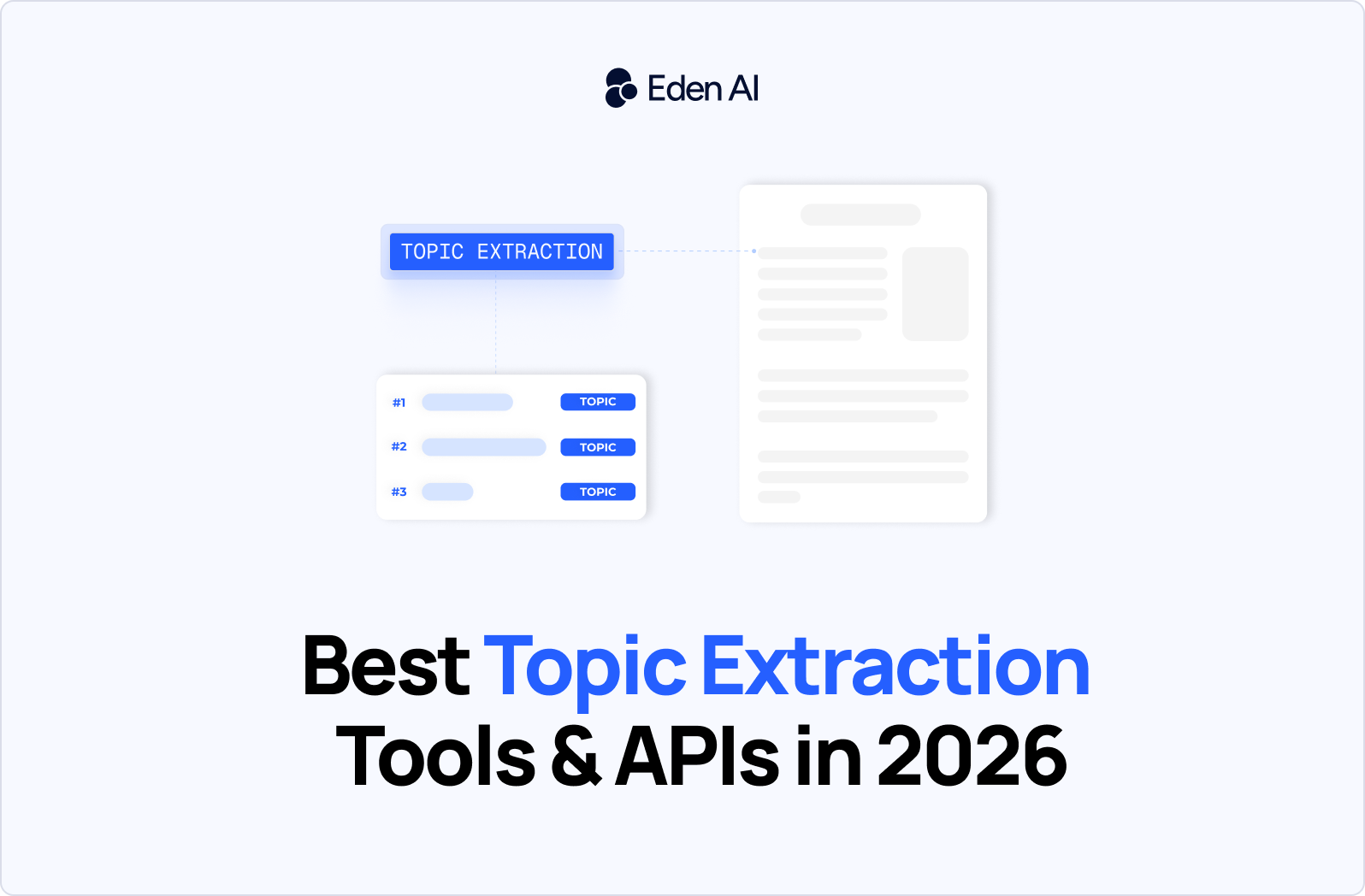
Topic extraction helps identify the main themes, subjects, or categories inside a text. It is commonly used to organize documents, route support tickets, analyze customer feedback, classify content, and summarize large volumes of text automatically.
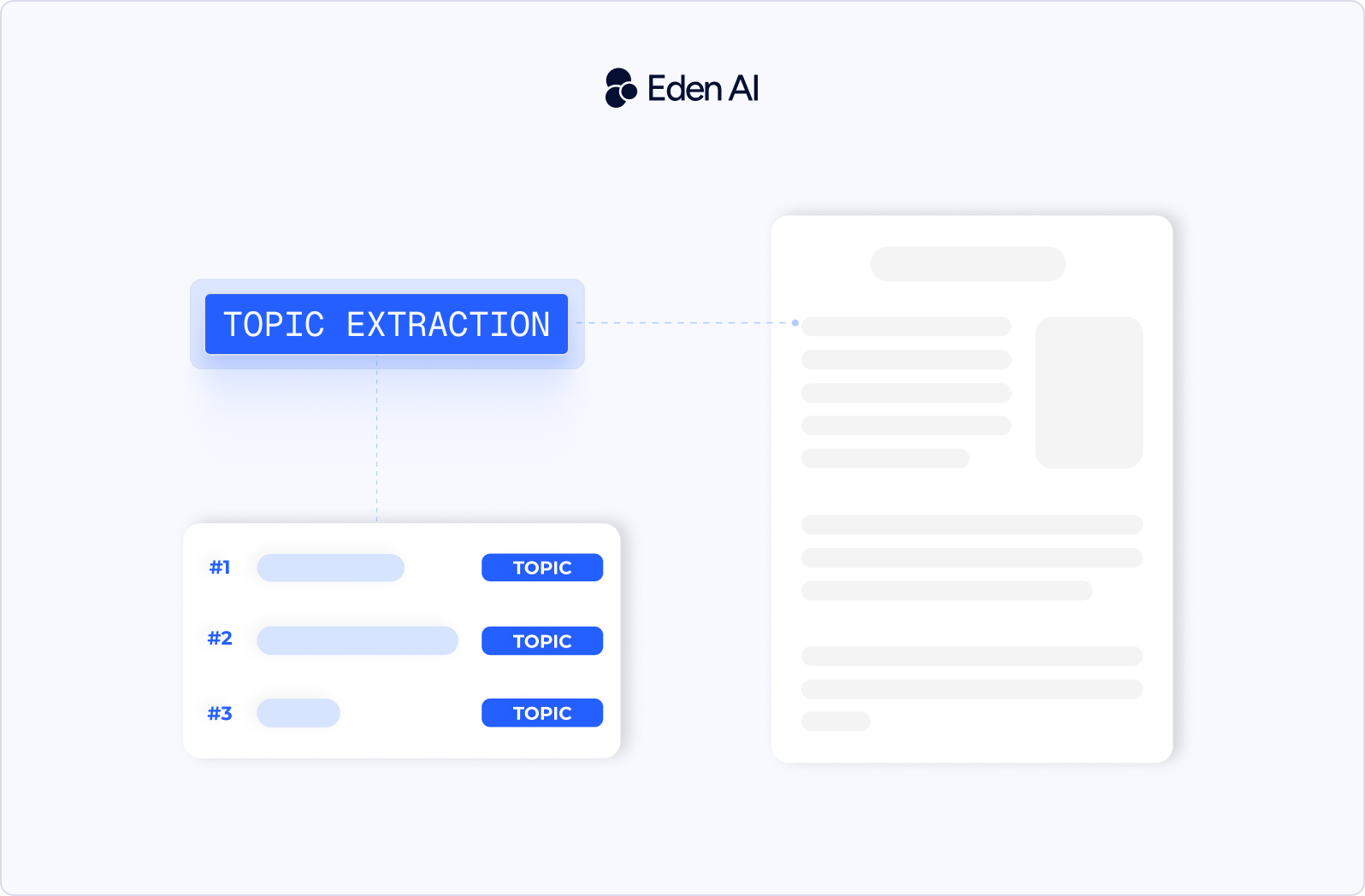
This guide compares the best topic extraction tools and APIs for developers and technical teams. You’ll find benchmark insights, integration criteria, pricing considerations, language support, and practical trade-offs to help you choose the right solution for production use.
Use the table below to quickly compare topic extraction tools by integration model, language coverage, pricing, and testing options. Detailed reviews follow with more information on accuracy, setup, latency, and scalability.
How We Evaluated These Tools
Eden AI evaluated these topic extraction providers through its unified API platform, which made it possible to run the same inputs across multiple providers under comparable conditions. This allowed us to compare outputs, latency, pricing, and integration effort using a consistent testing process.
All providers were tested in May 2026 using the same benchmark inputs and evaluation criteria.
LLM-Based Topic Extraction
LLM-based topic extraction is useful when teams need flexible schemas, contextual classification, or structured JSON outputs without training a dedicated NLP model.
Use LLM-based extraction when you need to:
- classify text into custom or changing topic categories;
- extract topics together with entities, sentiment, priority, or routing logic;
- return structured JSON for downstream systems;
- analyze long or ambiguous documents;
- identify emerging themes that are not part of a fixed taxonomy.
LLMs are usually less efficient than lightweight NLP models for simple, high-volume classification. But they are much better when the topic schema is flexible, contextual, or difficult to define with keywords only.
GPT-4o with Structured Outputs: Best for Flexible JSON-Based Extraction
GPT-4o can be used for topic extraction by prompting the model to return a fixed JSON schema. For example, developers can ask for a list of topics, confidence scores, supporting text spans, related entities, and routing labels.
With Structured Outputs, developers define the expected schema directly. This makes GPT-4o more reliable for production pipelines than plain prompting or basic JSON mode, where formatting errors can break downstream systems.
GPT-4o is strongest when the topic taxonomy is custom, contextual, or changes often. It can classify support tickets into internal product areas, extract emerging themes from user feedback, or return both high-level topics and granular subtopics in a single response. It can also combine topic extraction with entity extraction, sentiment analysis, priority scoring, or routing logic in one API call.
Key strengths
- Enforces structured JSON outputs, reducing parsing errors.
- Handles custom topic schemas without labeled training data.
- Extracts topics, entities, explanations, and evidence spans together.
Limitation: GPT-4o is more expensive and slower than lightweight NLP models for high-volume, simple classification tasks.
Best for: Teams that need flexible topic extraction with strict JSON outputs and contextual reasoning.
Pricing: GPT-4o public API pricing is $2.50 per 1M input tokens and $10.00 per 1M output tokens.
Claude API: Best for Long and Nuanced Documents
Claude can handle topic extraction through structured JSON outputs, tool use, and schema-guided prompts. Developers can define fields such as topics, subtopics, entities, confidence, reasoning summary, and source spans, then apply the schema to documents, emails, support tickets, or research notes.
Claude is especially useful when the text is long, ambiguous, or requires interpretation across multiple paragraphs. It can separate explicit topics from inferred themes, distinguish entities from broader subjects, and explain why a label was selected.
This makes Claude relevant for customer feedback analysis, legal document triage, product research, and internal knowledge-base tagging.
Key strengths
- Strong performance on long-form text where topics depend on broader context.
- Supports schema-based JSON outputs for extraction workflows.
- Useful for combining topic extraction with summarization or document-level reasoning.
Limitation: Claude requires careful schema design and evaluation, especially when labels are close in meaning or strict taxonomy consistency is required.
Best for: Teams processing long or nuanced documents where topic extraction depends on context, not just keywords.
Pricing: Claude Sonnet 4.6 public API pricing is $3 per 1M input tokens and $15 per 1M output tokens. Claude Haiku 4.5 is $1 per 1M input tokens and $5 per 1M output tokens.
GLiNER: Best for Open-Source Custom Entity Extraction
GLiNER is an open-source zero-shot model for named entity recognition. Developers provide the labels they want to extract at inference time, such as product feature, customer issue, contract clause, medical condition, or competitor name.
This is different from traditional NER systems, which usually detect fixed labels such as person, organization, location, or date. GLiNER lets teams define custom schemas without retraining a model for every new label set.
For topic extraction, GLiNER works best when topics appear as extractable spans or custom labels in the text. It is not a generative LLM, so it does not naturally produce explanations, summaries, or inferred themes like GPT-4o or Claude. However, it can be efficient for identifying custom entities and recurring issue categories at scale.
Key strengths
- Supports zero-shot custom entity extraction without labeled training data.
- Lightweight compared with large LLM APIs.
- Suitable for self-hosting and cost control.
- Better than classic NER for domain-specific schemas.
Limitation: GLiNER is focused on span and entity extraction, so it is less suitable when topics are abstract, implied, or require reasoning across the full document.
Best for: Teams that need custom entity extraction at scale with lower infrastructure cost and more control than hosted LLM APIs.
Pricing: Free and open-source. Costs depend on hosting, inference hardware, and maintenance.
Cloud NLU APIs - Best for Scale
Cloud NLU APIs are best for teams that need managed infrastructure, predictable scaling, enterprise controls, and production-ready NLP features without hosting models themselves.
They are usually less flexible than LLM-based extraction, but easier to operationalize for high-volume workflows such as entity extraction, keyword extraction, sentiment analysis, document classification, PII detection, and topic modeling.
Use cloud NLU APIs when you need:
- managed NLP infrastructure;
- stable pricing and enterprise support;
- high-volume text processing;
- prebuilt entity, keyword, sentiment, and classification features;
- integration with an existing cloud ecosystem.
Google Cloud Natural Language API: Best for Entity Salience and Sentiment
Google Cloud Natural Language API stands out for its entity salience scores and entity-level sentiment analysis. For topic extraction, this is useful when you need to identify not only which entities appear in a document, but also which ones are central to the text and whether the surrounding sentiment is positive, negative, or neutral.
Key strengths:
- Returns entities with types such as person, organization, location, event, product, and media.
- Provides salience scores to estimate how important each entity is within the document.
- Supports entity sentiment, giving score and magnitude for each detected entity.
Limitation: It is stronger for entity and content analysis than for highly customized topic taxonomies.
Best for: Teams already using Google Cloud that need entity extraction, sentiment analysis, and document classification in a managed API.
Pricing: Entity analysis starts at $1 per 1,000 units after the free tier, where one unit equals 1,000 characters. Entity sentiment analysis starts at $2 per 1,000 units.
AWS Comprehend: Best for AWS Teams and Custom Entity Recognition
AWS Comprehend combines prebuilt NLP APIs with custom entity recognizers trained on your own domain data.
For topic extraction, this is useful when generic labels are not enough. Teams can train Comprehend to detect internal product names, claims, SKUs, contract terms, support categories, or industry-specific entities.
Key strengths:
- Native integration with AWS services such as S3, Lambda, IAM, CloudWatch, and Textract.
- Supports entity recognition, key phrases, sentiment, language detection, PII detection, syntax, and topic modeling.
- Custom entity recognition supports domain-specific labels trained from your own annotations.
Limitation: Custom Comprehend requires training data and has separate training, endpoint, and inference costs.
Best for: AWS teams that need managed NLP at scale with the option to train custom entity recognizers.
Pricing: Standard NLP APIs start at $0.0001 per 100-character unit, or $0.10 per 1,000 units, with a 300-character minimum per request. Custom model training is $3 per hour.
Azure AI Language: Best for Multilingual NLP
Azure AI Language is a strong option for teams that need multilingual NLP inside the Microsoft ecosystem. It supports prebuilt text analytics, named entity recognition, key phrase extraction, PII detection, sentiment analysis, and custom NER through Language Studio.
For topic and entity extraction, Azure is especially useful for global products, multilingual support teams, research workflows, and organizations already using Azure OpenAI.
Key strengths:
- Broad language coverage, useful for multilingual support, research, and global user feedback analysis.
- NER identifies categories such as people, locations, organizations, quantities, dates, and other structured entity types.
- Works well in hybrid workflows with Azure OpenAI, where Azure AI Language handles deterministic NLP and Azure OpenAI handles flexible reasoning or schema generation.
Limitation: Pricing and feature availability can vary by region, tier, and deployment option, so cost modeling requires checking the Azure calculator.
Best for: Microsoft ecosystem teams that need multilingual NLP, compliance tooling, and hybrid workflows with Azure OpenAI.
Pricing: Standard text analytics is billed by text records, where one text record is up to 1,000 characters. Public pricing starts around $0.56 per 1,000 text records for core text analytics features.
IBM Watson: Best for Regulated Enterprise Workflows
IBM Watson Natural Language Understanding is designed for enterprise text analytics, especially where governance, security, and compliance controls matter.
It is often used in regulated or enterprise environments for customer records, healthcare-adjacent workflows, legal content, internal knowledge systems, and controlled document analysis..
Key strengths:
- Extracts entities, keywords, categories, concepts, sentiment, emotion, metadata, and semantic roles.
- Supports custom models, including custom entity and relation models through IBM’s tooling.
- Offers a Lite plan with 30,000 NLU items per month for testing and proof-of-concept work.
Limitation: Standard pricing can become expensive when multiple features are applied to the same document because usage is counted by text units multiplied by features.
Best for: Regulated teams that need enterprise-grade NLU with governance controls and custom model options.
Pricing: Lite plan includes 30,000 NLU items per month. Standard pricing starts at $0.003 per NLU item, or $3 per 1,000 NLU items.
Specialized Topic Extraction APIs - Best for Specific Use Cases
Specialized topic extraction APIs are useful when generic cloud NLP is too broad, but a full LLM workflow is too flexible, expensive, or complex.
These tools are strongest when you need semantic linking, predefined taxonomies, custom dictionaries, language-specific strengths, or domain-specific extraction behavior.
Use specialized APIs when you need to:
- link entities to external knowledge bases;
- classify content with a predefined taxonomy;
- extract topics in specific languages or domains;
- use custom dictionaries for brands, products, or internal terms;
- build search, recommendation, monitoring, or content intelligence workflows.
TextRazor: Best for Entity Linking and Semantic Disambiguation
TextRazor is worth considering when entity disambiguation matters. Disambiguation means identifying the exact meaning of a detected term based on context.
For example, “Apple” could refer to Apple Inc., the fruit, a record label, or a place. TextRazor links entities to Wikipedia and other knowledge sources, helping downstream systems understand the concept behind the text, not just the word itself.
This makes TextRazor useful for search, recommendation, media monitoring, content intelligence, and knowledge graph workflows.
Key strengths:
- Wikipedia-linked entity disambiguation for clearer semantic normalization.
- Combines entity extraction, topic tagging, relations, dependency parsing, and classification in one request.
- Pricing is request-based, and one request can run multiple extractors on up to 10 KB of text.
Limitation: TextRazor is less suited to custom internal taxonomies unless you invest in its custom rules and integration logic.
Best for: Teams building search, recommendation, media monitoring, or content intelligence systems that need entity linking and semantic context.
Pricing: Free plan with 500 requests per day. Paid plans start at $200/month for 6,000 requests per day.
MeaningCloud: Best for Rich Taxonomies and Custom Dictionaries
MeaningCloud is worth considering when taxonomy depth and customization matter more than generic NLP coverage.
Its Topics Extraction API uses a hierarchy of 200+ entity types and supports custom dictionaries. This helps teams identify domain-specific concepts, brands, products, people, places, events, quantities, and abstract topics with more structure than a standard entity API.
This is useful for publishers, market intelligence teams, legal teams, insurance companies, banking teams, and customer intelligence platforms that need consistent classification across large document collections.
MeaningCloud is also strong in Spanish and Portuguese, making it relevant for teams working across Iberian and Latin American datasets.
Key strengths:
- 200+ entity type hierarchy for detailed topic and concept classification.
- Custom dictionaries for domain-specific names, products, brands, and internal terms.
- Strong support for Spanish and Portuguese, alongside other major languages.
Limitation: The API is taxonomy-driven, so it is less flexible than LLM-based extraction for inferred themes or changing schemas.
Best for: Teams that need structured topic extraction with rich entity taxonomy and language coverage beyond English.
Pricing: Free plan available. Public software listings show paid plans starting around $99/month, with higher tiers and enterprise options.
Cohere: Best for Company-Specific Topic Classification
Cohere is worth considering when topic extraction needs to be adapted to your own data rather than handled through fixed labels.
In practice, customization means training or configuring the model around your company’s examples so it can recognize internal terminology, product names, support categories, risk labels, or domain-specific entities more consistently.
For topic extraction, Cohere can be used with classification prompts, structured generation, embeddings, reranking, and enterprise customization workflows. This makes it useful when topics are not just entities in text, but business categories defined by internal meaning.
For example, a support team could adapt extraction around labels such as “billing friction,” “provider outage,” or “advanced plan expansion signal.”
Key strengths:
- Can adapt extraction behavior to company-specific terminology and datasets.
- Supports LLM-based classification, structured responses, embeddings, and reranking workflows.
- Useful for combining topic extraction with semantic search or retrieval pipelines.
Limitation: Cohere’s current public pricing is more enterprise-oriented, and advanced customization usually requires sales engagement or production access.
Best for: Teams that need topic extraction aligned with internal language, product taxonomy, or proprietary business categories.
Pricing: Trial API keys are free but rate-limited and not for production. Production usage is pay-as-you-go where available, while enterprise products and model customization use custom pricing.
Open-Source Topic Extraction - Free, Self-Hosted Options
Open-source NLP is the right choice when you need full control over deployment, privacy, infrastructure, and cost.
It is especially useful for teams processing sensitive data, running on-premise workloads, or handling high volumes where API pricing would become expensive.
The trade-off is operational responsibility. Your team must manage deployment, scaling, monitoring, model updates, evaluation, and fallback logic.
Use open-source topic extraction when you need:
- self-hosted or on-premise NLP;
- lower long-term inference costs;
- full control over data privacy;
- custom model training or fine-tuning;
- predictable behavior without external API dependency.
spaCy v3: Best for Fast, Maintainable NLP Pipelines
spaCy v3 is a production-focused NLP framework for building fast and reliable NLP pipelines.
For topic extraction, spaCy is usually used through named entity recognition, keyword patterns, rule-based matching, text classification, or custom components trained on labeled data. It is a strong option when you need predictable behavior, low infrastructure complexity, and fast CPU inference.
Key strengths:
- Fast CPU inference and simple deployment compared with transformer-heavy stacks.
- Strong pipeline architecture for combining NER, rules, classification, and preprocessing.
- Trainable components for custom entity labels and topic categories.
Production requirements: spaCy can run well on CPU for many workloads. GPU is useful for transformer-based pipelines or large-scale training, but not required for basic NER inference.
Best for: Teams that need fast, maintainable NLP pipelines with predictable behavior and low infrastructure complexity.
Hugging Face Transformers: Best for Model Choice and Fine-Tuning
Hugging Face Transformers gives developers access to thousands of pretrained and fine-tuned models, including BERT, RoBERTa, DeBERTa, multilingual models, and domain-specific NER models.
For topic extraction, these models are commonly used as token classification systems for entity extraction, or fine-tuned classifiers for topic labels when you have annotated examples.
Hugging Face is a better fit when your team wants more model choice, higher accuracy potential, multilingual coverage, or domain-specific fine-tuning.
Key strengths:
- Large model hub with general, multilingual, and domain-specific NER models.
- Strong accuracy potential when fine-tuned on your own labeled dataset.
- Flexible stack for combining NER, embeddings, classification, and retrieval.
Production requirements: CPU inference is possible for small models, but GPU acceleration is usually needed for low latency, large batches, or transformer fine-tuning. You also need model serving, versioning, monitoring, and fallback logic.
Best for: Teams with ML infrastructure that want higher accuracy and more model choice than a lightweight NLP framework.
Unified API for Multiple Providers
Developers should choose Eden AI if:
- You want to benchmark multiple topic extraction providers on the same inputs before choosing one.
- You need to switch between providers without rewriting your integration or changing your application logic.
- You prefer unified billing and one API key, while keeping access to cloud APIs, LLM providers, and specialized NLP models.

.jpg)