Summarize this article with:
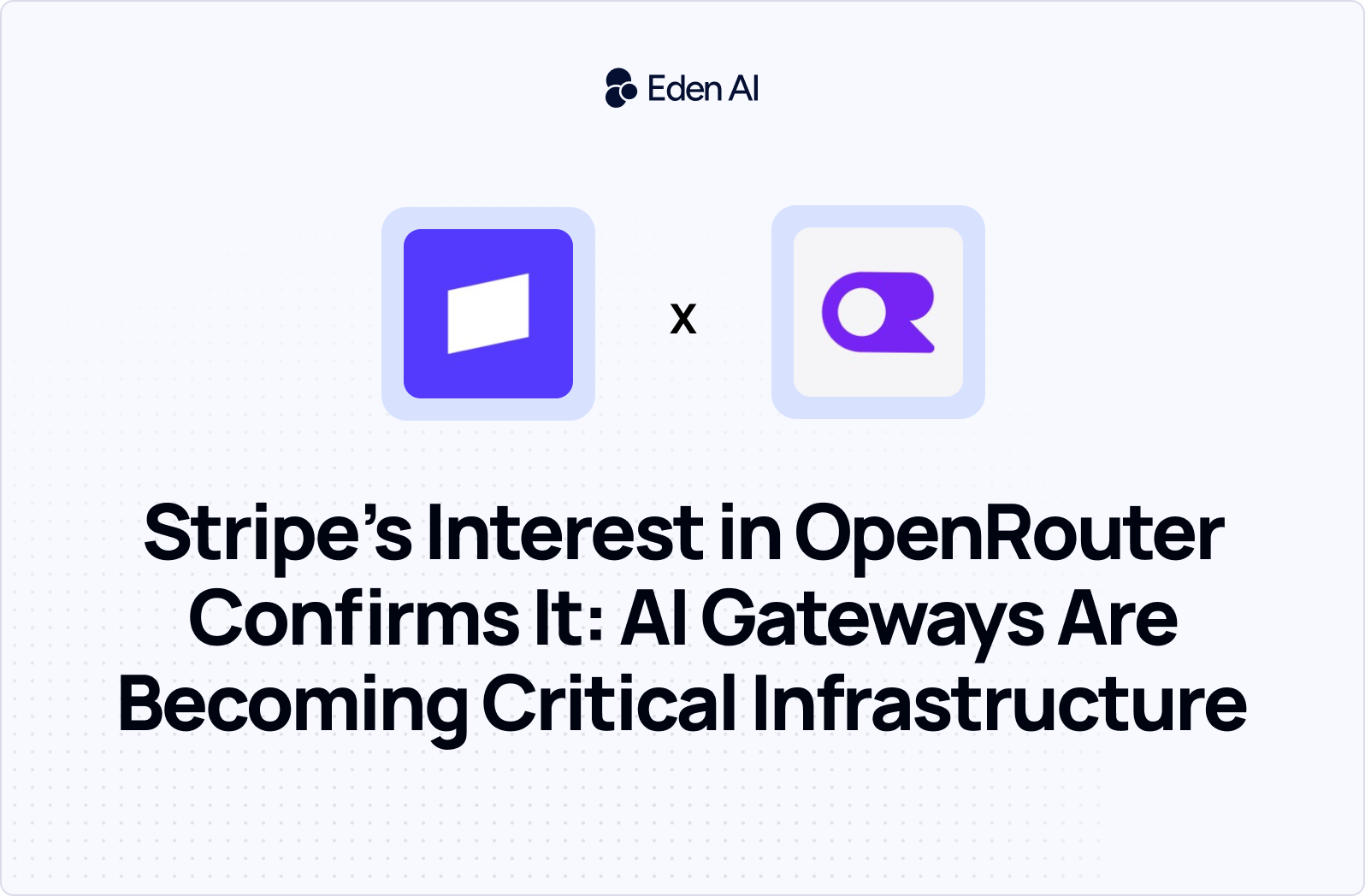
Stripe’s reported interest in acquiring OpenRouter highlights a broader shift in the AI market: the gateway connecting companies to models is becoming as strategic as the models themselves. As enterprises adopt multiple providers, this layer increasingly controls routing, costs, security, compliance and data residency.
For European companies in particular, choosing an AI gateway is therefore not only a technical decision, but also a question of sovereignty, portability and long-term control.
Reports that Stripe is considering acquiring OpenRouter at a valuation of around $10 billion have naturally attracted attention because of the size of the potential deal. But the valuation is not the most interesting part of the story.
The real signal is that the infrastructure sitting between companies and AI models is becoming one of the most strategic layers of the AI economy.
The transaction has not been confirmed, and the discussions may ultimately go nowhere. But the strategic logic is easy to understand. OpenRouter gives developers access to hundreds of AI models through a common interface. Stripe already provides much of the payment, billing, tax and fraud infrastructure used by internet companies.
Bringing those two layers together would connect AI consumption directly to the systems used to meter, bill and monetize it. The AI gateway is no longer just a convenient tool for developers. It is gradually becoming the control plane for enterprise AI.
The Most Strategic Layer May Not Be the Model
Over the past few years, most of the AI industry’s attention has focused on model providers.
- Which company has the best model?
- Which model performs best on coding?
- Which one has the largest context window?
- Which one is the cheapest?
These questions still matter. But for companies deploying AI at scale, they are becoming less decisive than they once were.
The market moves too quickly. A model that leads today may be overtaken a few weeks later. Prices fall, context windows grow, providers experience outages and new open-weight models appear constantly. Very few serious companies will build their entire AI strategy around a single model provider forever.
Instead, they will use different models for different workloads. They may choose one model for coding, another for document processing and a third for customer-facing applications. Sensitive workloads may need to stay in a specific region, while less critical requests may be optimized for cost, latency or availability.
The strategic question is therefore changing. It is no longer only: Which model should we choose? It is increasingly: Who controls how our company accesses, governs and pays for all these models?
That is the role the AI gateway is beginning to play.
A Gateway Controls Much More Than Routing
Routing is often described as the simple act of sending a request to one model rather than another. That definition is already outdated. An enterprise AI gateway can determine:
- which providers an application is allowed to use;
- where requests are processed;
- which models may receive sensitive data;
- how much each team is allowed to spend;
- what happens when a provider becomes unavailable;
- which requests and metadata are logged;
- how consumption is attributed internally;
- which models can be added or removed;
- and how the company interacts with upstream providers.
The gateway sits at the intersection of technical, financial, security and compliance decisions. As AI becomes embedded in customer support, internal knowledge systems, document processing, software development and autonomous agents, an increasing share of a company’s AI traffic will pass through this layer. That makes the gateway extremely valuable. It also makes the choice of gateway highly sensitive.
There Is No AI Sovereignty Without Gateway Sovereignty
In Europe, discussions about AI sovereignty often focus on where a model was trained or where a cloud region is located. Those questions are important, but they do not tell the whole story.
A company may use a European model while still sending its requests through an infrastructure layer operated under another jurisdiction. It may store data in Europe while allowing its routing provider to retain logs, inspect metadata or redirect traffic to another region.
Real sovereignty requires visibility and control across the full path of an AI request:
application → gateway → provider → model → storage and observability systems
The gateway is the decision point in that chain. It determines whether a request remains in Europe, whether it reaches a US-hosted provider, whether it can fall back to another model and what information is retained along the way. This is why data residency cannot be treated as a simple checkbox in a feature comparison.
For European companies, the location, governance and independence of the gateway itself should become an important procurement criterion.
The question should not only be: “Can you route my data to a European model?”
Companies should also ask: “Who operates the routing layer, under which jurisdiction, and can I verify that my traffic will remain within the boundaries I define?”
Consolidation Brings Convenience, but Also Dependency
A combination of Stripe and OpenRouter would make clear strategic sense.
OpenRouter has built a powerful distribution layer for AI models. Stripe already manages the financial infrastructure used by a large part of the internet economy and has made no secret of its ambition to become an important part of the AI economy as well.
Combining AI routing and payments could create a highly attractive platform.
Developers could consume models, monitor usage and pay for inference through a unified experience. Model providers could gain access to a large distribution and monetization network. Stripe could position itself directly in the flow of global AI consumption.
There is, however, another side to this consolidation.
When access, routing, observability and billing are concentrated within the same platform, leaving that platform becomes more difficult.
The dependency is no longer limited to an API endpoint. Over time, it may extend to:
- historical usage data;
- internal cost allocation;
- routing rules;
- model evaluations;
- provider relationships;
- access controls;
- audit logs;
- and operational processes.
That does not mean companies should avoid integrated platforms. The convenience they provide is real.
But portability should be designed into the architecture before it becomes necessary.
Companies Need an Exit Strategy From Day One
A modern AI architecture should assume that models, providers and infrastructure partners will change. Companies should therefore retain control over a few essential elements.
First, application code should not depend too heavily on proprietary model formats. A common interface makes it easier to change providers without rebuilding every application.
Second, routing rules should remain separate from business logic. Decisions based on cost, latency, geography, quality or availability should not be hard-coded into dozens of different products.
Third, companies should be able to export their usage data, logs and configurations in a usable format.
Fourth, the gateway should clearly show which provider, model and region processed each request.
Finally, sensitive workloads should be protected by explicit geographic and provider restrictions. Those restrictions should not be silently bypassed because an automatic fallback was triggered.
The objective is not to change gateway providers every six months. It is to preserve the ability to change when the strategic, regulatory or commercial context requires it. Without that ability, a platform designed to reduce model lock-in can simply create a new form of infrastructure lock-in.
AI Gateways Will Become the Cloud Control Planes of the AI Era
Cloud computing did not remove infrastructure complexity. It moved much of that complexity into centralized control planes. AI is following a similar path.
Enterprises will not want to manage hundreds of separate model integrations, provider contracts, security policies and billing systems. They will adopt a central layer for access, governance, observability, routing, security and payments.
This is why so many infrastructure companies are now moving toward the AI gateway category. The long-term winners will not necessarily be the platforms offering the largest number of models. Model catalogs are easy to expand and increasingly difficult to differentiate.
The more durable value will come from:
- reliability;
- intelligent routing;
- transparent pricing;
- governance;
- security;
- regional infrastructure;
- interoperability;
- and the consistent enforcement of enterprise policies across every model.
For European companies, another criterion must be added to that list: sovereignty by design.
What This Means for Eden AI
At Eden AI, we believed in the multi-provider approach long before “AI gateway” became a mainstream category. The original promise was straightforward: companies should not have to integrate every AI provider separately. That promise still matters. But the role of the gateway has become much broader.
Our customers increasingly need one infrastructure layer not only to access different models, but also to control where requests go, enforce provider policies, monitor consumption, manage fallbacks and maintain strategic flexibility as the market evolves.
For us, European sovereignty does not mean excluding every non-European model. European companies should remain free to use the best technologies available worldwide. Sovereignty means giving them control over that choice.
A company should be able to decide that one workload may use OpenAI, another must remain on European infrastructure and a third may only be processed by a provider offering specific zero-data-retention commitments.
Those choices must be technically enforceable, operationally visible and commercially reversible. That is the standard the gateway layer should meet.
The $10 Billion Signal
Whether Stripe ultimately acquires OpenRouter is almost secondary. The reported discussions already send a clear message: the market increasingly understands that the infrastructure controlling AI traffic may become as strategically important as the companies building the models themselves.
The next generation of AI infrastructure will not be defined by a single dominant model. It will be defined by the systems that determine which model is used, where it runs, how it is paid for and who remains in control.
The gateway is becoming that system. And as it becomes critical infrastructure, companies will need to evaluate it with the same level of scrutiny they apply to their cloud, payment and security providers.
Especially in Europe, the future of AI sovereignty will not only be decided by who builds the models. It will also be decided by who controls the route to them.

.jpg)