Summarize this article with:
- Artificial Intelligence is everywhere, from powering chatbots and virtual assistants to analyzing medical scans or financial documents.
- Even state-of-the-art Large Language Models (LLMs) or vision models can misinterpret input, hallucinate information, or underperform in certain cases.
- Normally, combining multiple models means coding integrations for several APIs , managing routing logic, and handling costs.
- You save time coding, and reduce the chance of errors creeping into your own integration logic.
- How Can You Lower AI Errors by Combining Multiple Models? enables automation, accuracy improvements, and cost reduction across AI-powered applications.
How Can You Lower AI Errors by Combining Multiple Models?
Artificial Intelligence is everywhere, from powering chatbots and virtual assistants to analyzing medical scans or financial documents. But if you’ve worked with AI, you know one thing: AI models make mistakes.
Even state-of-the-art Large Language Models (LLMs) or vision models can misinterpret input, hallucinate information, or underperform in certain cases. For SaaS companies, these errors can mean frustrated users and unreliable features.
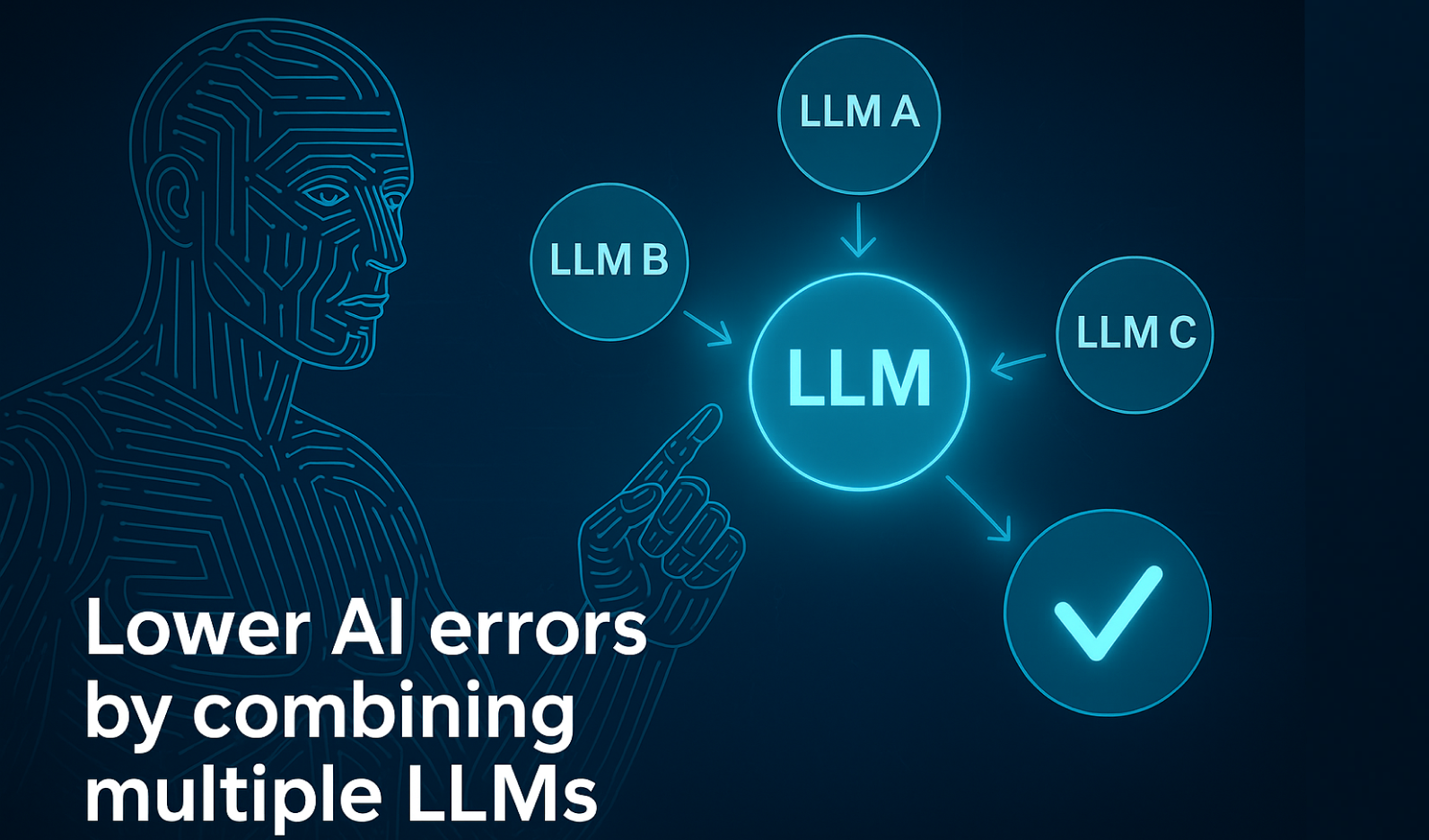
So how do you reduce those errors? One of the most effective strategies is combining multiple models.
Why Do AI Models Make Errors?
- Training data limitations: No dataset covers every scenario.
- Bias: Models may overfit or reflect dataset bias.
- Domain-specific weaknesses: A model trained for generic use might fail in niche contexts.
- Randomness: Some outputs vary even with identical inputs.
The Multi-Model Solution
By combining models, you can leverage their strengths while covering their weaknesses. This is often referred to as model ensembling or multi-model routing.
Benefits:
- Improved accuracy: If one model fails, another might succeed.
- Reduced hallucinations: Voting or confidence checks across models filter unreliable answers.
- Flexibility: Different models may be better suited for different tasks.
- Reliability at scale: Ensures more consistent results for production SaaS applications.
Strategies to Combine Multiple Models
- Model Voting (Majority or Weighted)
- Several models process the same input.
- The final output is based on majority consensus or weighted confidence scores.
- Useful for classification tasks like sentiment analysis or fraud detection.
- Model Routing
- Route each input to the best-performing model for that use case.
- Example: one LLM for short queries, another for longer, more complex tasks.
- Fallback Logic
- If the primary model fails or returns an error, a secondary model provides backup.
- Prevents downtime or blank responses.
- Hybrid Use Cases
- Combine models of different modalities (e.g., NLP + vision) for richer context.
Example Use Cases
- Customer Support Chatbots: Use multiple LLMs with fallback to avoid “hallucinations.”
- Document Processing: Route OCR tasks between providers based on language or document type.
- Healthcare AI: Combine vision models for medical scans to reduce diagnostic errors.
- Fraud Detection: Multiple classifiers reduce false positives and negatives.
Why Eden AI Helps Here
Normally, combining multiple models means coding integrations for several APIs, managing routing logic, and handling costs.
With Eden AI:
- You can access dozens of providers from a single API.
- Built-in model comparison, fallback, and cost optimization make multi-model strategies easier.
- You save time coding, and reduce the chance of errors creeping into your own integration logic.
Conclusion
AI models aren’t perfect, but combining them can drastically reduce errors, hallucinations, and reliability issues.
Using techniques like voting, routing, and fallback, you can make your SaaS features more accurate, stable, and trustworthy.
Platforms like Eden AI make this approach practical: instead of juggling multiple APIs, you can combine and optimize models effortlessly within one unified interface.

.jpg)
![[AUTO-DRAFT] OpenAI Quietly Cut Codex Context Window by 27 Percent: Why Provider-Specific Limits Are Not a Contract](https://cdn.prod.website-files.com/61e7d259b7746e3f63f0b6be/6a74828e12326e8199f45718_6a74828c58976902eb769454_openai-quietly-cut-codex-context-window-by-27-percent-why-provider-specific--openai.png)