Summarize this article with:
- AI integration goes far beyond connecting an API key.
- Different APIs and standards: Each AI provider has unique syntax, parameters, and authentication.
- Cost management: Balancing performance and budget across multiple providers.
- Access NLP, Vision, Speech, and OCR APIs from one endpoint.
- Managing complex AI integrations doesn’t have to be overwhelming.
Why Complex AI Integration Is Challenging
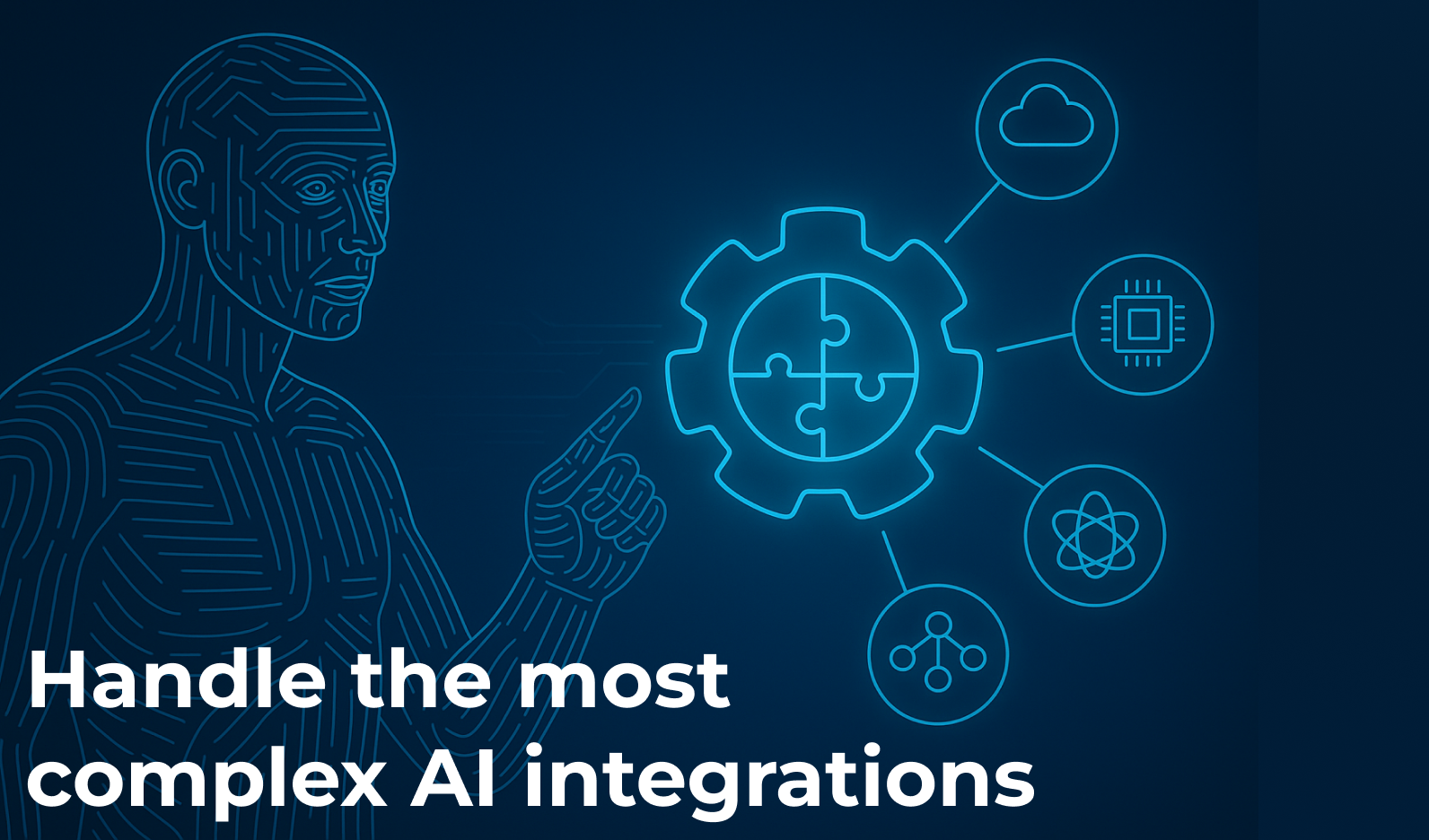
AI integration goes far beyond connecting an API key. When building real-world applications, developers face:
- Different APIs and standards: Each AI provider has unique syntax, parameters, and authentication.
- Multiple AI domains: NLP, Vision, Speech, OCR, each requires different inputs and outputs.
- Scalability issues: Handling large-scale workloads and failovers.
- Cost management: Balancing performance and budget across multiple providers.
- Monitoring and maintenance: Keeping track of latency, reliability, and errors in production.
Without a structured approach, these factors lead to technical debt and inconsistent results.
Best Practices for Managing AI Integrations
1. Use a Unified Interface
Instead of coding for each AI provider separately, use a standardized interface that abstracts differences.
Example: One API call format that works with multiple AI models.
2. Implement Load Balancing and Fallbacks
Avoid downtime by routing requests to alternative providers when one fails or becomes too slow.
3. Automate Provider Selection
Use dynamic routing logic to choose the most efficient or affordable AI model in real time.
4. Centralize Monitoring and Logging
Track latency, costs, and model accuracy from one place to improve system reliability.
5. Modularize Your Architecture
Keep AI integrations separate from business logic. This makes it easier to replace or update models without breaking your product.
How Eden AI Simplifies Complex AI Integration
Eden AI acts as an AI orchestration layer, giving you access to dozens of models and providers through a single, unified API.
With Eden AI, you can:
- Access NLP, Vision, Speech, and OCR APIs from one endpoint.
- Automatically balance load and manage fallbacks.
- Compare models by cost and performance in real time.
- Monitor everything through an intuitive dashboard.
You can integrate once, and manage everything effortlessly.
Conclusion
Managing complex AI integrations doesn’t have to be overwhelming.
By using a unified system like Eden AI, you can focus on delivering value, not managing APIs.
The result: faster development, lower costs, and a scalable AI infrastructure that adapts to any model or provider.

.jpg)
![[AUTO-DRAFT] OpenAI Quietly Cut Codex Context Window by 27 Percent: Why Provider-Specific Limits Are Not a Contract](https://cdn.prod.website-files.com/61e7d259b7746e3f63f0b6be/6a74828e12326e8199f45718_6a74828c58976902eb769454_openai-quietly-cut-codex-context-window-by-27-percent-why-provider-specific--openai.png)