Summarize this article with:
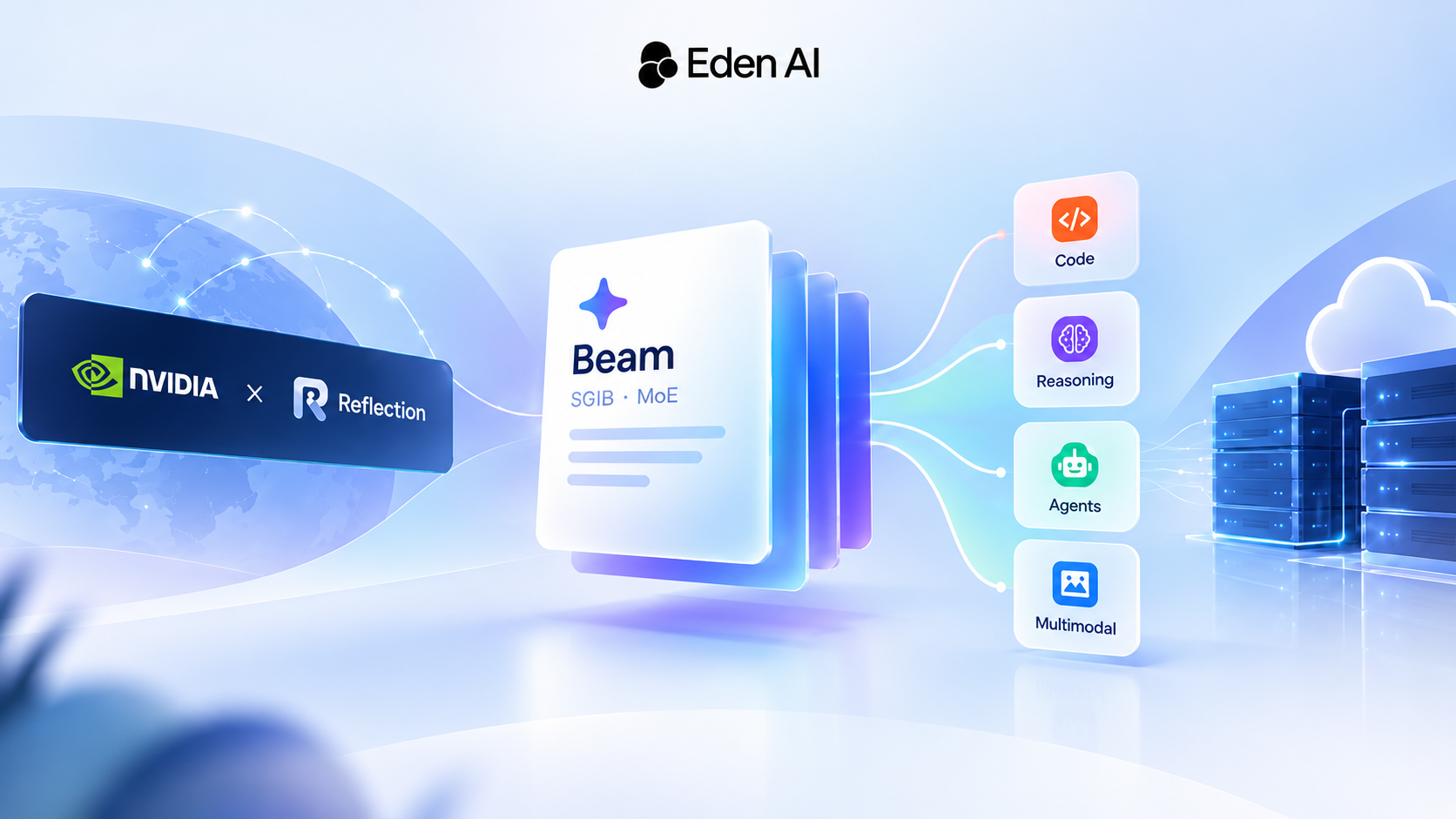
Nvidia is reportedly in early talks to acquire, further invest in, or acqui-hire Reflection AI, days after the lab released Beam, a 501B-parameter open-weight model. This article breaks down Beam's specs and claims, why Nvidia benefits from open models, what the Groq precedent shows, and what an Apache 2.0 license does and doesn't protect. It closes with practical steps to keep AI applications portable when providers change.
On October 10, the Financial Times reported that Nvidia is in early talks to deepen its investment in Reflection AI, acquire it outright, or pursue an acqui-hire in which it would hire the team and license the technology without taking control of the company. According to the report, an agreement could come within weeks, though the talks could still collapse.
Nvidia is not a newcomer to Reflection's cap table. The FT reported that it has already invested $800 million in the startup, which was founded in 2024 by former DeepMind researchers Misha Laskin and Ioannis Antonoglou. The story therefore raises a question that goes beyond one potential deal: what does it mean for developers when an open-weight model's future is tied to the commercial priorities of the companies behind it?
The timing makes the question concrete. Reflection introduced Beam, its first open-weight model, on October 5, five days before the report. Nvidia, meanwhile, has been steadily expanding its involvement in open models, where better models also drive demand for the infrastructure used to train and serve them.
No transaction has been announced, and neither company has commented publicly on the talks. But the underlying issue does not depend on whether a deal happens. Open weights can preserve access to a model that already exists. They cannot guarantee the future of the company that built it, the API that serves it, or the infrastructure that makes it practical to run.
What is Reflection AI's Beam?
Beam is a text-only, sparse Mixture-of-Experts (MoE) model with 501 billion total parameters and 23 billion active per token, built for coding, reasoning and agentic workloads. According to Reflection's announcement, its base model was pretrained on 23.8 trillion tokens in under four weeks on 6,144 NVIDIA GB300 GPUs, and midtraining extended its effective context length to 1 million tokens.
The reinforcement-learning phase is where Reflection invested most visibly. The company reports more than 100 million RL rollouts over four weeks on 10,500 NVIDIA GB300 GPUs, drawn from a pool of nearly one million coding, agentic and STEM environments. It describes the run as one of the largest conducted by any open lab and says capabilities were still improving when it ended.
Benchmarks and efficiency claims
Reflection positions Beam as competitive with larger open models such as GLM-5.2 and approaching Qwen 3.8-Max on coding and agentic tasks. Its updated figures include 80.9 on SWE-bench Verified and 80.1 on Terminal-Bench 2.1. The company also acknowledges that frontier open models such as Kimi K3 remain ahead on raw capability, and presents efficiency as Beam's main advantage.
The headline efficiency claim is that Beam matches GLM-5.2 on advanced reasoning benchmarks while using three to four times less inference compute. That figure needs context. Reflection estimates compute from active parameters and generated tokens, and explicitly excludes prompt prefill, context-dependent attention operations and serving overhead. It is an approximate comparison, not a measured end-to-end cost. Real production economics also depend on latency, context length, concurrency, hardware utilization, retries and the number of calls needed to complete a task. Beam also exposes a reasoning-effort parameter, so the same model can trade accuracy for tokens depending on the workload.
Two different kinds of access
Beam is currently available in two forms that should not be confused. The hosted Reflection API is a public beta: access is free but capped by daily limits, and Reflection reserves the right to change those limits or end the beta at any time. Separately, the company has committed to releasing the weights, technical report, model card and developer tooling later in October under the Apache 2.0 license.
The first is a managed service on changing terms. The second, once published, would let developers run and adapt a specific model version on their own. That distinction is central to understanding why Nvidia's interest matters.
Why Nvidia benefits from open models
Nvidia does not need to own every successful model to benefit from the market it creates. Training, evaluating and serving capable models requires computing infrastructure, and a larger ecosystem of model developers creates more demand for it. Beam illustrates the relationship directly: both its pretraining and its RL run depended on thousands of Nvidia GPUs.
A closer relationship could give Nvidia more influence over how Reflection develops and deploys future models, while giving Reflection access to capital and compute that are hard for a young lab to assemble alone. These are plausible incentives, not confirmed terms of any proposed deal.
Reflection is also part of a wider Nvidia-backed effort. In March 2026, Nvidia launched the Nemotron Coalition, which brings together Black Forest Labs, Cursor, LangChain, Mistral AI, Perplexity, Reflection AI, Sarvam and Thinking Machines Lab to build open frontier models through shared research, data and compute. Its first project is a base model co-developed by Nvidia and Mistral AI on DGX Cloud.
Shared infrastructure does not automatically compromise a lab's independence. Labs still compete on data, training methods, capabilities and product strategy, alternative hardware exists, and customers have different requirements. But it raises a fair question for enterprise buyers: how much real choice exists at the model layer if a growing share of the ecosystem depends on the same infrastructure provider?
The defensible point is not that Nvidia wins in every scenario. It is that infrastructure providers can profit from open models even when the models themselves are free. For developers, openness therefore has to be evaluated at more than one level: a permissively licensed model can still have a most-convenient deployment path that is commercially controlled. Hardware vendors moving closer to the model and inference layers is a broader trend, as shown by AMD's acquisition of Taalas.
What the Groq deal tells us, and what it doesn't
Nvidia's December 2025 agreement with Groq is a useful precedent for how a major deal can reshape a company without ending its independent operations. Under a non-exclusive inference technology licensing agreement, Nvidia licensed Groq's technology, while founder Jonathan Ross, president Sunny Madra and other team members joined Nvidia. Groq said it would keep operating independently and that GroqCloud would continue without interruption.
The following months bore that out. At GTC 2026, Nvidia unveiled its LPX platform incorporating Groq's inference technology. In June, Groq raised $650 million to expand its inference cloud under a new leadership team led by CEO Adam Winter, and in August it joined Nvidia's Cloud Partner program to deploy Nvidia hardware in its own data centers.
Groq is not a direct parallel. That deal centered on inference technology and talent, while a Reflection deal could involve a company building its own frontier models. Nor does the Groq case show that customers lost service or choice afterwards.
Its lesson is narrower but useful: legal independence, product roadmap, key personnel and commercial relationships are separate things, and each can change on its own. That is why developers should look at what a deal actually changes rather than treating acquisition, investment, licensing and acqui-hire as interchangeable. For any AI service they depend on, the practical questions stay the same. Will the model remain available? Will the API and its terms remain suitable? Can an alternative take over if they don't?
Open weights protect the past, not the future
An Apache 2.0 release gives developers real protection. The Apache License 2.0 grants a perpetual, irrevocable copyright license, so once a specific version of Beam is published under it, users can keep running, modifying and redistributing that version under the license's terms. A later change of ownership does not, by itself, revoke rights already granted to recipients of that release.
But the weights are only one part of the system around a model.
Two gaps matter most in practice. First, another model is rarely a drop-in replacement: differences in tool calling, structured outputs, context handling and reasoning behavior can break the application built around it. Second, self-hosting changes the dependency rather than removing it. Teams still need suitable hardware, inference software, maintenance, security controls and the skills to operate the model. For a 501-billion-parameter MoE like Beam, that cost can be substantial even when the weights are free. API prices can also move quickly, as the recent DeepSeek price shake-up showed.
None of this is an argument against open-weight AI. Releases such as Aleph Alpha's Kolibri, also under Apache 2.0, show how much control open weights can give. It is an argument for knowing exactly what has been made open, what is promised for the future, and what remains a managed service.
How to build AI applications that survive a provider change
Even capable agents reach beyond one model
Reflection's announcement contains a revealing detail. When Beam was given web access during training, it learned on its own to search for and query other large language models, and to call OCR APIs to read documents. As a text-only model, it reached for outside services to handle what it could not do itself.
That reflects a broader pattern in agentic AI. One model may plan and reason, but completing a task often requires external capabilities: retrieving information from the web, extracting text from a scanned document, calling a specialized service or delegating a subtask to another model. This is Reflection's own account of Beam's behavior, not proof that every agent will find the right tool unaided. But it shows why orchestration, not the model alone, determines how a system performs.
Consider a document-processing workflow. One model interprets the request, an OCR service extracts text from scanned pages, and a second model classifies or summarizes the result. If the preferred model becomes too expensive or unavailable, the system should be able to swap it without rebuilding the workflow. It also means model choice should be judged at the application level: a model that tops an isolated benchmark may not be the best fit for a workflow whose success depends on tool reliability, latency, data handling and the cost of completing the whole task.
Design for change, not for zero dependencies
Provider neutrality does not mean every model is interchangeable, or that every application needs a complex multi-provider setup. It means avoiding unnecessary coupling where a provider change would be expensive. Four practices make a meaningful difference:
- Abstract model access. Put model calls behind one consistent interface and isolate provider-specific parameters in adapters.
- Test alternatives on real tasks. Include tool calls, structured outputs and failure cases, not just benchmark prompts.
- Keep a validated fallback. For critical workflows, maintain a second model that has already been tested against the same requirements.
- Measure cost per completed task. Track the cost and latency of successful end-to-end tasks rather than comparing token prices alone.
A unified gateway helps with the integration layer. Eden AI's OpenAI-compatible Chat API gives one interface to models from many providers, so teams don't have to build and maintain a separate integration for each. Our guide to LLM routing strategies explains how to use that layer for model selection and fallback in production.
A gateway does not make model behavior identical, and it cannot remove every infrastructure or contractual dependency. Teams still need to test compatibility, verify data-handling requirements and decide which alternatives are acceptable for each workload. The goal is to make switching feasible, not to pretend it is free.
The real value of openness is the freedom to adapt
Beam is a notable technical release, and Nvidia's talks with Reflection AI are worth watching. But for developers, the most important question is not whether one company ends up buying another. It is how much control they keep over what they build when models, APIs, infrastructure and business arrangements change.
Open weights give lasting access to a particular model version. A resilient architecture goes further: it keeps the model replaceable, measures alternatives against real workloads and avoids tying critical workflows to a single service. The strongest form of openness is not access to a model today. It is the ability to keep building when tomorrow's model, provider or deal looks different.