Summarize this article with:
Most teams start with general-purpose LLMs because they are flexible, easy to test, and capable across many tasks. That works well during exploration, but production changes the decision. Cost per request, latency, output consistency, infrastructure requirements, and control over model behavior become just as important as raw capability.
The real question in SLM vs LLM in production is therefore not which model category is better overall, but which model is best for each task. General-purpose LLMs remain valuable for broad, ambiguous, and evolving workflows. Trained small language models become more attractive once a task is stable, measurable, and high-volume.
The strongest production architectures often combine both, starting generic and specializing where the economics and performance justify it.This article provides a practical framework for choosing when to use each model and how to combine them.
General-purpose LLMs are usually the better starting point when requirements are uncertain or broad reasoning matters. Trained SLMs become more attractive once a task is stable, narrow, measurable, and executed at sufficient volume to justify the added training and deployment effort.
What is a SLM and a LLM?
A large language model is a general-purpose AI model trained on broad datasets and typically built with billions of parameters. LLMs are strong at open-ended generation, reasoning, coding, summarization, and handling unfamiliar requests. Their main trade-offs are higher inference cost, greater latency, and less predictable outputs.
A small language model is a compact AI model with fewer parameters, often trained or fine-tuned for a narrower task or domain. SLMs are well suited to repetitive workflows such as classification, extraction, routing, and structured generation. Their main trade-off is reduced flexibility and weaker performance outside their intended scope.
.png)
When to use a general-purpose LLM
General-purpose LLMs are the best fit when the task is still evolving or requires broad capabilities rather than narrow specialization. Their main advantage is flexibility: one model can handle many input types, domains, and task formats without dedicated training.
Use an LLM for:
- Exploration and changing use cases: LLMs let teams test new workflows before requirements, schemas, and success criteria are fully defined.
- Rapid prototyping and prompt testing: Engineers can iterate on prompts, tools, and evaluation logic without preparing a training dataset.
- Open-ended reasoning and research: Broad pretraining helps LLMs synthesize information, compare options, and respond to questions with multiple valid paths.
- Coding and technical assistance: General-purpose models can work across languages, frameworks, debugging tasks, documentation, and code generation.
- Multi-step workflows: LLMs are better suited to tasks that require planning, tool use, intermediate reasoning, or adapting steps dynamically.
- Unpredictable inputs: They handle variation in wording, intent, context, and output format more reliably than narrowly trained models.
- Low-volume production workflows: When request volume is limited, the cost of training and operating a specialized SLM may not be justified.
During this stage, Eden AI provides one API to explore, compare, route, and monitor multiple LLM providers without rebuilding each integration.
When to use a trained custom SLM
A trained small language model is most useful after a workflow is already understood, measured, and running at meaningful volume. It is an optimization step, not usually the best starting point for an uncertain product requirement.
Use a trained SLM when the workflow has:
- A narrow, repeatable task: Intent detection, ticket routing, and document extraction benefit from specialization because inputs and success criteria are clearly defined.
- Stable prompts and instructions: Once prompt structure changes infrequently, training can capture the desired behavior directly instead of relying on long prompts.
- Defined output formats: SLMs can be optimized for consistent labels, JSON schemas, extracted fields, or constrained responses.
- High request volume: Repeated workloads create stronger incentives to reduce inference cost and infrastructure requirements.
- Strict latency targets: Smaller models can support faster response times on latency-sensitive paths, depending on deployment and hardware.
- A need for predictable behavior: Specialized training can reduce unnecessary variation and improve consistency within a known task boundary.
Good candidates include RAG question-answering over a stable knowledge domain and multi-turn tool-calling flows with a limited set of tools and expected actions. The key requirement is operational maturity: teams should already have representative data, clear evaluation criteria, and enough production traffic to justify specialization.
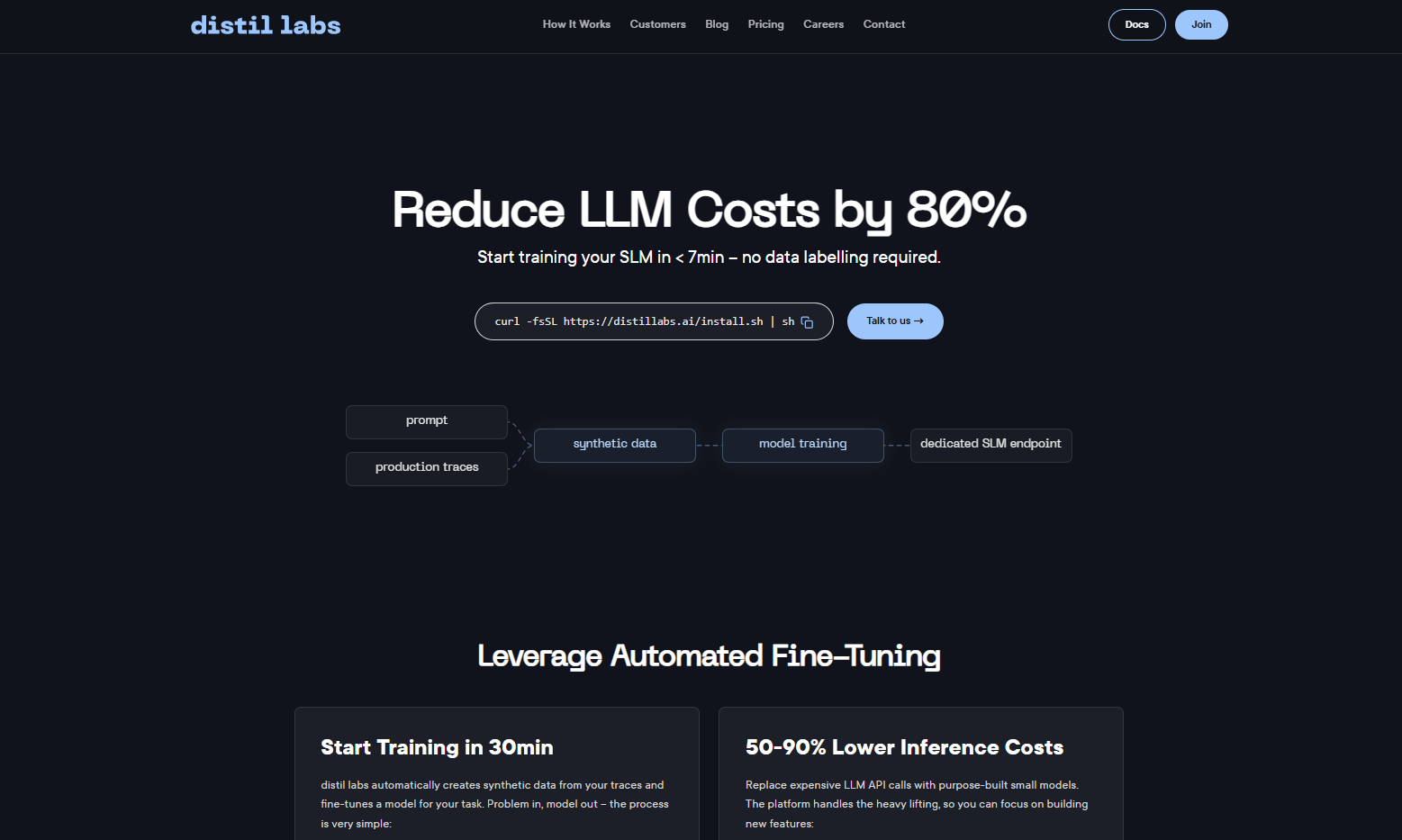
distil labs trains custom SLMs for these stable, high-volume workflows once the task and performance target are well defined.
Build a hybrid architecture: general-purpose first, specialized later
A practical production architecture does not require choosing one model category for every request. It starts with general-purpose models, uses production data to identify specialization opportunities, then routes each task to the most appropriate model.
1. Explore and monitor with general-purpose LLMs
Teams can begin by testing multiple models through Eden AI, comparing quality, latency, cost, and reliability without maintaining separate provider integrations. This stage is useful for refining prompts, defining evaluation criteria, and understanding how requests vary in production.
2. Identify workflows ready for specialization
Production monitoring reveals which workflows are stable, high-volume, and expensive enough to optimize. Strong candidates have repeatable inputs, defined outputs, consistent prompts, and measurable success criteria. Examples might include ticket classification, document extraction, or a constrained tool-calling flow.
3. Train and route to custom SLMs
distil labs can train custom SLMs for those mature workflows. Because the resulting models are exposed through OpenAI-compatible endpoints, Eden AI can route requests to them like any other model provider.
Routing then happens at the request level. Complex, open-ended, or unfamiliar requests continue to a capable frontier LLM. Narrow, repetitive requests with known boundaries go to the custom SLM. Both paths remain behind one gateway, where teams can apply fallback logic, monitor performance, and redirect traffic when a model fails or falls below a defined threshold.
This creates a gradual LLM-to-SLM migration path rather than a disruptive replacement project. General-purpose models preserve flexibility where it matters, while specialized models improve the economics and predictability of stable production workloads.
Conclusion
The production decision is not simply SLM vs LLM. It is about matching each request to the model that delivers the required quality, cost, latency, and control. General-purpose LLMs remain the stronger choice for exploration, flexible workflows, open-ended reasoning, and unpredictable inputs. Trained SLMs become valuable once a task is stable, high-volume, measurable, or latency-sensitive.
Eden AI helps teams orchestrate, compare, monitor, and route requests across multiple models through one API. distil labs turns mature production workflows into efficient custom SLMs designed around specific task requirements.
Teams can explore and compare models with Eden AI, then specialize the workflows that justify it with distil labs.

.jpg)
![[AUTO-DRAFT] OpenAI Quietly Cut Codex Context Window by 27 Percent: Why Provider-Specific Limits Are Not a Contract](https://cdn.prod.website-files.com/61e7d259b7746e3f63f0b6be/6a74828e12326e8199f45718_6a74828c58976902eb769454_openai-quietly-cut-codex-context-window-by-27-percent-why-provider-specific--openai.png)