Summarize this article with:
- Explicit content detection APIs help automate moderation by detecting unsafe, NSFW, or inappropriate content in images, videos, text, and sometimes audio.
- The best API depends on content type, risk level and budget: Sentisight is the cheapest per image, Google Cloud Vision and Azure AI Content Safety are solid general-purpose baselines, Amazon Rekognition covers image and video at scale, and Sightengine or Hive are built for full trust & safety workflows.
- Production moderation is more than detection: teams should look at output quality, severity levels, confidence scores, latency, pricing, and how easily results can be turned into real moderation decisions.
- Some providers are lightweight and fast to deploy, like Sentisight, API4AI, or Google SafeSearch, while others are better for complex workflows with human review, dashboards, or policy tuning.
- Six of the APIs below can be called through Eden AI with one key and one response format, which is how we ran the head-to-head part of this comparison. The table says which ones, so you can reproduce it.
The best Explicit Content Detection APIs in 2026 are:
- Sentisight - best for cheapest per-image filtering
- Azure AI Content Safety - best for enterprise moderation (text + image)
- Google Cloud Vision SafeSearch - best for simplest image moderation
- Amazon Rekognition Content Moderation - best for scalable image & video
- Sightengine - best for UGC & real-time moderation
- Hive Moderation - best for full-scale trust & safety systems
- WebPurify - best for AI + human moderation
- Imagga - best for on-premise moderation
- API4AI NSFW - best for simple NSFW endpoint
- OpenAI GPT-4o - best for borderline cases & custom policies
We've included a quick comparison table below, covering each API's modalities, output format, workflow capabilities, and best-fit use cases.
| API | Modalities | Output style | Customization / workflow | Best fit for dev teams | On Eden AI |
|---|---|---|---|---|---|
| Sentisight | Image | NSFW classification | Threshold only | Cheapest first-pass filtering at volume | Yes |
| Azure AI Content Safety | Image, Text | Harm categories + severity | Threshold tuning, Azure ecosystem | Teams already on Azure, enterprise governance | Yes |
| Google Cloud Vision SafeSearch | Image | 5 likelihood categories | Simple thresholding | Teams wanting a simple, cheap image-only baseline | Yes |
| Amazon Rekognition Content Moderation | Image, Video | Hierarchical moderation labels | Human review via A2I, policy tuning | AWS-native moderation at scale | Yes |
| OpenAI GPT-4o | Image, Text | Free-form, policy written in the prompt | Any policy, no fixed taxonomy | Borderline cases and non-standard policies | Yes |
| Sightengine | Image, Video, Live stream, Text | Fine-grained moderation models | Custom rules, timestamps, strong moderation focus | Specialist moderation vendor for product teams | No |
| Hive Moderation | Image, Video, Livestream, Text, Audio | Enterprise moderation models | Dashboard, higher-limit enterprise paths | High-scale trust & safety use cases | No |
| WebPurify | Image, Human moderation, Hybrid | Category-based moderation | AI, human, or hybrid; callbacks/SNS/polling | Teams wanting human escalation built in | No |
| Imagga | Image, Short video | Safe / suggestive / explicit | On-premise deployment, custom training | Teams that cannot send uploads to a hosted API | No |
| API4AI NSFW | Image | NSFW-focused classification | Simple URL/file inputs, RapidAPI option | Lightweight NSFW endpoint for quick shipping | No |
What is an Explicit Content Detection API?
An Explicit Content Detection API is an AI-powered service that automatically analyzes images, videos, or text to identify content that may be unsafe, inappropriate, or not suitable for certain audiences.
An Explicit Content Detection API lets you programmatically flag or filter NSFW (Not Safe For Work) content using machine learning models, without having to build your own moderation system.
What Is Inappropriate Image Detection? (And How APIs Automate It)
Inappropriate image detection helps platforms identify visual content that may violate safety, legal, or community rules. In practice, “inappropriate” can include nudity, sexual content, violence, hate symbols, drugs, and other unsafe visuals. For example, an API can flag explicit adult content, a violent scene involving weapons, or visible drug paraphernalia.
This is especially useful for products that handle user-uploaded images, such as profile pictures, chat attachments, marketplaces, forums, or social feeds.
Inappropriate image detection APIs automate this process with machine learning models. These models analyze visual patterns in an image and compare them with known categories of risky content. Most APIs do not simply return “safe” or “unsafe.” Instead, they return a confidence score for each category, such as adult content, NSFW, violence, or medical imagery.
Developers can then use these scores to decide what should be blocked, reviewed, blurred, or accepted.
Automation matters because manual review does not scale well when image volume grows. APIs help teams apply content moderation rules consistently, set moderation thresholds, and route content automatically. High-risk images can be blocked instantly, while uncertain cases can be sent to human reviewers.
The APIs below all handle inappropriate image detection, but they differ significantly in category depth, accuracy, and pricing.
How We Chose the Best Explicit Content Detection APIs in 2026
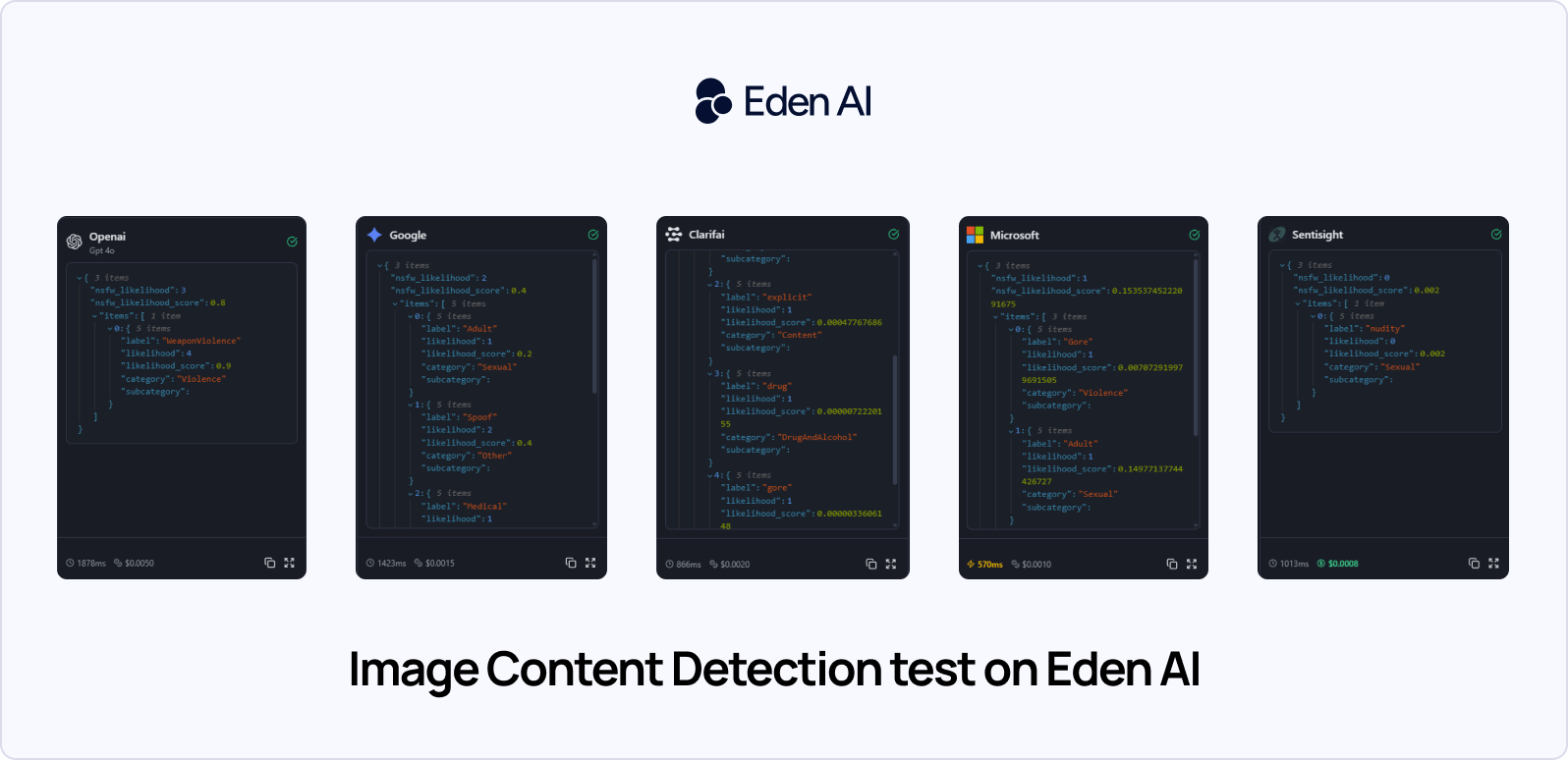
We split the work in two. For the providers available through Eden AI, we ran the same image moderation request across all of them and compared how each API behaves on identical inputs: response structure, latency, cost, and signal clarity. For the others, we worked from public documentation, pricing pages, and the output formats each vendor publishes. We say which is which in the table above, because a comparison you cannot reproduce is not worth much.
Some APIs return simple likelihood scores, others provide detailed categories (nudity, violence, drugs), while a few expose more structured outputs that are easier to plug into real moderation logic. We also observed variations in response time, pricing per call, and how usable the outputs are without additional processing.
Top 10 Explicit Content Detection APIs in 2026
Below is an in-depth breakdown of the leading explicit content detection APIs available today. We focus on analysing what actually matters in production for developers: what the API does best, its pros and cons, its best use case and pricing.
Azure AI Content Safety
Azure AI Content Safety is a strong choice for teams already operating within the Microsoft ecosystem and looking for a unified approach to text and image moderation. It provides structured outputs with severity levels, making it easier to build policy-driven moderation logic rather than relying on simple binary decisions.
From a developer perspective, it integrates smoothly with Azure services and offers tooling (like Foundry/Studio) to test, tune, and review moderation workflows. However, it can feel heavier if used as a standalone moderation API outside the Azure stack.
Pros:
- Native integration within Azure ecosystem
- Structured outputs with severity levels
- Built-in tools for testing and workflow setup
Cons: Less lightweight for simple use cases
Best For: Enterprise applications already on Azure that need moderation as part of a broader AI and governance strategy.
Pricing: Usage-based pricing (varies depending on region and volume).
Google Cloud Vision SafeSearch
Google SafeSearch is one of the fastest ways to add basic explicit content detection to a product. It focuses on image moderation and returns simple likelihood scores across key categories like adult, violence, and racy content, making it easy to plug into decision logic without heavy processing. It's particularly well-suited for MVPs or as a first filtering layer before applying stricter rules or human review.
Pros:
- Extremely easy to integrate and use
- Reliable baseline accuracy for image moderation
- Well-documented with fast time-to-value
Cons:
- Limited customization and control
- Image-only (no video or text moderation)
- Costs can increase quickly at scale
Best For: Quick image moderation setups, MVPs, or as a first-pass filter before more advanced moderation systems.
Pricing: Pay-as-you-go, with 1,000 free units per month, then billed per request.
Sentisight
Sentisight is the cheapest way to add explicit content detection to a product, and it is the one most teams have never heard of. It returns a straightforward NSFW classification and costs a fraction of the big three cloud vendors, which makes it a good default for high volume filtering where you mostly need a first pass before anything reaches a human.
The trade-off is scope. It does one thing, there is no video, no text, no workflow layer, and it is served from Asia Pacific, which matters if your data residency policy is strict.
Pros:
- Cheapest per-image price of the providers we tested
- Simple, predictable output that needs no post-processing
- Fast to integrate
Cons:
- Image only
- No moderation workflow, dashboard or human review
- Served from Asia Pacific, which can be a blocker for EU data residency
Best For: High volume first-pass filtering where cost per image is the constraint and a specialist workflow is not needed.
Pricing: $0.75 per 1,000 images through Eden AI.
Amazon Rekognition Content Moderation
Amazon Rekognition is a solid choice for teams already building on AWS and needing both image and video moderation at scale. It provides a wide set of moderation labels and integrates naturally with other AWS services, making it easy to embed into existing pipelines.
Pros:
- Supports both image and video moderation
- Strong integration with AWS ecosystem
- Human-in-the-loop workflows with Amazon A2I
Cons:
- Output structure can be complex and harder to interpret
- Requires extra logic to translate labels into decisions
Best For: AWS-native products that need scalable moderation with optional human review, especially for image and video content.
Pricing: Pay-as-you-go with no minimum commitment. Typical pricing includes around $0.001 per image and $0.10 per minute of video (usage-dependent).
Sightengine
Sightengine stands out as a moderation-first API, built specifically for content filtering rather than general computer vision. It supports image, video, text, and real-time moderation, with outputs designed to plug directly into moderation workflows.
Unlike general-purpose APIs, Sightengine focuses on practical moderation needs: fine-grained categories, real-time analysis, and rule-based filtering.
Pros:
- Easy to integrate with clear, usable outputs
- Supports real-time and multi-modal moderation
- Strong focus on operational workflows
Cons:
- Less relevant if moderation is not a core part of your product
- More specialized, less flexible outside moderation use cases
Best For: UGC-heavy platforms (social apps, marketplaces, communities) where moderation needs to be fast, reliable, and deeply integrated into the product.
Pricing: Starts at $29/month for 10,000 operations, with usage-based overage pricing. Plans are designed specifically around moderation workloads.
Hive Moderation
Hive is built for teams that need moderation at scale across multiple content types, including images, text, audio, and video. It goes beyond simple detection by offering a full moderation suite with detailed classification models and a dashboard for review, escalation, and policy management.
Pros:
- Multi-modal moderation (image, video, text, audio)
- Dashboard for review, escalation, and workflow management
- Large set of detailed moderation classes
Cons:
- More complex to integrate and operate
- Less suited for simple or early-stage use cases
- Limited self-serve access at higher volumes
Best For: Large-scale platforms with dedicated trust & safety needs, where moderation spans multiple content types and requires structured workflows.
Pricing: Usage-based pricing. Visual moderation starts around $3.00 per 1,000 requests on the self-serve tier, with higher limits available via enterprise plans.
WebPurify
WebPurify focuses on hybrid moderation, combining automated AI detection with human review. This makes it particularly useful in scenarios where context matters and fully automated systems are not enough to make reliable decisions.
From a developer perspective, integration is straightforward, and the ability to escalate content to human moderators adds an extra layer of safety. The trade-off is slower response times and higher costs when human review is involved.
Pros:
- Combines AI moderation with human review
- Strong support for edge cases and nuanced decisions
Cons:
- Costs increase with manual review usage
- Less suited for real-time-only pipelines
Best For: Platforms like marketplaces, dating apps, or communities where edge cases require human judgment and moderation accuracy is critical.
Pricing: Around $0.0026 per image for automated moderation, $0.02 per image for human review, and ~$0.15 per minute for video moderation.
Imagga
Imagga takes the opposite bet from most of this list: it will run inside your own infrastructure. Its adult content model returns three levels, safe, suggestive and explicit, on images and short videos.
That on-premise option is the reason to look at it. If your compliance position is that user uploads must never leave your network, every hosted API in this comparison is disqualified, and the usual fallback is an open-source model you maintain yourself. Imagga sits between the two.
Pros:
- On-premise deployment, so images never leave your infrastructure
- Three clear levels, safe, suggestive and explicit, easy to threshold
- Handles short video as well as images
- Publishes its accuracy figures, 98% recall on explicit content and 92.5% overall, which most vendors do not
Cons:
- Those accuracy figures are the vendor’s own, measured on its own set
- No pricing published for the on-premise option
- Narrower than the trust and safety platforms, no dashboard and no human review
Best For: Teams whose compliance position rules out sending user uploads to a hosted API, and who do not want to maintain an open-source model themselves.
Pricing: Usage-based on the hosted API, custom quote for on-premise.
API4AI NSFW
API4AI is designed for simplicity: a focused NSFW image detection API that's easy to integrate and quick to deploy. It classifies images for explicit content without adding unnecessary complexity.
This makes it a strong option for developers who want to ship fast and don't need advanced moderation workflows or multi-modal support.
Pros:
- Very simple and fast to integrate
- Clear, focused NSFW detection
- Predictable and affordable pricing
Cons:
- Image-only (no video or text moderation)
- Limited customization and workflow capabilities
- Not suited for complex moderation systems
Best For: Lightweight use cases where you need a quick, reliable NSFW filter without building a full moderation pipeline.
Pricing: Starts at $8/month for 10,000 images, with ~$0.00075 per additional image and adjustable strictness levels.
OpenAI GPT-4o
GPT-4o is a different approach to the same problem. Instead of a fixed classifier that returns preset categories, you describe your policy in the prompt and a multimodal model applies it. That matters when your rules do not map onto anyone's standard taxonomy: a marketplace banning weapon listings, a kids' product with a stricter bar than the industry default, a platform that needs to explain in writing why something was blocked.
The cost is the obvious catch. It is roughly twenty times a dedicated classifier per image, and latency is higher. It earns its place on the borderline cases, not on the whole stream.
Pros:
- Policy defined in plain language, no retraining and no fixed taxonomy
- Can return a reason, not just a score, which helps with appeals and audit
- Handles context that classifiers miss
Cons:
- Around twenty times the cost of a dedicated classifier per image
- Higher and less predictable latency
- Non-deterministic, so two identical calls can differ
Best For: The borderline tier of a moderation pipeline, after a cheap classifier has filtered the obvious cases, or any policy that does not fit a standard category list.
Pricing: $24.00 per 1,000 images through Eden AI.
How to Choose the Best Explicit Content Detection API
Developers should choose the best explicit content detection API according to your content type, product risk, and how moderation decisions are made in your system.
Match the API to your content
Teams should define what you actually need to moderate before comparing providers because not all APIs support the same modalities. You should identify your usual inputs like images, videos, live streams or mixed contents because choosing an API that doesn't match your inputs will create limitations later.
Evaluate the output
Developers need to choose the API whose output maps directly to your moderation decisions rather than just accuracy. Your team can consider usable signals such as categories, confidence scores and severity levels.
Choose the API with workflow not just API calls
Developers should think in terms of workflows: threshold tuning, flagging vs blocking, and sometimes human review for edge cases because in production, moderation is more than just detecting content.
Test on your data
Your team must run a test on several APIs with your real user content, memes, low-quality images, and borderline cases. This test will quickly reveal the limits of each API and help you choose the best API for your use case.
Choose based on risk level, not features
Ultimately, the right choice depends on your risk level. A simple API like Sentisight or API4AI is often enough for low-risk use cases, while platforms handling large volumes of user-generated content, such as marketplaces and social apps, will need more advanced systems like Amazon Rekognition, Sightengine or Hive, with fine-grained control and escalation mechanisms.
FAQ - Explicit Content Detection APIs
An explicit content detection API is a tool that automatically analyzes images, videos, text, or other media to identify unsafe, adult, violent, or inappropriate content. Developers use these APIs to moderate user-generated content, protect platforms from harmful material, and enforce content policies at scale.
The best explicit content detection API depends on the type of content you need to moderate. Google Cloud Vision and Amazon Rekognition are strong options for image and video moderation, while providers such as Hive, Sightengine, and Imagga offer more specialized moderation features. Eden AI lets developers compare several providers through one unified API.
Explicit content detection APIs use AI models to scan content and classify it into categories such as adult content, nudity, violence, hate symbols, or suggestive material. The API usually returns labels, confidence scores, and severity levels that developers can use to automatically approve, flag, or block content.
Using an explicit content detection API helps platforms moderate content faster and more consistently than manual review alone. It is especially useful for marketplaces, social platforms, dating apps, gaming communities, and media platforms that handle large volumes of user-generated content.
Yes, some explicit content detection APIs can moderate videos by analyzing frames, scenes, or timestamps to detect inappropriate visual content. Providers such as Amazon Rekognition, Hive, and other moderation-focused APIs can help identify unsafe content in video files, although pricing and processing time may vary by provider.
Developers should compare accuracy, supported content types, moderation categories, latency, pricing, confidence scores, and ease of integration. They should also consider whether the provider supports their specific policy needs, such as detecting nudity, violence, weapons, drugs, or hate symbols.
Inappropriate image detection is the automated process of analyzing images using machine learning to identify content that violates platform policies, including nudity, sexual content, violence, hate symbols, and drug-related imagery. APIs handle this at scale by returning a confidence score for each category, allowing teams to set thresholds and route content without reviewing every image manually.
They overlap but are not identical. NSFW, meaning “Not Safe for Work,” detection typically focuses on sexual and explicit content. Inappropriate image detection is broader and can also flag violence, self-harm, weapons, and hate symbols. Most modern APIs cover both through a single content moderation endpoint.