Summarize this article with:
In 2026, GitHub Copilot and Claude both moved toward usage-based billing, so the licenses-vs-tokens question has quietly answered itself. Here is what an AI coding seat really costs today, what I hear from engineering teams, and why the smartest move is to stay flexible.
Seat licenses, AI credits, tokens: the pricing of AI coding tools changed more in 2026 than in the three years before. Here is how to choose without locking yourself in.
Over the past few weeks, I have had almost the same conversation with a Swiss healthcare group, a French EdTech company, a 500-person industrial company and a media group. They don't know each other, they don't work in the same industry, but they all asked me the same question: should we keep paying GitHub Copilot or Claude Code licenses per developer, or switch to tokens?
It is a fair question. AI coding has moved from autocomplete to agents that read whole repositories, run tests and open pull requests. Consumption now varies enormously from one developer to the next, new models arrive every month, and finance teams have started asking a question nobody can answer: how much does AI cost us per project?
Here is what I tell them, with the numbers as they stand today.
In six months, the vendors answered the question themselves
The surprising part is that GitHub and Anthropic have already moved. The flat, all-you-can-eat seat is disappearing from AI coding tools.
Sources: GitHub changelog, Anthropic pricing and Claude Code documentation, checked on 23 October 2026.
GitHub announced that all Copilot plans moved to usage-based billing on 1 June 2026. Premium requests were replaced by GitHub AI Credits, consumption is calculated on input, output and cached tokens, and paid plans can buy extra usage. Copilot code review now also consumes GitHub Actions minutes, a cost that rarely shows up in the initial budget.
On Anthropic's side, Claude Enterprise now combines a seat fee with usage billed at API rates. And the Claude Code cost documentation estimates that enterprise deployments average around $13 per developer per active day, or $150 to $250 per developer per month, with 90% of users staying under $30 a day. According to Business Insider, archived versions of that page showed $6 per day until mid-April. The estimate doubled in a few months.
In other words, a license is no longer a flat fee. It is an access right plus a token meter. The real question has shifted.
What an AI coding seat really costs in 2026
| Option | List price | What is included | What to watch |
|---|---|---|---|
| GitHub Copilot Business | $19 per user per month | $19 of AI Credits per user | Extra usage billed on tokens; code review uses Actions minutes |
| GitHub Copilot Enterprise | $39 per user per month | $39 of AI Credits per user | Requires GitHub Enterprise Cloud |
| Claude Team | Standard: $20 (annual) or $25 (monthly). Premium: $100 or $125 | Claude access with plan usage limits | 5 to 150 seats; Claude Code usage depends on the seat type |
| Claude Enterprise | From $20 per seat per month | Access, admin and security controls | Usage billed on top at API rates |
| Tokens through Eden AI | Provider price, no markup, 5.5% platform fee | Hundreds of models, one key, one invoice | Needs budgets and limits to stay predictable |
Sources: GitHub, GitHub Docs, Claude pricing, Claude Code documentation and Eden AI pricing.
The gap between the price on the pricing page and the cost on the invoice is where most teams get surprised. Quesma, which sells into engineering teams, reports that every company it spoke with that moved from seats to token-billed Enterprise saw its bill at least double, and cites Uber exhausting its 2026 AI coding budget by April. Those are third-party reports, not official figures, but they match what I hear.
What I hear from engineering teams
A few stories from recent conversations, anonymized:
- The Swiss healthcare group has around 160 Copilot users out of roughly 300 GitHub accounts, and its AI consumption grows by 10 to 25% a month. Their questions were not about the license price. They wanted one invoice, the cost per project, routing that stays in Europe, and a way to keep patient data out of prompts.
- The French EdTech company found that Copilot was barely used and is about to drop it. Its twenty developers already test tokens through an aggregator, with a monthly budget they control.
- The 500-person industrial company runs developers on OpenCode and business teams on Open WebUI. Their idea: offer internal "Standard" and "Pro" presets, and let IT change the model behind each preset without anyone reconfiguring their laptop.
- The media group has 100 Copilot licenses for around 1,000 potential users. It wants to scale AI to everyone without multiplying licenses by ten.
Different companies, same pattern: the license price is never the real problem. Visibility, control and the freedom to change are.
Licenses vs tokens: the honest comparison
Where licenses still win. A seat is simple to buy, the experience is well integrated, and for a small team with light, homogeneous usage, it is often the cheapest option. For a single developer who codes with agents all day, a flat individual subscription can also cost far less than the same volume at API prices. If that is your situation, keep it.
Where tokens win. You pay for real usage, not for empty seats. You choose the model for each task instead of the vendor's list. You can use open-source tools such as Cline or OpenCode. And you can attribute every dollar to a team, a repository or a project.
The catch. Tokens without governance are unpredictable. Ten API keys, five invoices and no budget alerts is not flexibility, it is chaos. That is why the real choice is not licenses or tokens. It is governed tokens or ungoverned ones.
The real risk is lock-in: stay flexible
Three major pricing changes in six months. A best model for coding that is rarely the same from one quarter to the next. A contract signed in January that no longer matches reality in October. In this market, the most expensive decision is the one you cannot undo.
Staying flexible means keeping four doors open:
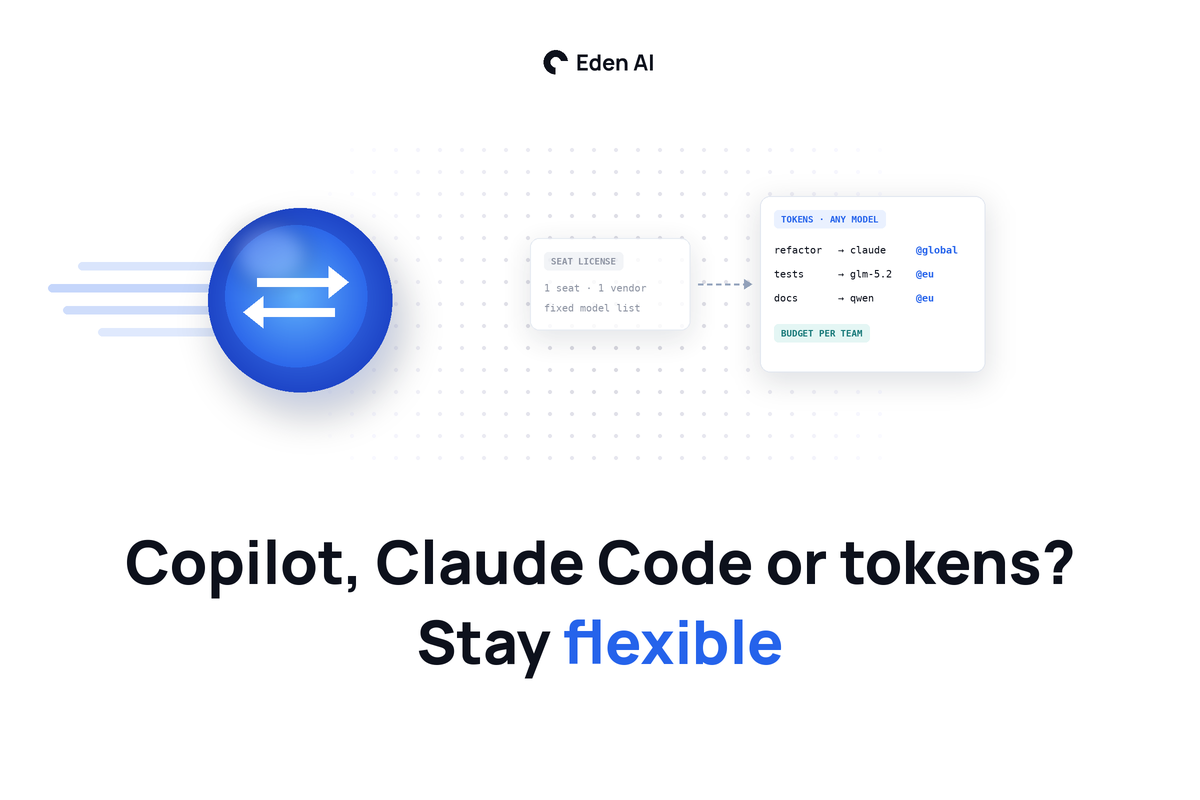
- The model: switch models by task, price or benchmark without touching developers' machines.
- The tool: let each developer keep Claude Code, Cline, OpenCode or Codex CLI.
- The provider: when a provider goes down, rate-limits you or raises prices, route elsewhere.
- The contract: no annual commitment per seat; pay for what you use and adjust every month.
Change the model behind the gateway, not the tool on every laptop.
Cheaper models, hosted in Europe
Model choice is where tokens pay off most visibly. Not every coding task needs a frontier model. Architecture decisions and complex refactors deserve the best model available. Writing unit tests, docstrings or small fixes often does not.
List prices checked on 23 October 2026. Output tokens dominate agentic coding costs: on output, GLM-5.2 is about 3.4 times cheaper. Quality varies by task; test on your own codebase.
On Eden AI, GLM-5.2 from Zhipu costs around $1.40 per million input tokens and $4.40 per million output tokens, against $3 and $15 for Anthropic's latest Sonnet. DeepSeek and Qwen models offer a similar trade-off. Routing routine tasks to these models and keeping a frontier model for the hard ones can cut the bill significantly.
The usual objection is data: "we can't send our code to a Chinese model." It helps to separate two things: who trained the model weights, and where inference runs. On Eden AI's EU endpoint, requests are hosted, processed and routed in Europe, by European providers when you choose them, and a model that cannot run in the EU is simply not available there. Several of the teams I spoke with asked specifically for GLM and DeepSeek hosted in Europe.
Two honest caveats. Public benchmarks do not replace a test on your own repository. And some legal teams remain cautious about these models even when they are hosted in Europe. Ask them early.
How we approach it at Eden AI
We built Eden AI's gateway around exactly these conversations:
- No markup on provider prices, with a transparent 5.5% platform fee on the self-serve plan.
- Your developers keep their tools. We have setup guides for Claude Code, Cline, OpenCode and Codex CLI. With Claude Code, for example, you can switch between Claude, GPT or Gemini without reinstalling anything.
- Budgets that make tokens predictable: budget caps per API key, the cost of each request returned in the response, and organization management to attribute spend to a team, a client or a project.
- Resilience: automatic fallback when a provider has an incident.
- European data residency and security: a dedicated EU endpoint, no storage of prompts or outputs by default, no training on customer data, and the controls described on our security page.
A simple decision grid
- Small team, light and homogeneous usage: a Copilot Business or Claude Team seat is probably enough.
- Heavy individual users: a flat individual subscription can be very cost-effective for one person.
- Agentic, heterogeneous or multi-model usage, or sensitive data and GDPR constraints: tokens through a gateway with budgets, attribution and an EU endpoint.
- Most companies: a hybrid setup. Seats for some profiles, governed tokens for power users and projects.
Stay able to change your mind
The right question is no longer how much a license costs. It is how much you pay for what you cannot see, and how much it would cost you to change. Nobody knows which model will be best for coding in 2027. The right decision today is the one that lets you change your mind tomorrow.
If you want to see what this looks like on your own codebase, create an Eden AI account, connect Claude Code or Cline in a few minutes, and compare models on a real project. Or talk to us and we will look at your current AI coding spend together.
Frequently asked questions
Is GitHub Copilot still a flat-rate license?
No. Since 1 June 2026, every Copilot plan uses usage-based billing with GitHub AI Credits. Copilot Business costs $19 per user per month with $19 of credits included, Copilot Enterprise $39 with $39 of credits, and extra usage is billed on top.
How much does Claude Code really cost per developer?
Anthropic's documentation estimates around $13 per developer per active day in enterprise deployments, or $150 to $250 per developer per month, with 90% of users under $30 a day. Actual costs depend heavily on how intensively developers use agents.
Can I use Claude Code with models other than Claude?
Yes, through a compatible gateway. Connected to Eden AI, Claude Code can call Claude, GPT, Gemini and other models with a single API key and a single invoice.
Are Chinese models hosted in Europe GDPR-compliant?
Hosting in Europe avoids international data transfers, which helps, but compliance depends on the whole chain: gateway, provider, retention rules and contracts. Who trained the weights and where inference runs are two different questions. Have your DPO assess the full setup.
Should we drop our Copilot or Claude licenses?
Not necessarily. Licenses remain good value for light, homogeneous usage. Tokens through a governed gateway make more sense for agentic, multi-model or sensitive workloads. Most organizations end up with a mix of both.