Summarize this article with:
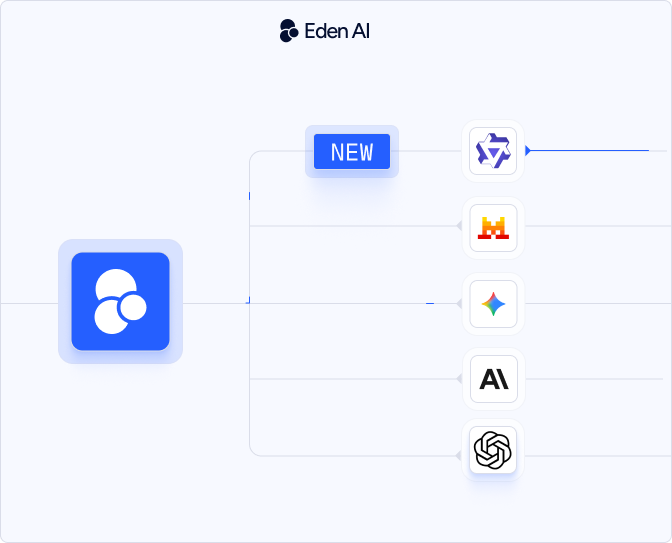
- Qwen is now available on Eden AI, giving developers access to Alibaba’s open-source LLM family through one unified API.
- Developers can use Qwen for text generation, coding, reasoning, multilingual applications, and long-context workflows.
- With Eden AI, teams can test Qwen alongside GPT, Claude, Gemini, Llama, and 500+ other models without managing separate provider accounts.
- This integration helps developers compare models faster, control usage in one place, and move from testing to production with fewer integration steps.
What Is Qwen?
Qwen is an open-source family of large language models built by Alibaba’s Qwen Team for natural language, reasoning, coding, and multilingual AI tasks.
Released under the Apache 2.0 license, Qwen includes several model variants, such as Qwen3 for general-purpose language tasks, QwQ for reasoning-focused use cases, and Qwen3-Coder for software development workflows.
The model family supports 119 languages and includes versions ranging from 0.6B to 235B parameters, giving developers options for different latency, cost, and performance requirements.
Our Interview with Qwen’s Senior Account Executive
To better understand Qwen’s role in the AI ecosystem and its integration with Eden AI, we spoke with Louis de Gouvion Saint Cyr, Senior Account Executive at Alibaba Cloud.
In this interview, he shares how Alibaba Cloud supports developers and enterprises with scalable cloud and AI infrastructure, what makes the Qwen model family relevant for multilingual, long-context, and multimodal use cases, and why making Qwen available through Eden AI helps reduce friction for teams testing and deploying AI models.
Can you introduce your company and its mission?
Qwen or Alibaba Cloud is the digital technology and intelligence backbone of Alibaba Group. Our mission is to make cloud computing and AI accessible, secure, and scalable for businesses and developers worldwide. We provide infrastructure, platform services, and pre-built AI models to help organizations innovate faster without managing complex underlying systems.
Can you go into more detail about your offering, your models, and what makes them unique?
Through DashScope API and Model Studio (Bailian), we offer the Qwen family of large language models.
Key capabilities :
- Multilingual support : Fluent in 100+ languages, with strong performance in Asian and European languages
- Long-context handling : Native support for inputs up to 256K tokens for document analysis or extended conversations
- Multimodal reasoning : Integrated vision-language understanding for charts, diagrams, and screenshots
- Developer flexibility : REST API, SDKs, private deployment options, and fine-tuning tools
- Enterprise readiness: Data encryption, VPC isolation, and compliance with GDPR, ISO, and regional standards
What sets Qwen apart is its balance of performance, cost efficiency, and adaptability across technical and business use cases, backed by infrastructure proven at Alibaba Group scale.
Who are your target users or customers?
- Developers & startups building multilingual chatbots, content tools, or code assistants
- Enterprises modernizing customer support, internal knowledge systems, or data workflows
- ISVs & SaaS providers embedding AI features via API with predictable pricing
- Teams in EMEA, APAC, and emerging markets seeking local technical support and low-latency inference
We prioritize use cases where reliability, language coverage, and total cost of ownership matter.
What led you to integrate with Eden AI?
Eden AI's aggregator model aligns with how many developers evaluate and adopt AI services: compare, test, and switch providers without re-architecting. By integrating with Eden AI, we make Qwen models more discoverable and easier to prototype with, while letting developers leverage Alibaba Cloud's scale when they're ready to productionize. It's a practical step toward reducing friction in the AI adoption journey.
.png)
What’s next for your company? What are your future plans or vision?
We are focused on three areas :
- Model efficiency : Smaller, faster variants for edge and cost-sensitive deployments
- Vertical solutions : Pre-configured workflows for retail, finance, and logistics
- Developer experience : Enhanced tooling for evaluation, monitoring, and iterative fine-tuning
Long-term, we aim to support responsible AI adoption globally, making powerful models accessible while maintaining security, transparency, and developer control.
Which Qwen Models Are Available on Eden AI?
Eden AI provides access to 40 Qwen models across text generation, coding, vision, audio, and translation. The table below focuses on the text and chat models, helping developers compare context length, pricing, and the best use cases for each option.
Why Use Qwen?
- Open-source licensing: Qwen models are released under the Apache 2.0 license, which allows free commercial use, modification, and deployment.
- Coding benchmark performance: Qwen3-Coder scores 77.2 on SWE-bench Verified, a benchmark used to evaluate software engineering and code-fixing capabilities.
- Multilingual coverage: Qwen supports 119 languages, making it usable for applications that need to process or generate content across different markets.
- Flexible reasoning modes: Qwen3 supports hybrid thinking and non-thinking modes, so developers can choose between faster responses or deeper reasoning depending on the task.
- Competitive pricing: Qwen models are available from $0.01 per million tokens, giving teams a low-cost option for high-volume AI workloads.
Why Access Qwen Through Eden AI?
Using Qwen through Eden AI means you do not need an Alibaba Cloud account. You can access Qwen directly with your existing Eden AI API key and keep the same integration setup.
With Eden AI’s unified API, you can switch between Qwen, GPT, Claude, Gemini, Llama, and 500+ other models without rebuilding separate provider integrations. This is useful for teams comparing models on accuracy, latency, cost, or language coverage before choosing one.
Eden AI also includes fallback routing, so if one model is unavailable, requests can be automatically redirected to another model. Usage tracking, billing, and rate limits are centralized across all models, giving technical teams a clearer view of their AI usage.
How to Get Started with Qwen on Eden AI
You can start using Qwen on Eden AI by creating an account, generating an API key, and calling a Qwen model through Eden AI’s unified API.
- Create an Eden AI account
- Get your API key: Open your Eden AI dashboard and copy your API key.
- Call a Qwen model through Eden AI: Use Eden AI’s OpenAI-compatible API format to send a request to a Qwen3 model.
from openai import OpenAI
import os

client = OpenAI(
    api_key=os.getenv("EDENAI_API_KEY"),
    base_url="https://api.edenai.run/v3"
)

response = client.chat.completions.create(
    model="qwen3-max",
    messages=[
        {
            "role": "system",
            "content": "You are a helpful assistant for developers."
        },
        {
            "role": "user",
            "content": "Explain how to choose the right Qwen model for a coding task."
        }
    ],
    temperature=0.3,
    max_tokens=500
)

print(response.choices[0].message.content)

.jpg)