.png)
Summarize this article with:
Why OpenClaw Depends on LLMs
At its core, OpenClaw is not an intelligence engine by itself: OpenClaw is an orchestration layer designed to coordinate tasks, workflows, and agents. The real “thinking” is delegated to Large Language Models (LLMs), which handle reasoning, generation, and decision-making.
Without LLMs, OpenClaw cannot:
- interpret user intent
- generate outputs
- make autonomous decisions
This creates a hidden dependency: your entire OpenClaw performance is only as strong as the LLM behind it. If your LLM underperforms, is expensive, slow, or unavailable, your entire system inherits those limitations.
Why You Should Avoid Connecting OpenClaw to a Single LLM Provider
At first glance, using a single LLM provider may seem simpler. But in practice, it quickly becomes a limitation as soon as you move beyond testing.
Here’s the real difference:
Reduce Costs Strategically
LLM pricing varies significantly depending on token usage, latency, and task complexity. If you rely on a single premium model for everything, you often end up overpaying.
A multi-LLM setup allows you to:
- use lightweight models for simple tasks
- reserve advanced models for complex reasoning
This leads to one key advantage: You only pay for the level of intelligence you actually need.
Improve Output Quality Per Use Case
No LLM dominates every task. Some are better at reasoning, others at structured data extraction, and others at conversational interactions. By combining multiple models, you can:
- assign the best model to each task
- improve consistency and accuracy of outputs
Which leads to a critical insight: The best results don’t come from one model, but from choosing the right model at the right time.
Ensure Reliability in Production
One of the biggest risks in production is depending on a single provider. Issues like API outages, rate limits, or performance degradation can directly impact your application.
With a multi-LLM strategy, you can:
- implement fallback systems
- maintain consistent uptime
- deliver a stable user experience
This transforms your system from fragile to resilient: You remove the single point of failure and gain full control over availability.
What Is an AI Gateway and What Is It Used For?
An AI gateway is a unified API layer that allows developers to access and manage multiple AI models through a single integration. Instead of connecting OpenClaw (or any system) to different providers one by one, the gateway centralizes everything: API access, billing, model routing, and scalability.
A Unified API with OpenAI-Compatible Format
One of the biggest challenges when working with multiple AI providers is the lack of standardization. Each provider comes with its own request formats, authentication methods, and response structures, which quickly adds complexity to your stack.
An AI gateway removes this friction by introducing a single, standardized interface, often compatible with OpenAI formats. This means you can interact with different models using the same structure, without rewriting your integration each time.
One Billing System, One API Key
Managing multiple AI providers independently can quickly become operationally heavy: multiple invoices, scattered API keys, and limited visibility over usage.
An AI gateway simplifies this by consolidating everything into:
- one API key
- one billing system
- centralized usage monitoring
This isn’t just about convenience. It directly impacts how teams operate at scale.
Continuous Model Evolution Without Friction
The AI ecosystem evolves at a rapid pace. New models are released frequently, pricing shifts, and performance improvements can quickly make previous choices obsolete.
Without an AI gateway, adapting to these changes requires:
- new integrations
- code updates
- repeated testing cycles
With an AI gateway, this becomes seamless. You gain the ability to:
- access new models instantly
- switch or compare models easily
- keep your stack up to date without heavy engineering effort
Why Choose Eden AI Over Other AI Gateways?
When teams evaluate an AI gateway, the focus is often on the number of models available. But in real production environments, that’s rarely the deciding factor. What actually matters is how much control you have over performance, costs, reliability, and scalability.
This is where Eden AI stands out: not just as another gateway, but as a complete infrastructure layer for managing AI in production.
More than 500 LLMs, and even more
Most AI gateways limit their scope to Large Language Models. Eden AI takes a broader approach by giving access to multiple AI capabilities through a single API.
This includes not only LLMs for text generation and reasoning, but also:
- OCR and document parsing
- speech-to-text and text-to-speech
- image analysis and detection
Smart Routing: Fallback & Optimization
In production, choosing a single model is rarely optimal. Performance, cost, and latency vary depending on the task and context. Eden AI introduces advanced routing capabilities that change how decisions are made:
- automatic fallback systems when a provider fails
- smart routing to select the best model per request
This leads to a fundamental shift: You no longer choose one model, you continuously use the best model available. The impact is immediate:
- reduced downtime
- optimized cost per request
- better output quality over time
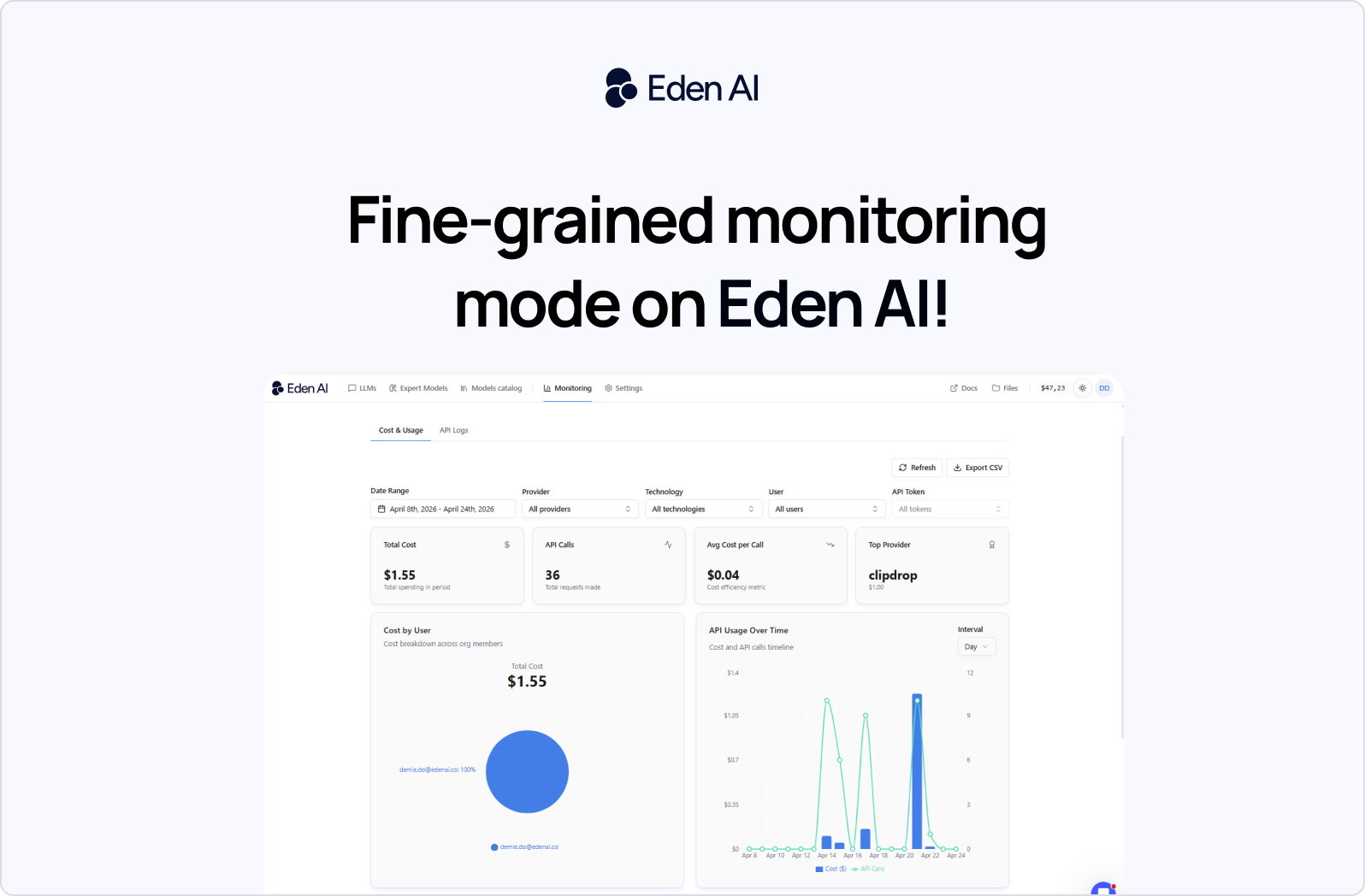
Granular Monitoring: From Black Box to Full Visibility
Running AI in production without visibility is a common mistake. Many platforms provide only high-level metrics, making it difficult to understand what’s really happening.
Eden AI offers fine-grained monitoring at the agent and workflow level, with detailed logs for every request. You can track:
- costs
- latency
- performance
Developers can identify inefficiencies, debug faster, and continuously optimize your workflows based on real data. Instead of guessing, you operate with clarity.
Data Security, GDPR & Governance Built-In
For many companies, especially in Europe, data privacy is not optional. It’s a requirement. Eden AI is designed with strong data governance and GDPR-ready infrastructure, ensuring that sensitive data is handled properly across all AI providers. Eden AI provides:
- better control over how data is processed
- compliance with European regulations
- safer handling of sensitive information
This is essential for enterprise use cases and any application dealing with regulated data.
A Lightweight Pricing Model That Scales With You
One of the biggest barriers to adopting AI at scale is pricing rigidity. Many platforms require subscriptions or long-term commitments, even during experimentation. With Eden AI:
- no subscription
- no commitment
- pay only for what you use
This creates a clear advantage: Your costs scale with your actual usage, not with assumptions or upfront commitments. It’s particularly valuable for startups and teams transitioning from prototype to production, where flexibility is key.
How to Connect OpenClaw to Multiple LLMs through Eden AI
To make your OpenClaw setup production-ready, you can connect it to multiple LLMs through Eden AI, which provides a unified API to access and orchestrate different providers without managing multiple integrations.
Instead of relying on a single model, you can route requests dynamically, optimize cost and performance, and add fallback mechanisms directly within your OpenClaw workflows.
Access a step-by-step implementation and ready-to-use code examples here: Github
Watch the full setup tutorial and see how multi-LLM routing works in practice:
FAQ: Connect OpenClaw to Multiple AI Models
Why does OpenClaw depend on LLMs?
OpenClaw acts as a layer that organizes tasks, but it cannot interpret user intent or generate outputs on its own. LLMs are responsible for:
- understanding prompts
- generating responses
- making decisions within workflows
This makes LLM selection a critical factor in your system’s performance, cost, and reliability.
Why should you use an AI gateway with OpenClaw?
Using an AI gateway removes the complexity of integrating and managing multiple LLM providers individually. It allows you to:
- switch between models easily
- optimize cost and performance
- avoid vendor lock-in
Is it better to use one or multiple LLM providers?
Using multiple LLM providers is generally more effective in production. It allows you to route tasks dynamically and choose the best model based on cost, speed, or quality. A single provider limits your system, while a multi-LLM strategy gives you control and optimization opportunities.
What makes Eden AI different from other AI gateways?
Eden AI goes beyond standard gateways by offering:
- access to multiple AI types (LLMs, OCR, speech, vision)
- smart routing and fallback systems
- granular monitoring per agent and workflow
- GDPR-ready data governance
- pay-as-you-go pricing with no commitment
It’s designed for teams that want full control over performance, cost, and scalability, not just model access.