.png)
Summarize this article with:
A resume parser API converts CV files into structured fields such as contact details, work history, education, skills, and job titles, so applications can be searched, scored, or stored without manual data entry.
- Affinda: A practical choice for teams that need recruitment workflow features around the parser, not extraction alone.
- Textkernel: Designed for enterprise multilingual parsing at scale, with broader talent data and matching capabilities.
- Superparser: Suited to smaller teams that want transparent published pricing and a straightforward API.
- Cost: Published self-serve rates land roughly between $40 and $200 per 1,000 CVs in 2026, while several enterprise vendors publish no pricing.
- What matters most: Choose based on input quality, especially the share of scanned versus digital-native CVs, and whether you need extraction only or candidate-to-job matching too.
Best Resume Parser APIs in 2026 at a Glance
Resume parser pricing is published in incompatible units, including per page, per parse, per credit, and per month. The table below normalizes available rates into an approximate cost per 1,000 CVs. Per-page pricing is not per-CV pricing. A parser priced at $0.20 per page costs roughly $0.40 for a typical two-page CV, although the real figure depends on your document mix and average CV length.
Resume Parser API vs. Resume Data API vs. CV Parsing Software
What a resume parser API does
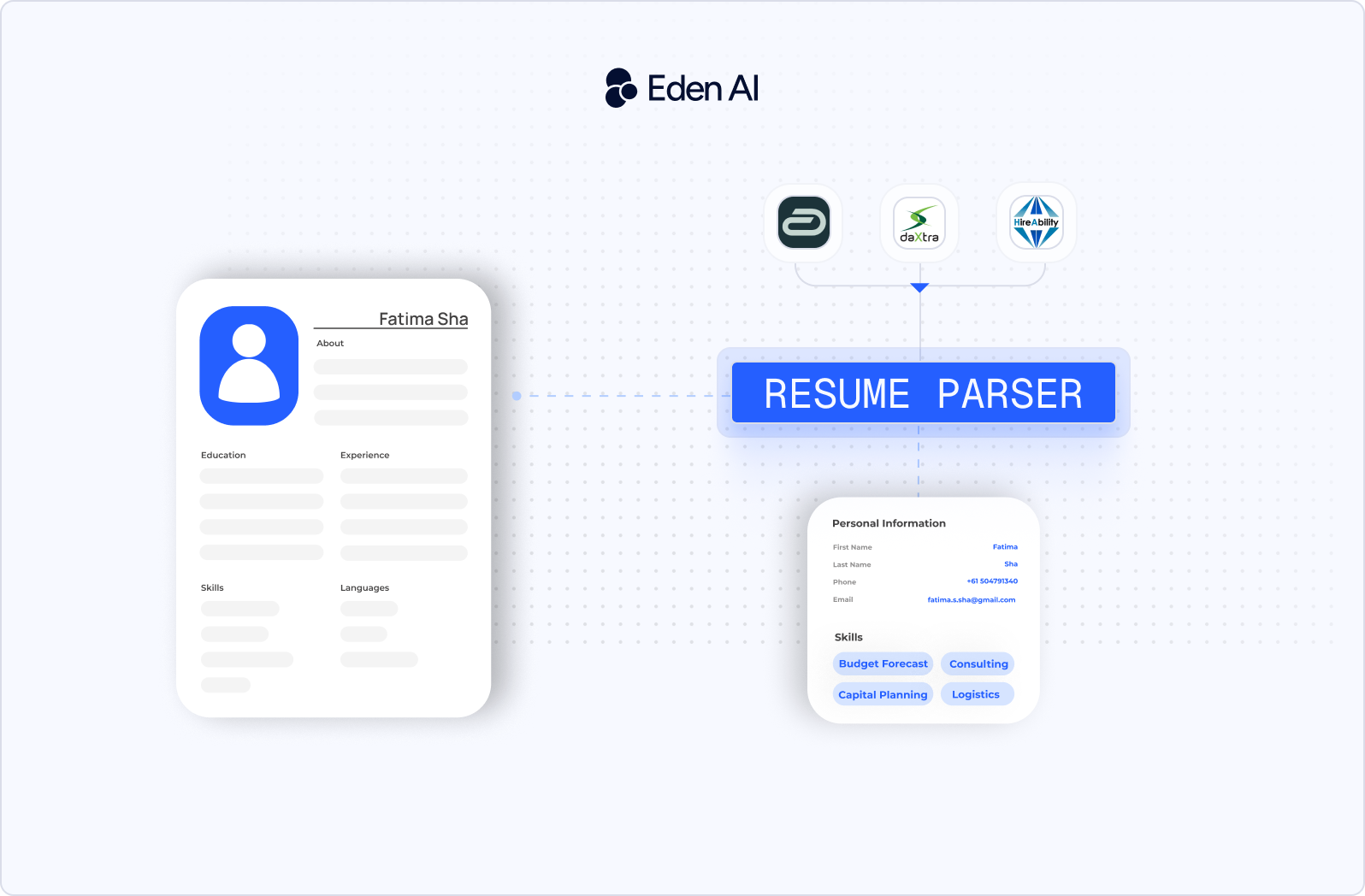
A resume parser API is an endpoint, not a finished product. Your application sends a CV file through an HTTP request, and the API returns structured data, usually as JSON. The response can include contact details, employment history, education, skills, certifications, languages, and other fields extracted from the document.
There is no dashboard for recruiters and no interface for reviewing candidates. Your engineers decide where the file comes from, how the response is validated, and what happens to the extracted data. It might be stored in an ATS, used to populate a candidate profile, or passed into a matching system.
The terms CV parser API and CV parsing API describe the same category. The wording changes by region, but the underlying function is identical: converting an unstructured resume or CV into structured fields that another application can use.
What people mean by "resume data API"
A resume data API usually describes the same category from the output side. Instead of focusing on the act of parsing a document, the phrase focuses on accessing structured resume data through an API. In most searches, the user still wants to upload a CV and receive normalized fields in return.
Some vendors use resume data API more broadly. Their products may include resume parsing plus endpoints for comparing a candidate against a job description, generating a match score, identifying missing skills, or mapping raw skill names to a searchable taxonomy. These additional endpoints can reduce the amount of logic your team must build after extraction.
The distinction matters when comparing providers. One API may return only the text found in the CV, while another normalizes job titles, dates, locations, and skills for search or ranking. If someone is looking for a resume data API, they usually need a parsing API, possibly with a matching or enrichment endpoint attached.
When you want CV parsing software instead
CV parsing software is a finished application with a user interface. An HR or recruiting team logs into a dashboard, uploads CVs, reviews the extracted fields, and may export the results or move candidates through a recruitment workflow. Resume parsing software may also include search, duplicate detection, redaction, screening, and ATS synchronization.
An API has no interface and requires engineering work. In return, it gives your team control over the output, validation rules, user experience, and downstream workflow. It is the better shape when parsing must be embedded into your own ATS, job board, HR platform, or internal tool.
If nobody on the team writes code, an API is the wrong shape. Look for parsing software instead, or check whether your existing ATS already includes CV parsing. The rest of this guide covers APIs, because that is where the meaningful accuracy and pricing differences sit.
How We Evaluated Best Resume Parser APIs
We first evaluated these resume parser APIs through tests on Eden AI, comparing latency, cost, and output quality, including accuracy and data depth. We then assessed each API based on its real-world performance in recruitment workflows, going beyond vendor claims. Our evaluation focused on the following key criteria:
- OCR & input robustness: Ability to handle scanned resumes, images, and poorly formatted documents
- Multilingual support: Coverage and consistency across multiple languages and international CV formats
- Workflow capabilities: Features beyond parsing such as matching, screening, search, or recruitment automation
- Developer experience: Ease of integration, API clarity, documentation quality, and long-term maintainability
- Real-world validation: Presence of user reviews, market adoption, and overall product maturity

The 12 Best Resume Parser APIs in 2026
The 12 best resume parser APIs in 2026 are Affinda, Textkernel, RChilli, Daxtra, HireAbility, Klippa, Hirize, Superparser, CVParser AI, SenseLoaf, OpenAI GPT-4o, and Extracta.
1. Affinda: Best for recruitment workflows beyond parsing
Affinda extends beyond CV field extraction into job description parsing, candidate search and match, CV redaction, and automated summaries. It suits product teams that want one vendor to cover several recruitment data tasks and need capacity for high document volumes. A 14-day free trial and published per-page rate make initial budgeting easier than with most enterprise competitors.
Strengths: Broad recruitment feature set beyond parsing; supports high-volume processing; publishes a pay-as-you-go rate; offers a 14-day free trial; can reduce the number of separate recruitment APIs a team must connect and maintain.
Limitations: Per-page billing means cost changes with CV length; detailed pricing for individual features still requires sales contact; reviewers report a learning curve when configuring the wider platform; teams needing extraction alone may find the surrounding feature set unnecessary.
2. Textkernel: Best for enterprise multilingual parsing
Textkernel provides an extraction engine used across much of the HR technology market. Its 2021 acquisition of Sovren expanded its enterprise parsing, skills data, and labor market capabilities. It fits large platforms needing deep field extraction, taxonomy support, and multilingual processing. It is not self-serve, so it is the wrong entry point for teams wanting to start building today.
Strengths: Established enterprise parsing engine; deep field extraction; skills taxonomy and labor market data; suited to multilingual, high-volume deployments; broad relevance for large ATS, job board, and talent intelligence products.
Limitations: No public pricing or self-serve signup; evaluation must run through sales; enterprise contracts add procurement overhead; excessive for basic contact and work-history extraction; slower to evaluate when developers need immediate API access and predictable entry costs.
3. RChilli: Best for taxonomy enrichment and ATS integration
RChilli is a long-established parser used in ATS, job board, and recruitment platform integrations. Its main differentiator is enrichment: it can map a skill phrase from a CV into a structured taxonomy that supports search, filtering, and candidate ranking. That makes it more relevant for products building talent intelligence features than for teams that only need raw extraction.
Strengths: Strong ATS and job board integration focus; structured skills taxonomy; suited to large parsing volumes; enrichment supports search and ranking use cases; useful when downstream systems need normalized fields instead of the wording found in each CV.
Limitations: Product presentation follows a traditional enterprise sales model rather than modern self-serve onboarding; public reviews repeatedly mention billing and support responsiveness; fewer workflow add-ons than newer recruitment platforms; developers may need more sales involvement before assessing fit.
4. Daxtra: Best for staffing and recruitment agencies
Daxtra provides multilingual CV parsing and recruitment data tools for staffing firms, agencies, and enterprise hiring teams. Its deployment options include private cloud, which can suit organizations with stricter infrastructure or data processing requirements. Broad ATS integration coverage and a long presence in high-volume staffing make it a familiar choice for established recruitment operations.
Strengths: Designed for staffing and recruitment workflows; multilingual structured extraction; broad ATS integration coverage; private cloud deployment is available; established presence in agency environments where parsing must connect with existing recruitment systems.
Limitations: No public pricing; evaluation requires sales contact; developer onboarding is less immediate than with API-first competitors; the platform may involve more implementation work than a standalone extraction API; small product teams may find the buying process disproportionate to their needs.
5. HireAbility: Best for configurable output schemas
HireAbility focuses on configurable resume parsing for teams that need control over how extracted data is returned. It supports XML and JSON output, more than 50 languages, and private cloud deployment for organizations with stricter data requirements. It suits established HR platforms whose internal schemas or infrastructure policies do not fit a fixed, public API product.
Strengths: Configurable parsing output; supports XML and JSON; covers more than 50 languages; private cloud deployment can meet stricter hosting requirements; suitable for teams maintaining older XML integrations alongside newer JSON-based services.
Limitations: Pricing requires a quote; the public product presentation feels dated; limited self-serve material makes technical evaluation harder before a sales conversation; onboarding is less direct than with newer API-first vendors; buyers must request details that competitors expose publicly.
6. Klippa: Best for scanned and low-quality documents
Klippa approaches resume parsing from document AI rather than recruitment software. That background makes it a strong shortlist candidate when intake includes scans, mobile photos, or documents with inconsistent image quality, rather than mostly digital-native PDFs. It also offers GDPR-compliant processing and ISO-certified operations, which may matter in regulated or enterprise procurement.
Strengths: Strong fit for scanned, photographed, and low-quality documents; broader document processing capabilities; GDPR compliant; ISO certified; relevant for workflows where image cleanup and OCR quality matter as much as CV field extraction.
Limitations: CV parsing is one feature inside a wider document platform; less specialization in skills taxonomies and recruitment workflows; direct pricing is quote-based; public reviews discuss document processing broadly rather than resume parsing performance; HR-specific capabilities are less visible.
7. Hirize: Best for fast integration with matching included
Hirize is a newer API-first vendor that combines resume parsing with candidate matching and custom parser options. It targets teams that want to add both extraction and matching without assembling separate services. Published credit pricing makes initial cost modeling easier, and its positioning is better suited to fast product integration than to a long enterprise procurement process.
Strengths: API-first setup; parsing and matching are bundled; custom parser options are available; published credit pricing supports early budgeting; useful for teams that want to prototype a matching workflow without sourcing a separate ranking engine.
Limitations: Independent review coverage is limited; public product messaging spans several recruitment capabilities, leaving parser-specific depth thinly documented; enterprise-scale performance is less established than for older vendors; buyers have fewer external references for assessing long-term reliability and support quality.
8. Superparser: Best for transparent pricing at small scale
Superparser is aimed at small teams that want straightforward resume extraction without an enterprise sales process. It publishes a real free tier and monthly plans, making it easier to estimate cost before integration. Its higher-volume published plan produces the lowest normalized cost per 1,000 CVs in this comparison, based on the listed plan allowances.
Strengths: Transparent monthly pricing; genuine free tier; low normalized cost on the higher plan; approachable for small teams and early-stage products; easy to compare against an internal build because the monthly commitment and included credits are public.
Limitations: Feature depth is lighter than enterprise parsers; taxonomy and multilingual capabilities are less documented; third-party review coverage is sparse; there is little public evidence of large enterprise deployments, complex recruitment workflows, or performance across difficult document types.
9. CVParser AI: Best for simple high-volume extraction
CVParser AI focuses on turning a CV into structured data. It accepts a direct file upload or a URL pointing to the document, then returns the parsed profile, detected CV language, and raw text. The narrow scope suits teams that already have their own workflow, storage, and matching layers and do not want to pay for extra recruitment features.
Strengths: Focused extraction API; accepts files and document URLs; returns structured profile data, language, and raw text; published entry pricing supports volume planning; narrow functionality can reduce integration complexity for teams with an existing recruitment stack.
Limitations: Public technical detail is limited; independent reviews are scarce; parsing depth and enterprise readiness are hard to assess without running an evaluation; pricing is published in GBP, so costs in other currencies move with exchange rates; workflow and enrichment features must be sourced elsewhere.
10. SenseLoaf: Best for end-to-end recruitment automation
SenseLoaf treats resume parsing as the first step in a broader recruitment workflow. Extracted data feeds candidate matching, screening, integrations, and PII masking intended to reduce bias during review. It suits teams that want several recruitment functions from one platform and prefer not to connect separate tools for parsing, ranking, and candidate processing.
Strengths: Connects parsing with matching and screening; includes integration features; supports PII masking; covers more of the recruitment workflow than a standalone parser; useful when parsed data must immediately feed candidate ranking and review processes.
Limitations: No public direct pricing; parser-specific technical documentation is limited; independent validation is thinner than for established vendors such as Affinda, Textkernel, Daxtra, and RChilli; extraction-only buyers may pay for workflow features they will not use; technical comparison requires sales contact.
11. OpenAI GPT-4o: Best for unusual layouts and flexible output schemas
OpenAI GPT-4o is a general-purpose vision language model, not a dedicated resume parser. Developers describe the fields they want and request structured output, avoiding a fixed vendor schema. This flexibility helps with two-column, design-heavy, or unusual CV layouts that can confuse traditional parsers. It is a credible alternative, but it requires more application-side controls.
Strengths: Handles unusual and visually complex layouts; supports developer-defined output structures; avoids per-field licensing; page-level processing can be inexpensive; can adapt to custom fields without waiting for a parser vendor to change its schema.
Limitations: No built-in skills taxonomy, matching, redaction, or audit trail; extracted skills remain raw strings unless normalized separately; output can vary between calls, so schema validation and retry logic are required; no HR-specific quality guarantees; model changes require ongoing regression checks.
12. Extracta: Best for schema-defined structured extraction
Extracta lets developers define the output structure they need and extract document data into that schema. It particularly suits teams whose internal CV model does not fit a traditional parser’s fixed fields, or products that process several document types through one extraction interface. The tradeoff is less built-in recruitment context.
Strengths: Developer-defined output schema; adaptable to nonstandard data models; useful beyond CV documents.
Limitations: Limited independent review coverage and market presence; not CV-specific; no built-in skills taxonomy or recruitment workflow features; public information is too thin to judge parsing depth without a direct evaluation.
Standalone Parsing API vs. ATS-Embedded Parsing
Check whether you need a separate parser at all. Most modern applicant tracking systems already include resume parsing, and if the parser inside your ATS handles your documents adequately, adding another service creates extra cost, integration work, and another failure point. A standalone API only makes sense when the built-in parser cannot support your product, document mix, or data requirements.
When your ATS parser is already enough
The parser included in your ATS is often sufficient for moderate hiring volumes and standard recruitment workflows. This is especially true when most applicants submit digital-native PDF or DOCX files and you mainly need contact details, current job titles, work history, and education to populate candidate records.
Using the existing parser also keeps the workflow simpler. Recruiters stay inside one system, there is no separate API contract to maintain, and your team does not need to reconcile two different candidate schemas. Unless extraction errors are creating measurable operational problems, replacing an adequate ATS parser may not justify the effort.
When you need a standalone API
If you want a dashboard that recruiters log into rather than an endpoint engineers call, most of the vendors above are the wrong shape. Look instead at CV parsing software or the parsing already included in your ATS.
What Resume Parser API Pricing Actually Costs
Pricing in this category is hard to compare on purpose. Vendors quote per page, per parse, per credit, and per month, while a credit does not mean the same thing everywhere. Headline rates can hide the effect of document length, OCR, matching calls, and monthly minimums.
Per page versus per parse versus per credit
Per-page pricing charges for every page processed. A parser at $0.20 per page costs roughly $0.40 for a typical two-page CV, and longer documents increase the bill. Per-parse pricing charges once per file, although vendors may count retries or attachments separately.
Credit pricing needs closer inspection. One credit may cover a digital PDF, while OCR for a scanned file, skills enrichment, or matching against a job description may consume more. Ask exactly what consumes a credit before modeling cost.
Why per file beats per page on long CVs
Eden AI publishes unit rates for five providers. SenseLoaf and Affinda charge per file, while OpenAI GPT-4o, Extracta, and Klippa charge per page. The cheapest option therefore changes with CV length.
Per-page pricing can win on single-page CVs, then becomes expensive fast. A three-page CV costs $0.045 with SenseLoaf and $0.30 with Klippa, close to seven times more. Check your average CV page count before comparing unit prices, because the lowest headline rate may not produce the lowest bill.
Cost per 1,000 CVs compared
At published self-serve rates in 2026, parsing APIs land roughly between $40 and $200 per 1,000 CVs. Superparser drops from roughly $80 to roughly $40 between its plans, CVParser AI sits around $65, Hirize around $145, and RChilli around $150.
Enterprise vendors may negotiate lower unit rates at volume, but sales, procurement, and contracting add overhead. Klippa, SenseLoaf, and Affinda publish no simple direct per-CV rate. The figures above are Eden AI list prices for those providers, not pricing published directly by the vendors.
Cost per 1,000 CVs only becomes comparable after checking extraction quality on your own documents.
What drives parsing costs up
- Document length: Longer CVs cost more under per-page billing.
- Scanned files: OCR for image-based documents may consume extra credits.
- Matching and enrichment: These calls may be billed separately from extraction.
- Low volume: Unit rates fall at higher tiers, so small pilots can look misleadingly expensive.
- Quote-based vendors: The hidden cost is evaluation time, not only license fees. Five of the twelve providers listed here publish no firm direct pricing.
How to Choose a Resume Parser API in 2026
Start with your input quality
Audit 50 CVs from the actual pipeline before comparing providers. Count how many are scanned or photographed, how many use multi-column layouts, and how many are written in a language other than your primary one.
If scanned documents represent more than a small minority, OCR performance matters more than extra workflow features. In that case, start the shortlist with Klippa and Affinda, then evaluate them against the same difficult files.
Define what “best” means for your case
There is no best resume parser, only the best fit for a specific workload. High-volume staffing teams should prioritize throughput and cost per CV. Product teams need stable schemas and useful documentation. International hiring requires consistent multilingual extraction, while blind screening depends on reliable redaction.
Rank these requirements before contacting vendors. Otherwise, the buying process will focus on impressive features that add complexity without solving the problems your team actually has.
Test with real data, not sample CVs
Vendor demos tend to use clean, digital-native documents with conventional formatting. Your pipeline probably includes older PDFs, unusual layouts, incomplete sections, scans, and inconsistent job titles.
Use the evaluation method described earlier in this guide and test each shortlisted provider against the same representative document set. Sample CVs supplied by a vendor can show how the API works, but they cannot tell you how it will perform on your intake.
Cost the integration, not just the license
A cheaper parser with poor documentation and an unstable response schema can cost more over two years than a higher-priced API that is integrated once. Review schema stability, API versioning, error responses, retry behavior, and deprecation policies alongside the unit price.
The main hidden cost is switching. Every parser returns a different JSON structure, so changing providers later means rewriting and retesting your mapping layer. That mapping layer is the real lock-in in this category.
Resume Parsing, GDPR and Candidate Data
CVs contain dense personal data, including names, contact details, employment history, education, and sometimes sensitive information. Resume parsing therefore sits inside data protection rules. This is not legal advice, but these are the questions procurement and legal teams will ask before approving a provider.
Where data is processed, stored and retained
Ask two questions first: can the vendor process candidate files in an EU region, and what happens to uploads after the API returns a response? Confirm whether files are retained, for how long, and whether their contents are used for model training. Several vendors covered here do not offer EU processing by default.
Get each answer in the contract or data processing agreement, not only in a sales call. The written terms should identify processing locations, subprocessors, retention periods, deletion rules, and optional logging settings.
Redaction and blind screening
Blind screening requires PII masking before a recruiter or hiring manager sees the CV. Affinda provides a resume redactor, while SenseLoaf includes PII masking in its recruitment workflow. Most other parsers do not make redaction a standard feature, so check whether it is built in, optional, or left for your team to implement.
GDPR compliance statements and ISO 27001 certification are procurement table stakes, not proof that every deployment is compliant. Klippa is the most explicit among the vendors covered here, publicly stating GDPR compliance, ISO 27001 certification, and regional hosting options.
Automated decision-making
If parsed output feeds an automated rejection, this stops being only a parsing question. GDPR Article 22 applies to decisions based solely on automated processing that produce legal effects or similarly affect a person. New York City Local Law 144 also places bias-audit and notice requirements on covered automated employment decision tools.
Parsing candidate data is routine processing. Deciding automatically who advances or gets rejected is regulated decision-making and requires a separate legal, bias, and governance review.
Compare Resume Parser APIs with Eden AI
You cannot know which parser fits your CVs without testing several against the same document set. Doing that directly usually means separate contracts, different authentication methods, incompatible API formats, and multiple response schemas that your engineering team must normalize.
Eden AI provides access to five of the parsers covered in this guide: Affinda at $0.070 per file, SenseLoaf at $0.045 per file, Klippa at $0.100 per page, Extracta at $0.100 per page, and OpenAI GPT-4o at $0.040 per page.
They use one API and one standardized response format. You can compare all five against your own CVs, switch providers by changing a request parameter, or route scanned and digital-native documents to different parsers without rebuilding the integration. Pricing is pay-as-you-go, with a free tier for initial testing.
import json
import os
import requests

API_KEY = os.environ["EDENAI_API_KEY"]
CV_PATH = "resume.pdf"

UPLOAD_URL = "https://api.edenai.run/v3/upload"
PARSER_URL = "https://api.edenai.run/v3/universal-ai"

headers = {"Authorization": f"Bearer {API_KEY}"}

# Upload the CV and retrieve its file ID
with open(CV_PATH, "rb") as cv_file:
    upload_response = requests.post(
        UPLOAD_URL,
        headers=headers,
        files={"file": cv_file},
        data={"purpose": "resume_parser"},
        timeout=60,
    )

upload_response.raise_for_status()
file_id = upload_response.json()["file_id"]

# Parse the uploaded CV with Affinda
parse_response = requests.post(
    PARSER_URL,
    headers={
        **headers,
        "Content-Type": "application/json",
    },
    json={
        "model": "ocr/resume_parser/affinda",
        "input": {"file": file_id},
    },
    timeout=60,
)

parse_response.raise_for_status()
result = parse_response.json()
parsed_cv = result["output"]["extracted_data"]

print(json.dumps(parsed_cv, indent=2, ensure_ascii=False))
For no-cost alternatives, see the separate guide to free and open-source resume parsers.