Summarize this article with:
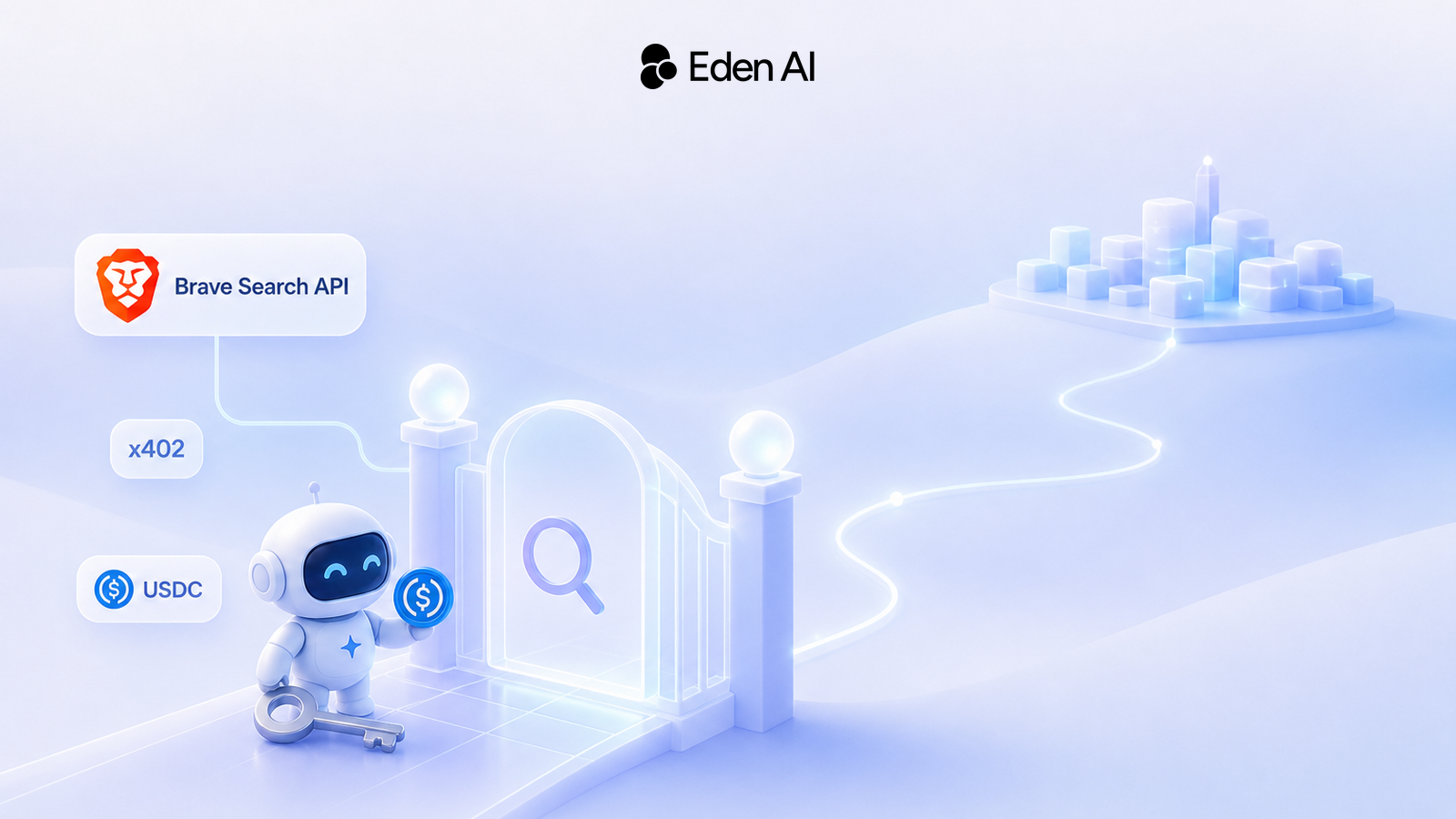
Brave added accountless, per-request USDC payments on Base to its Search API through the x402 protocol, at the same $0.005 per query. Teams trade API-key provisioning for wallet funding, payment signing, a facilitator and on-chain settlement. This article explains the flow, what changes compared with API keys, and when each access model fits.
On November 12, 2026, Brave added x402 payments to its Search API. Agents can now pay $0.005 per query in USDC on the Base blockchain, without creating an account or provisioning an API key.
The price did not change. What changed is how access is provisioned: a funded wallet, a signed payment, Brave's facilitator and Base settlement replace the API key. Accountless access is not credential-free. The wallet's signing authority becomes the sensitive asset.
Brave says the API queries its own independent search index. This article explains the payment flow and helps you choose between backend-managed API keys, agent-owned wallets and a multi-provider access layer.
| Launched | November 12, 2026, by Brave |
|---|---|
| Query price | $0.005, or $5 per 1,000 |
| Payment | USDC on Base through x402 |
| Paid host | search.agent.s.brave.app |
| Facilitator | Operated by Brave |
| Onboarding | No account or API key required |
| Supported search | LLM Context, web, news, image, video and local |
| Open-source proxy | bx402: x402 on Base, MPP on Tempo |
Sources: Brave's November 12 announcement, the agent payments guide and the bx402 repository. Status as of November 16, 2026.
How Brave's x402 payment flow works
The paid host uses the same API paths as api.search.brave.com, and query parameters pass through unchanged. Only the host changes, to search.agent.s.brave.app. Brave's guide says the signed payment is the credential.
One paid Brave Search request
Send the search request
The client calls the paid host without a payment.
Receive HTTP 402
The response states the price and payment options for that request.
Check the spending policy
Your client rejects any amount above its configured limit.
Sign the payment
The wallet signs a USDC payment for the stated amount.
Retry the request
The client sends the request again with the signed payment.
Verify, search and settle
Brave's facilitator verifies the payment and settles it on Base.
Return results and receipt
Brave returns the results with a receipt of the Base transaction.
The first 402 is a normal step in the purchase, not an authentication error. Brave's guide calls that response the authoritative price of the request. Your client should read it before signing rather than trust a cached price.
In the x402 specification, the 402 carries the payment details in a PAYMENT-REQUIRED header, the retry sends a PAYMENT-SIGNATURE header, and a successful response returns a PAYMENT-RESPONSE header with the settlement result.
The spending check is your code, not a Brave feature. According to the bx402 repository, the x402 rail verifies the payment without moving funds, runs the search, then settles. A failed search is never charged, and a returned result means the payment settled.
What changes compared with API-key access
The main change is who provisions access. With an API key, your backend holds a credential tied to a Brave account. With x402, the agent or its wallet service holds signing authority over funded USDC.
| Area | API-key path | Brave x402 path |
|---|---|---|
| Onboarding | Create an account, pick a plan, get a key | Fund a wallet with Base USDC |
| Sensitive asset | API key | Wallet signing authority |
| Host | api.search.brave.com | search.agent.s.brave.app |
| Request sequence | One request with the key | 402, sign, then retry |
| Payment timing | Prepaid credits on the account | Each request carries its payment |
| Spend control | Backend and account controls | Wallet policy and client-side caps |
| Dependencies | Brave API and key check | Paid host, facilitator and Base |
| Endpoint coverage | Includes Answers, Autosuggest and Spellcheck | Web, LLM Context, news, image, video, local |
Sources: Brave announcement, agent payments guide, API pricing page and bx402 repository. Checked November 16, 2026.
API keys are still needed for part of the API. Brave's guide says Answers, Autosuggest and Spellcheck are not sold on the paid host yet. The bx402 repository explains why: Answers bills per query and per token, and Autosuggest and Spellcheck cost less than the fee to settle one payment.
So onboarding moves rather than disappears. Someone still funds the wallet, sets how much it may spend and protects its signing key. Your audit trail also has to link agent actions to wallet payments. The bx402 repository notes that the server returns the settled transaction hash in the PAYMENT-RESPONSE header, but Purl does not print it, so log that header yourself.
Same price, different settlement
As of November 12, 2026, Brave charges $0.005 per query, or $5 per 1,000 queries, through x402. Brave says this follows its published API rates for LLM Context and the other supported search endpoints. The new route is a payment option, not a discount.
Brave says gas fees on Base "will be covered for a limited time". It has not published an end date or how gas will be charged afterward. When you compare long-term costs, keep the query price and future network costs separate.
Who should provision search access for the agent?
It depends on who controls the workload and the budget. Each pattern fits a different operating model.
Access decision
Match provisioning to the operating model
Backend-controlled
Use a conventional API key
Choose this when your backend makes the search calls and your team already handles provisioning and billing. It keeps wallets and on-chain settlement out of the request path.
Agent-controlled
Consider an agent-owned wallet
Use x402 when an agent buys search from an assigned USDC budget with no human signup. Set per-request and session limits before it can sign.
Multi-provider
Compare an access layer
If the agent needs several search or AI providers, compare separate keys and wallets with one integration layer. Check which providers it covers first.
For experiments, a low-balance wallet and a hard per-payment cap contain the spend. For workloads with approval, audit or custody rules, decide who may fund and sign before you give payment authority to an autonomous process.
If you are still choosing a search provider, our comparison of web search APIs for AI agents covers the main options. For agents that run multi-step research rather than single queries, see our guide to deep research APIs, with pricing and speed.
How to test the x402 request flow
Brave recommends Purl, a CLI wallet developed by Stripe, for this path. Its --max-amount option caps a payment in the token's base units. In Brave's example, 10000 equals $0.01. Before paying, GET /openapi.json on the paid host lists every paid path with its price.
The script below first shows the unpaid 402 response with curl. Purl then handles the challenge, the signature and the paid retry. The loop makes at most three paid calls, each capped at $0.01. You need Purl and a wallet funded with Base-native USDC.
Bash
#!/usr/bin/env bash
set -euo pipefail

URL='https://search.agent.s.brave.app/res/v1/llm/context?q=latest+AI+search+APIs'
MAX_QUERIES=3
MAX_PER_QUERY=10000  # $0.01 in USDC base units

command -v curl >/dev/null
command -v purl >/dev/null

# Inspect the unpaid 402 challenge without authorizing payment.
curl --silent --show-error --include "$URL"

# Purl handles the 402, signing and the paid retry.
for ((i=1; i<=MAX_QUERIES; i++)); do
  purl --max-amount "$MAX_PER_QUERY" "$URL"
done
The $0.01 cap leaves room above the current $0.005 price and refuses any challenge above $0.01. The script can authorize at most $0.03 (three requests times the $0.01 cap). In production, keep the budget outside the process, so a restart cannot reset the session limit.
Where Eden AI fits
Eden AI answers the same need with one integration for many providers. It gives access to more than 1,000 AI models, from LLMs to OCR, speech and image, from more than 80 providers. Web search is one of its expert models, documented in the Search API reference.
With the search-with-provider endpoint, your application chooses which supported provider handles a query. For agents, Eden AI's MCP server gives the expert models as tools, so one agent can combine web search with OCR, translation or speech in the same workflow.
The two patterns solve different problems. Brave's x402 route lets an agent buy Brave searches per request from a wallet. Eden AI gives an agent one integration across several search providers and expert models. For agents that also fetch and read pages, our article on how AI agents read the web shows an open-source pipeline. Compare provider coverage, authentication, spending controls and failure behavior for your workload.
What to keep in mind
Open questions
Brave has not published latency or reliability figures for x402 compared with API-key requests. The gas subsidy has no published end date. Brave says other networks and stablecoins are coming soon, without dates.
- Protect the signer: removing the API key moves the sensitive credential to the wallet.
- Cap every payment: reject a 402 price above your policy before the wallet signs.
- Enforce a total budget: a per-request cap alone does not stop many valid purchases.
- Plan for dependencies: the x402 route adds Brave's facilitator and Base settlement to every request.
- Watch gas and networks: the end of gas coverage and new payment networks could change your costs and setup.
FAQ
Is x402 cheaper than using a Brave API key?
Can I still use a normal Brave Search API key?
Why is a wallet still a credential?
Which asset and network does Brave's x402 route use?
Who pays for an agent's searches?
How can I set a hard spending limit for Brave x402 requests?
Does x402 add latency to Brave Search requests?
How is x402 different from an API gateway?
Further reading
- Brave's x402 launch announcement: the payment flow, pricing, facilitator and temporary gas coverage.
- Brave's agent payments guide: the paid host, supported paths and Purl's spending cap.
- The bx402 repository: the open-source proxy behind x402 on Base and MPP on Tempo, with endpoint prices.
- The x402 protocol specification: the standard headers, payment payloads and facilitator flow.
- Best Web Search APIs for AI Agents: provider options and selection criteria for agent search.
- How AI Agents Read the Web: an open-source pipeline for web data with Crawl4AI and DeerFlow.