Summarize this article with:
- Content moderation APIs detect harmful content across text, images, and video using AI models trained on hate speech, explicit material, violence, spam, and self-harm categories.
- OpenAI Moderation remains free in 2026 and now covers both text and images through the omni-moderation model, making it the best entry point for small teams.
- Hive Moderation leads multi-modal accuracy at $1.50 per 1K text and $3.00 per 1K image requests, with audio and video coverage that no other provider matches in a single API.
- Multi-modal moderation (text + image + video in one pipeline) reduces integration overhead by up to 70% compared to stitching together separate provider stacks.
- EU data residency is critical for GDPR compliance. Eden AI routes moderation requests to EU-hosted providers when you need data to stay in Europe.
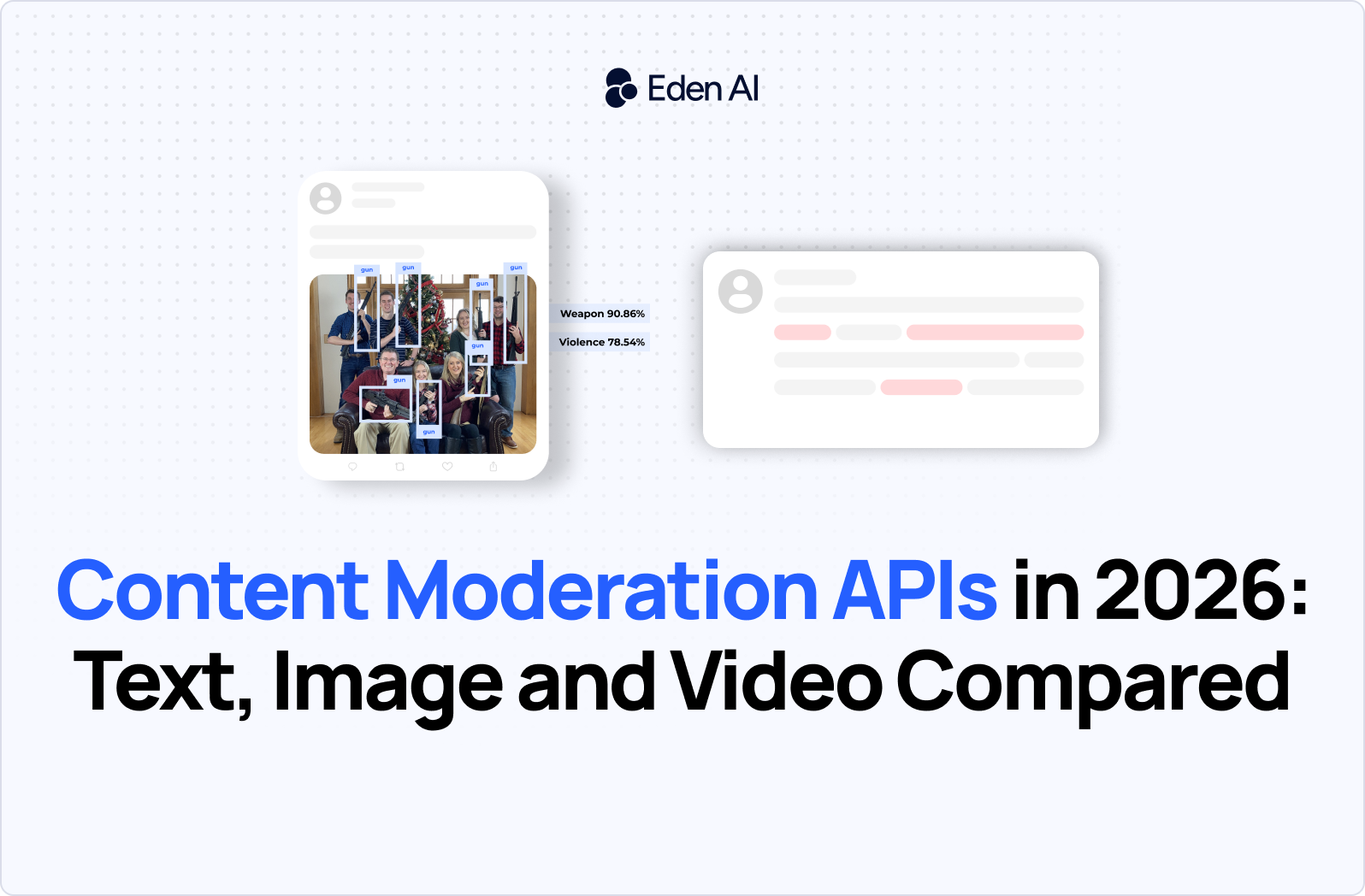
Content moderation APIs use machine learning to automatically detect harmful content in text, images, and video. In 2026, the leading providers are OpenAI Moderation (free, text + image), Hive Moderation (best multi-modal accuracy at $1.50 to $3.00 per 1K requests), AWS Rekognition (best for AWS-native teams), and Azure AI Content Safety (best for enterprise compliance). Eden AI unifies access to all of them through a single API endpoint.
What Is a Content Moderation API?
A content moderation API uses AI to automatically classify user-generated content into safety categories. These categories typically include hate speech, explicit imagery, violence, self-harm, spam, and harassment. The API returns structured scores or labels so your application can block, flag, or route content for human review without manual inspection.
Moderation APIs process content in real time. When a user posts a comment, uploads an image, or submits a video, your backend sends it to the moderation endpoint and receives a response within milliseconds. Based on the scores, your system decides whether to publish, hold, or reject the content automatically.
Why Content Moderation Is Harder in 2026
Three forces have made content moderation more complex than it was even two years ago:
- AI-generated content floods every channel. Synthetic text, images, and video now represent a growing share of user uploads. Moderation systems must detect both harmful content and AI-generated manipulation (deepfakes, synthetic profiles, generated misinformation).
- Regulatory pressure is mounting. The EU AI Act, the UK Online Safety Act, and similar regulations in Australia and Canada require platforms to demonstrate active moderation. Fines for non-compliance now reach into the millions.
- Multi-modal content is the norm. Users rarely post just text. A single post might contain an image, embedded video, and a caption. Moderation pipelines need to handle all three modalities together.
The Best Content Moderation APIs by Modality
Best for Text Moderation
Text moderation is the most mature category. The two leaders are OpenAI Moderation and Google Perspective API, both of which are free.
OpenAI Moderation uses the omni-moderation model to classify text into 11 categories: sexual, hate, harassment, self-harm, violence, illicit, and more. It covers 100+ languages and returns calibrated confidence scores. The API is completely free for anyone with an OpenAI account, with no usage caps for standard tiers.
Google Perspective API focuses on community platforms and forums. It provides toxicity, insult, threat, profanity, and identity attack scores. Perspective is free for developers and has been widely adopted by news organizations and comment platforms. It supports 20+ languages with high accuracy on English, Spanish, German, French, and Portuguese.
For enterprise teams that need custom categories or deeper compliance tooling, Azure AI Content Safety offers text moderation with severity levels (0 to 7) across four categories: hate, sexual, violence, and self-harm. Its Content Safety Studio provides an interactive dashboard for testing thresholds and managing blocklists.
Best for Image Moderation
Image moderation requires detecting explicit content, violence, weapons, drugs, and increasingly, AI-generated imagery.
Hive Moderation leads this category with human-level accuracy on nudity detection, violence classification, and weapon identification. At $3.00 per 1,000 image requests, it is the most expensive option, but its precision justifies the cost for platforms where false positives damage user trust.
Sightengine specializes in visual moderation with 120+ detection classes. Beyond standard categories, it detects AI-generated images, deepfakes, and near-duplicate content. This makes it particularly valuable for platforms fighting synthetic media. Pricing starts at approximately $1.00 per 1,000 images.
AWS Rekognition Unsafe Content Detection works well for teams already in the AWS ecosystem. It identifies explicit content, suggestive content, violence, and graphic imagery at $1.00 per 1,000 images (first 5M per month). Its strength is tight integration with S3, Lambda, and CloudFront for automated moderation workflows.
Best for Video Moderation
Video moderation is the most expensive and technically demanding modality. Most providers handle it by sampling frames and applying image moderation models to each frame, plus analyzing audio tracks separately.
Hive Moderation is the only provider that covers text, image, video, and audio in a single API. Video moderation is priced at $0.13 per minute of video processed, with OCR moderation (text in frames) at $2.00 per 1,000 requests. For platforms with significant video uploads, this is the most complete solution.
AWS Rekognition Video offers asynchronous video moderation through Amazon's video analysis pipeline. It detects unsafe content, faces, and text in video frames. Pricing is per minute of video analyzed, and it integrates with AWS Step Functions for building automated review pipelines.
How to Access Content Moderation APIs Through Eden AI
Managing separate API keys, SDKs, and billing accounts for each moderation provider creates operational overhead. Eden AI provides a unified endpoint that routes moderation requests to any supported provider through one API key.
The Eden AI moderation endpoint uses the v3 universal-ai API. The model string follows the pattern text/moderation/provider. You can add fallback providers so that if the primary fails, the request cascades to the next one automatically.
import urllib.request
import json
import os

url = "https://api.edenai" + ".run/v3/universal-ai"
headers = {
    "Authorization": "Bearer " + os.environ["EDENAI_API_KEY"],
    "Content-Type": "application/json",
}

payload = json.dumps({
    "model": "text/moderation/openai",
    "fallbacks": ["text/moderation/microsoft", "text/moderation/google"],
    "input": {
        "text": "Your text content to moderate goes here."
    }
}).encode()

req = urllib.request.Request(url, data=payload, headers=headers, method="POST")
with urllib.request.urlopen(req) as resp:
    result = json.loads(resp.read())
    print(json.dumps(result, indent=2))
This approach gives you three advantages:
- Single integration. One API key, one billing account, one response format regardless of which provider serves the request.
- Built-in fallbacks. If OpenAI's moderation endpoint is down or rate-limited, the request automatically falls through to Microsoft Azure AI Content Safety or Google.
- Provider comparison. You can fire parallel requests to multiple providers and compare scores, latency, and cost in your own dashboard.
Comparing Moderation Accuracy and False Positive Rates
Content moderation accuracy depends on the required balance between precision, which limits false positives, and recall, which catches more genuine violations. Commercial APIs usually prioritize precision, producing relatively few false positives while detecting only 10–50% of unsafe conversations.
A customer-support platform may prioritize a low false positive rate to avoid blocking legitimate complaints. A platform handling threats or child safety may accept more false positives in exchange for higher recall. Accuracy should therefore be evaluated against the consequences of both missed violations and unnecessary blocks.
Which API provides the best text moderation accuracy?
A March 2026 Hive benchmark covering approximately 2,400 text samples reported about 88% accuracy, a 9% false positive rate, and a 12% false negative rate. These figures provide a useful reference point, but they should not be treated as universal performance guarantees.
OpenAI’s omni-moderation model delivers stronger multilingual performance than its legacy moderation model. Its higher sensitivity can catch more questionable content, but that sensitivity also increases the likelihood of false positives.
Google Perspective performs reliably in English and major European languages. Its performance is weaker for low-resource languages, making language coverage an important part of any content moderation accuracy evaluation.
Which API is most accurate for images and visual content?
Hive’s visual forensics benchmark reports approximately 95.8% accuracy. The model can nevertheless flag heavily edited human-created images as AI-generated, illustrating why aggregate accuracy does not eliminate category-specific errors.
Sightengine reduces false positives by returning more than 120 granular classes. For example, separating bikini, underwear, and explicit nudity allows teams to apply different rules instead of treating every form of exposed skin as the same violation.
Why can vendor accuracy benchmarks be misleading?
Vendor benchmarks are not directly comparable when providers use different datasets, category definitions, languages, thresholds, and class distributions. A high overall accuracy score can also conceal poor recall for rare but serious violations or a high false positive rate within a specific category.
Teams should test each API on a representative sample of their own text, images, languages, and policy categories. The evaluation should report precision, recall, false positives, and false negatives separately. Production thresholds should then be adjusted according to the cost of blocking legitimate content versus allowing harmful content through.
Language Coverage and Regional Compliance
Language support varies significantly between providers. If your platform serves a global audience, this matters enormously.
- OpenAI Moderation covers 100+ languages, making it the broadest option for multilingual platforms.
- Hive Moderation supports 50+ languages with strong performance on English, Spanish, French, German, Portuguese, Arabic, and Hindi.
- Google Perspective API focuses on 20+ languages with the highest accuracy on English, Spanish, German, and French.
- Azure AI Content Safety officially supports 8 core languages (English, German, Japanese, Spanish, French, Italian, Portuguese, Chinese) with degraded performance on others.
For GDPR compliance, data residency is critical. EU-based platforms need moderation endpoints that process data within European borders. Eden AI supports EU data residency by routing requests to providers with EU-hosted endpoints, including Azure AI Content Safety (France Central, West Europe, Switzerland North) and Google Cloud services in EU regions.
Pricing Comparison: What Does Moderation Actually Cost?
Content moderation APIs cost anywhere from free to several dollars per thousand items, while video moderation commonly costs between $0.10 and $0.13 per minute. The true content moderation cost depends on how each provider bills: per text record, image, video minute, operation, monthly tier, or enterprise contract.
Pricing should be normalized against the actual workload before providers are compared. A text “request” may contain only 1,000 characters, while an image-analysis request may consume multiple operations. Video pricing can depend on duration, frame-sampling frequency, and detection multipliers.
OpenAI Moderation and Google Perspective are the clearest free options. OpenAI supports text and images without stated usage caps, while Perspective is limited to text. Azure, AWS, Hive, and Sightengine provide free tiers or credits, but their limits and billing units differ substantially.
What would common monthly workloads cost?
- 100,000 text comments: OpenAI Moderation and Google Perspective cost $0. Azure costs $38 when every comment fits within one 1,000-character text record. Longer comments increase the record count and total cost.
- 500,000 images: OpenAI Moderation costs $0. Azure costs $375, while AWS Rekognition costs $500 at its first-million pricing tier. Sightengine’s largest listed tier includes 200,000 operations, so 500,000 standard image checks exceed that tier; advanced detectors would consume three to ten times more operations.
- 10,000 minutes of video: AWS Rekognition costs $1,000, excluding its temporary free-tier allowance. Hive costs $1,300 for video moderation at $0.13 per minute.
The lowest-cost provider can vary by modality. Through Eden AI, teams can route text to free OpenAI moderation, images to the most suitable cost-and-accuracy option, and video to AWS or Hive through one endpoint and one bill, without maintaining separate provider integrations and contracts.
Building a Multi-Provider Moderation Pipeline
Production moderation often requires more than one provider. A common pattern is tiered moderation:
- Fast pass with free APIs. Send all content through OpenAI Moderation or Google Perspective first. These are free and fast (sub-100ms latency).
- Escalation to premium providers. Content that scores near the threshold (neither clearly safe nor clearly harmful) gets sent to Hive Moderation or Sightengine for a more precise second opinion.
- Human review queue. Content that remains ambiguous after two API passes goes to human moderators. The API scores provide context so reviewers can make faster decisions.
This tiered approach keeps costs low while maintaining high accuracy. Most content (typically 85 to 95%) passes the first free tier with no further action needed.
AI-Generated Content Detection: A New Moderation Category
In 2026, moderation is no longer just about harmful content. Platforms increasingly need to detect whether content was generated by AI. This is relevant for several reasons:
- Academic integrity platforms need to detect AI-written essays.
- Social networks need to flag synthetic profiles and AI-generated images.
- News organizations need to verify that submitted media is authentic.
Sightengine is the leader in this emerging category. Its AI-generated image and video detection models identify content from major generators (Midjourney, DALL-E, Stable Diffusion, Sora) with high accuracy. Hive Moderation also offers AI-generated content detection as part of its image moderation suite.
Eden AI provides access to AI detection through the universal-ai endpoint using model strings like text/ai_detection/sapling for text and image detection providers for visual content.
Conclusion
Content moderation in 2026 requires covering text, image, and video across many languages while meeting tightening regulatory requirements. The best approach combines free APIs (OpenAI, Google Perspective) for the fast first pass with premium providers (Hive Moderation, Sightengine) for high-stakes decisions. Eden AI unifies access to every moderation provider through a single endpoint with built-in fallbacks, so you never depend on a single vendor.



.png)