Summarize this article with:
Sending every task to a large language model is the 2026 default. By 2027, specialized AI models will do most of the work. We tested both on three real tasks.
Most AI products in 2026 have one reflex: send everything to a large language model. Summaries, yes, but also invoices, moderation, translation, personal data. LLMs can do all of it, so they end up doing all of it.
That reflex is about to change. Gartner predicts that by 2027, organizations will use small, task-specific AI models at least three times more than general-purpose LLMs, because they answer faster, need less compute and cost less to run.
At Eden AI, we call these specialized models expert models. We ran three everyday tasks through both an expert model and a fast LLM to see where the difference really is.
What is a specialized AI model?
A specialized AI model is built and trained for one task: reading an invoice, transcribing speech, detecting toxic content, removing personal data, translating text. It does not chat or reason about anything else. In exchange, it returns a predictable, structured result, usually faster and cheaper than a general model.
Eden AI gives access to both kinds through the same API key:
| General-purpose LLMs | Specialized AI models (expert models) | |
|---|---|---|
| Built for | Any text or multimodal task: chat, reasoning, writing, tool calling | One task: OCR, speech-to-text, translation, moderation, personal data removal, image analysis... |
| Output | Free text, or JSON if you ask for it | A fixed, structured format, often with confidence scores |
| Pricing | Per token, varies with prompt length and reasoning | Per page, character, second or request |
| On Eden AI | Around 1,000 models on /v3/chat/completions | 265 models from 47 providers, 37 tasks, on /v3/universal-ai |
| Model string | google/gemini-3.8-flash | text/anonymization/microsoft |
We tested both on three tasks
Same inputs, sent through Eden AI on 2 November 2026: once to an expert model, once to Gemini 3.8 Flash, a fast and inexpensive LLM, with its default settings. Each call was run three times; latency is the median.
| Task | Expert model | Gemini 3.8 Flash (LLM) | Verdict |
|---|---|---|---|
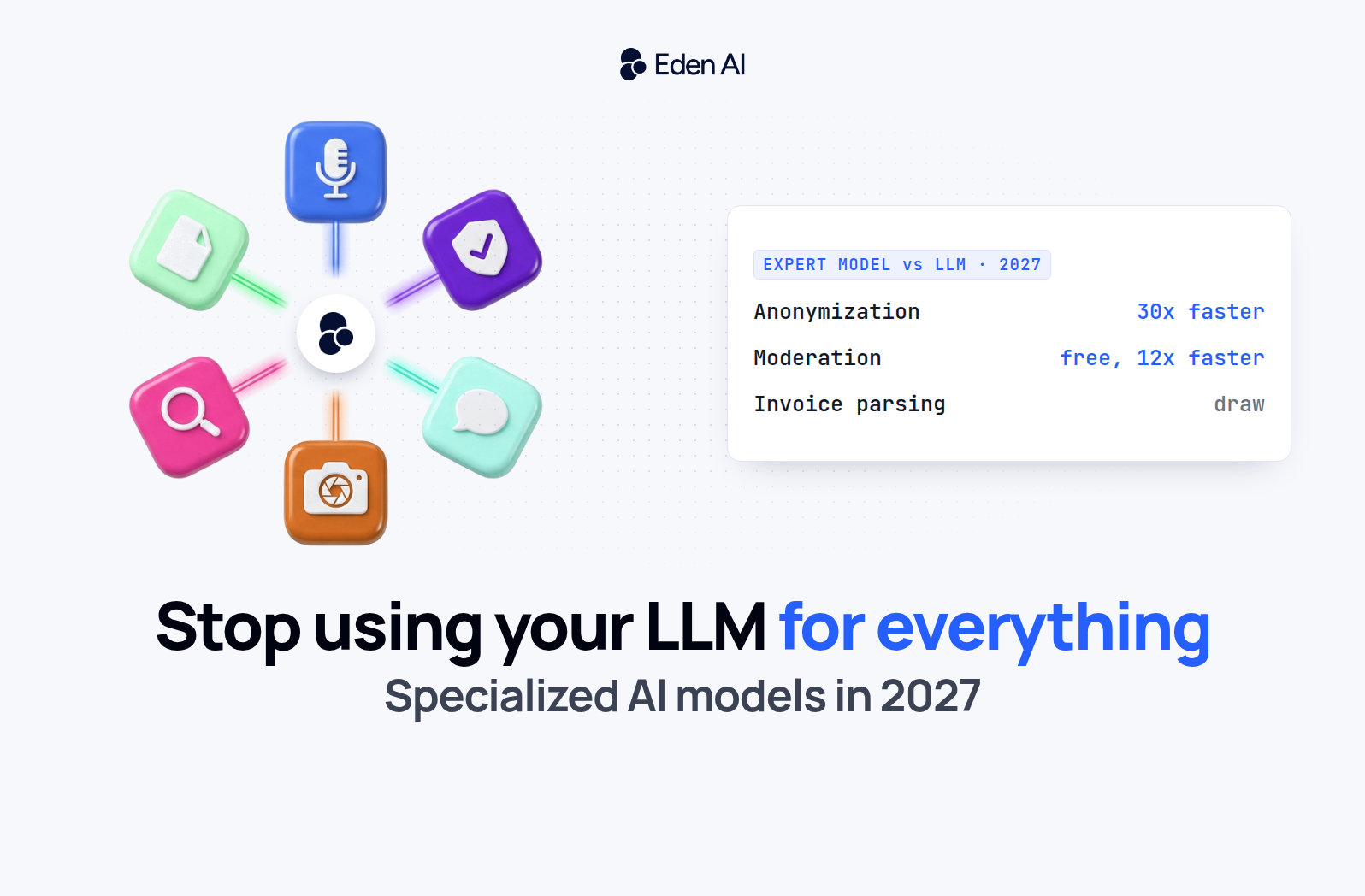
| Personal data removal | Microsoft: 0.28 s, $0.00025, every item typed and located | 8.96 s, about $0.0037, all items masked | Expert: ~30x faster, ~15x cheaper |
| Moderation | OpenAI moderation: 0.41 s, free, 13 category scores | 5.11 s, about $0.0014, its own severity estimate | Expert: free, ~12x faster |
| Invoice parsing (1 page) | Microsoft: 6.06 s, $0.01, all key fields right except the IBAN | 9.52 s, about $0.0055, all fields right | Draw: test on your documents |
Personal data removal: the expert wins by a mile
We sent a customer ticket containing a name, an email, a phone number, an address and an IBAN. Both approaches hid all of it. The expert model answered in 0.28 seconds for $0.00025, about 30 times faster and 15 times cheaper than the LLM. It also returned the type, position and confidence score of every item it found, which is what an audit trail needs.
Moderation: free, instant and scored
On a threatening message, OpenAI's moderation model answered in 0.41 seconds, at no cost, with a score for each of 13 categories, such as harassment at 0.98. The LLM agreed that the message should be flagged, but took 5 seconds and returned its own estimate of severity. Scores per category can be turned into thresholds; an LLM's opinion is harder to tune.
Invoice parsing: a draw
On a clean, one-page invoice, Microsoft's invoice parser got the number, dates, line items, VAT and totals right in 6 seconds for $0.01, and returned the dates in a standard format. It missed the IBAN. Gemini 3.8 Flash got everything right, including the IBAN, for about half a cent, but took 9.5 seconds and returned the dates as written on the document.
On simple documents, a fast LLM is a serious option. Expert parsers keep the edge on structure: the same fixed output schema across the dozen invoice parsers available on Eden AI, so you can switch provider without rewriting your code.
When to choose a specialized model, and when an LLM
- Choose a specialized model for narrow, repetitive tasks at volume: moderation, personal data removal, speech-to-text, OCR, translation, image analysis. You get lower cost, lower latency and an output you can rely on.
- Choose a specialized model when you need to prove what happened: confidence scores, positions and categories are easier to audit than free text.
- Choose an LLM for open-ended work: reasoning, writing, unusual formats, or tasks that change every week.
- Combine both for most real products. Gartner also recommends composite approaches, with several models and workflow steps rather than one model doing everything.
A common pattern: specialized models handle the steps that must be fast, cheap or compliant, and the LLM handles the step that needs judgement.
How to combine them with Eden AI
LLMs and expert models share the same base URL and API key on Eden AI. In this example, a specialized model removes personal data from a support ticket before an LLM drafts the reply, so the LLM never sees the customer's details:
import requests

BASE = "https://api.edenai.run/v3"
headers = {"Authorization": "Bearer YOUR_EDENAI_API_KEY"}

ticket = ("Hi, this is Claire Dubois. My order 55102 has not arrived. "
          "Reach me at [email protected] or +33 6 12 34 56 78.")

# 1. A specialized model removes personal data first
anon = requests.post(f"{BASE}/universal-ai", headers=headers, json={
    "model": "text/anonymization/microsoft",
    "input": {"text": ticket, "language": "en"},
}).json()
safe_text = anon["output"]["result"]

# 2. The LLM only sees the anonymized text
reply = requests.post(f"{BASE}/chat/completions", headers=headers, json={
    "model": "google/gemini-3.8-flash",
    "messages": [{"role": "user", "content": f"Draft a short support reply to this ticket:\n{safe_text}"}],
}).json()

print(reply["choices"][0]["message"]["content"])
We ran it on 2 November 2026: the name, email and phone number were masked before the LLM drafted its reply. The whole pipeline cost about a quarter of a cent.
What Eden AI adds:
- One key for both worlds: around 1,000 LLMs on
/v3/chat/completionsand more than 250 expert models from 47 providers on/v3/universal-ai, across 37 tasks. See LLMs vs expert models in our docs. - Switch provider with one string:
text/anonymization/microsoftbecomestext/anonymization/amazon, and the output format stays the same. - Agents can use them as tools: our MCP server exposes expert models such as OCR, web search, speech and translation to any MCP client or agent loop.
- Europe when you need it: more than 100 expert models are available in the EU region.
What to keep in mind
- Our tests are indicative: one input per task, synthetic data, three runs each. Test on your own data before choosing.
- LLM costs depend on the prompt: a longer document, or a model that reasons more, changes the bill. Expert models are usually priced per page, per character or per second, which is easier to forecast.
- Check language and region support: not every expert model supports every language or region, and the catalogue lists both for each model.
- Gartner's figure is a forecast, published in April 2025, not a measurement.
If you are still deciding between model sizes for your LLM workloads, our guide on SLM vs LLM in production covers that side of the question.
FAQ
What are specialized AI models?
Specialized AI models, also called task-specific or expert models, are built for one task, such as OCR, speech-to-text, translation, moderation or personal data removal. They return a structured result and are usually faster and cheaper than a general-purpose LLM for that task.
Are specialized AI models better than LLMs?
For narrow, repetitive tasks, often yes. In our tests, an expert model removed personal data about 30 times faster and 15 times cheaper than a fast LLM, and moderation was free. For open-ended work and reasoning, LLMs remain the better choice.
Why will specialized models grow in 2027?
Gartner predicts that by 2027 organizations will use small, task-specific AI models at least three times more than general-purpose LLMs, because they respond faster, use less compute and reduce operating costs.
What are expert models on Eden AI?
Expert models are Eden AI's specialized AI models: more than 250 models from 47 providers across 37 tasks, including OCR, document parsing, speech, translation, moderation, image analysis and web search. They are available through the /v3/universal-ai endpoint, with the same API key as LLMs.
Can I use specialized models and LLMs together?
Yes. On Eden AI, both use the same API key and base URL, so a single workflow can call an expert model for one step and an LLM for the next, as in the example above.