Summarize this article with:
- Shadow AI appears when the unofficial path to AI is faster than the official one. It is a supply problem, not a discipline problem.
- Start with visibility, then policy, then the charter. The order matters more than the quality of the document.
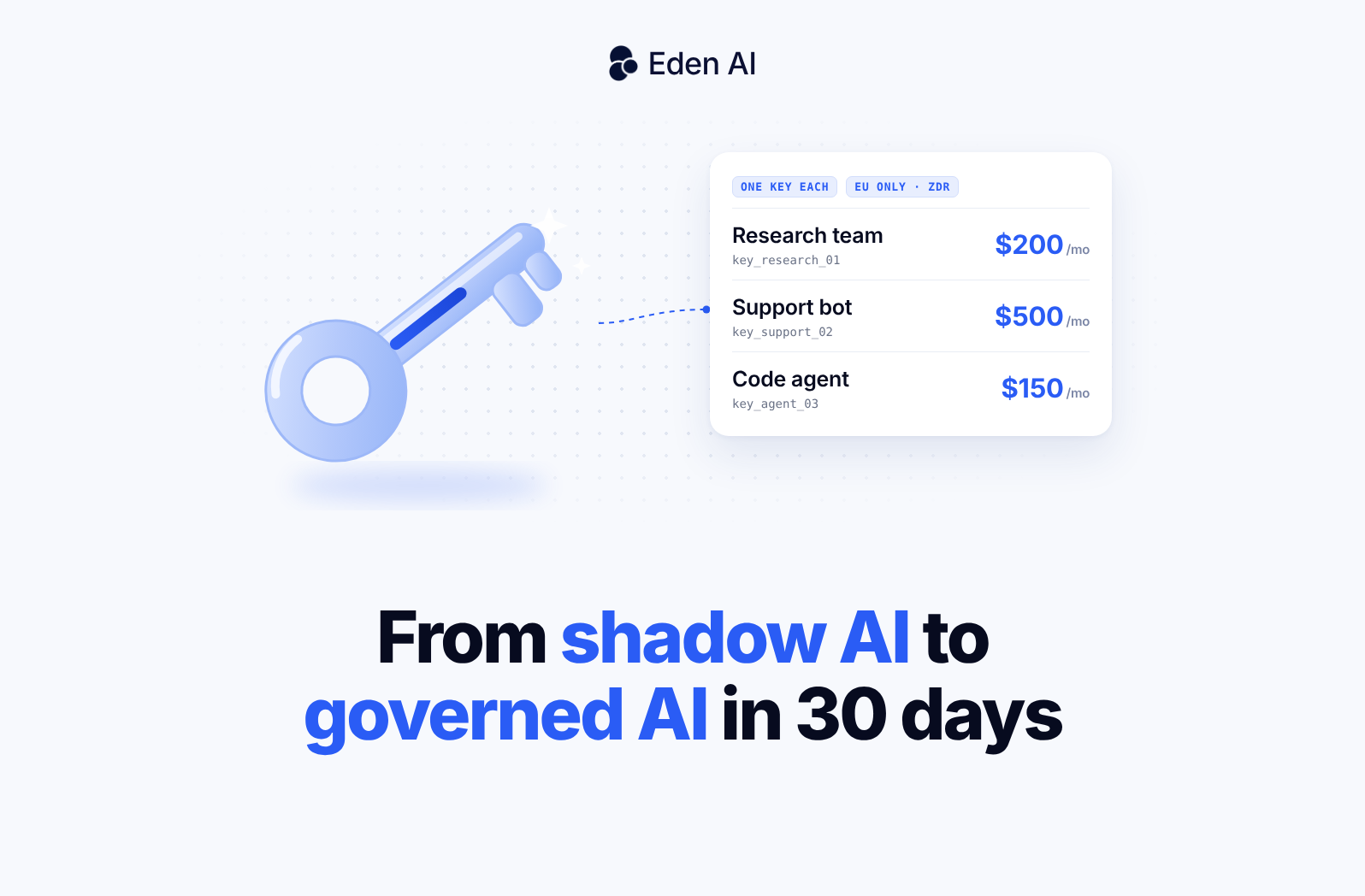
- The unit of control is the key: one key per person, project or agent, each with a budget and a model allowlist.
- A charter written after a month of observed usage is short, specific and enforceable.
Shadow AI is not a discipline problem, it is a supply problem, and the fastest way to fix it is to start with visibility, then policy, then the charter.
This week I spoke with a research lab, a large software group and a systems integrator. Three different sectors, three different sizes, and almost the same sentence every time: "People are already using AI. We now need to put a framework around it."
At the lab, researchers were paying for personal Claude subscriptions out of their own pocket, because nothing official existed yet. At the software group, a governance team was pulling usage data from six AI tools into a data warehouse three times a day, just to build a cost dashboard. At the integrator, the requirement was one traceable API key per end user, created on the fly.
Nobody had done anything wrong. People used the tool that was available. This article is the playbook we share with teams in that position: how to go from scattered, invisible AI usage to something governed, in about 30 days, without freezing the teams that are already getting value from AI.
Why shadow AI happens
Shadow AI appears whenever the unofficial path is faster than the official one. If a personal credit card gets someone a working API key in three minutes and an official request takes three weeks, the credit card wins, every time, and it wins in good faith.
Procurement makes it worse. Many organizations cannot buy AI the way developers want to buy it. Prepaid credits and card payments do not fit a process built on quotes, purchase orders, bank transfers and supplier questionnaires. A team that needs a course to start in a week will route around that process, not wait for it.
The consequence is that usage, data flows and budgets already exist by the time a policy is drafted. A charter written in a vacuum describes an organization that no longer exists. That is why the order of operations matters more than the quality of the document.
Step 1 (weeks 1-2): get visibility before you write a single rule
You cannot govern what you cannot see. The first job is to route AI traffic through one place where every call can be attributed, without asking teams to change how they work.
In practice that means three things:
- One entry point. A single OpenAI-compatible endpoint in front of all providers, so teams keep their SDKs and only change a base URL.
- One key per person, project or agent. The company is not the unit of control, the key is. Per-key attribution answers "who spent what, on which model" without a spreadsheet.
- Usage you can export. Cost, tokens, latency and errors per key, available through a dashboard and an API, so finance and security do not need a data-engineering project.
The anti-pattern here is the home-made cost dashboard: usage exported from each vendor, loaded into a warehouse several times a day, then modeled in a BI tool. It works, and it takes a quarter to build. A gateway gives you the same view on day one because the attribution happens at the source.
Step 2 (weeks 2-3): turn what you observed into policy
Once a week or two of real usage is visible, rules stop being guesses. You can see which models people actually use, which teams spend the most, and which workloads touch sensitive data.
The controls buyers ask for most often are simple:
- Budget per key, project or member: who can spend how much before someone is alerted or stopped.
- Model allowlist: which models a given team may call.
- Region filter (for example EU only): where inference is allowed to run.
- Zero Data Retention (ZDR) filter: which providers may not store prompts and outputs.
- Fallbacks and latency or cost routing: what happens when a provider degrades.
Two caveats from our own experience. First, ZDR is a chain of contracts, not a switch: a feature that stores inputs (for instance files kept in object storage) can quietly break the guarantee, so the interface should show it. Second, some customers, such as resellers serving banks or hospitals, need real isolation per customer with separate organizations, data residency and documented guarantees. Separate API keys alone do not give you that. We are rolling out policy controls progressively, so check the documentation for what is available today.
Step 3 (week 4): write the charter last
A charter written after a month of observed usage is short, specific and enforceable, because it describes decisions you have already tested. A one-page version is usually enough:
- Data rules. What may and may not be sent to a model, by data category.
- Approved models and regions. The default list, and who can approve an addition.
- Ownership. Who owns budgets, who reviews usage, and how often.
- Exceptions. How a team requests a new model or a higher limit, and the expected response time. If this takes weeks, shadow AI returns.
- Incident handling. What happens when a key leaks or a provider has an outage.
The point of writing it last is credibility. A charter that reflects how people already work gets followed. One that ignores it gets worked around, and you are back at step zero.
Common pitfalls and a 10-question checklist
The same mistakes come up in almost every rollout:
- One shared key per team. You lose attribution and cannot revoke one person without breaking everyone.
- Governance as a BI project. Reconstructing usage after the fact is slower and less accurate than attributing it at the source.
- Prepaid cards in procurement. If the only way to pay is a card, regulated and public-sector teams will go elsewhere or go around you.
- Ignoring agents. Agentic tools consume far more tokens than chat. Budgets per project and per member matter more than a chat interface.
- Starting with the PDF. A charter before visibility describes intentions, not reality.
To test where you stand, answer these ten questions:
- Do you know what AI cost your company last month, by team?
- Can you list every model your people call today?
- Does each person, project or agent have its own key?
- Can you revoke one key without affecting others?
- Is there a budget or alert per key?
- Do you know which providers retain prompts, and for how long?
- Can you restrict inference to a region such as the EU?
- What happens to your product if your main provider slows down or fails?
- Can a team get a new model approved in days rather than weeks?
- Can procurement pay by quote and bank transfer?
If you answered "no" or "I don't know" to more than three, you have shadow AI. Most organizations do.
Start with visibility
Governed AI is not about slowing people down. It is about giving them an official path that is as fast as the unofficial one, and then seeing what happens on it. Visibility first, policy second, charter third: that order is what turns a 30-day project into something that lasts.
Eden AI gives you one OpenAI-compatible API in front of hundreds of models, per-member and per-project keys and budgets, EU region and ZDR filters, and usage you can see and export. You can create a free evaluation account and run your first week of visibility today, or ask us for our compliance pack (DPA, certifications, provider list) if you need to bring security and legal into the conversation.