.png)
Summarize this article with:
The full GLM-5.3 benchmark picture is mixed: Z.ai reports leadership on several agentic and defensive-security evaluations, while GPT-5.6 Sol and Claude Fable 5 remain ahead on some coding, terminal, and offensive-security tests.
What is GLM-5.3?
GLM-5.3 is a 743-billion-parameter Mixture-of-Experts (MoE) language model released by Z.ai (Zhipu AI) on August 14, 2026. It is designed primarily for coding, agentic workflows, terminal-based tasks, and other long-horizon work that requires sustained reasoning and tool use.
The defining technical detail is that GLM-5.3 uses the same 743B-parameter MoE base model as GLM-5.2. Z.ai attributes the improvements entirely to expanded post-training, including more training environments, greater task variety, and additional reinforcement-learning compute. That is unusual because a major model update can deliver substantial capability gains without changing the underlying pretrained model or increasing its parameter count.
GLM-5.3 is built around coding, terminal work, long-horizon agents, and defensive security tasks. It remains a text-first model, with no new multimodal capability introduced in this release, so teams that require native image, audio, or video understanding will need to consider other models or a multi-model architecture.
For developers working with large repositories or extended agent trajectories, GLM-5.3 provides a 1 million-token context window through the glm-5.3[1m] model ID. It supports three reasoning-effort levels: low, high, and max, with max as the default. Z.ai has also announced MIT-licensed open weights, expected around August 28, 2026, roughly two weeks after launch.
GLM-5.3 is positioned as a leading open-weight alternative to closed frontier models such as GPT-5.6 Sol, Claude Opus 4.8, and Gemini 3.1 Pro, competing primarily on cost and deployment control rather than the absolute capability ceiling.
What Changed from GLM-5.2
GLM-5.3 is not a new pretrained model. It uses the same 743B-parameter Mixture-of-Experts base as GLM-5.2, with Z.ai attributing the gains to expanded post-training: more environments, broader task coverage, and additional reinforcement-learning compute. The improvements are concentrated in terminal work, long-horizon software engineering, agent tasks, and security rather than in a broader architectural or multimodal upgrade.
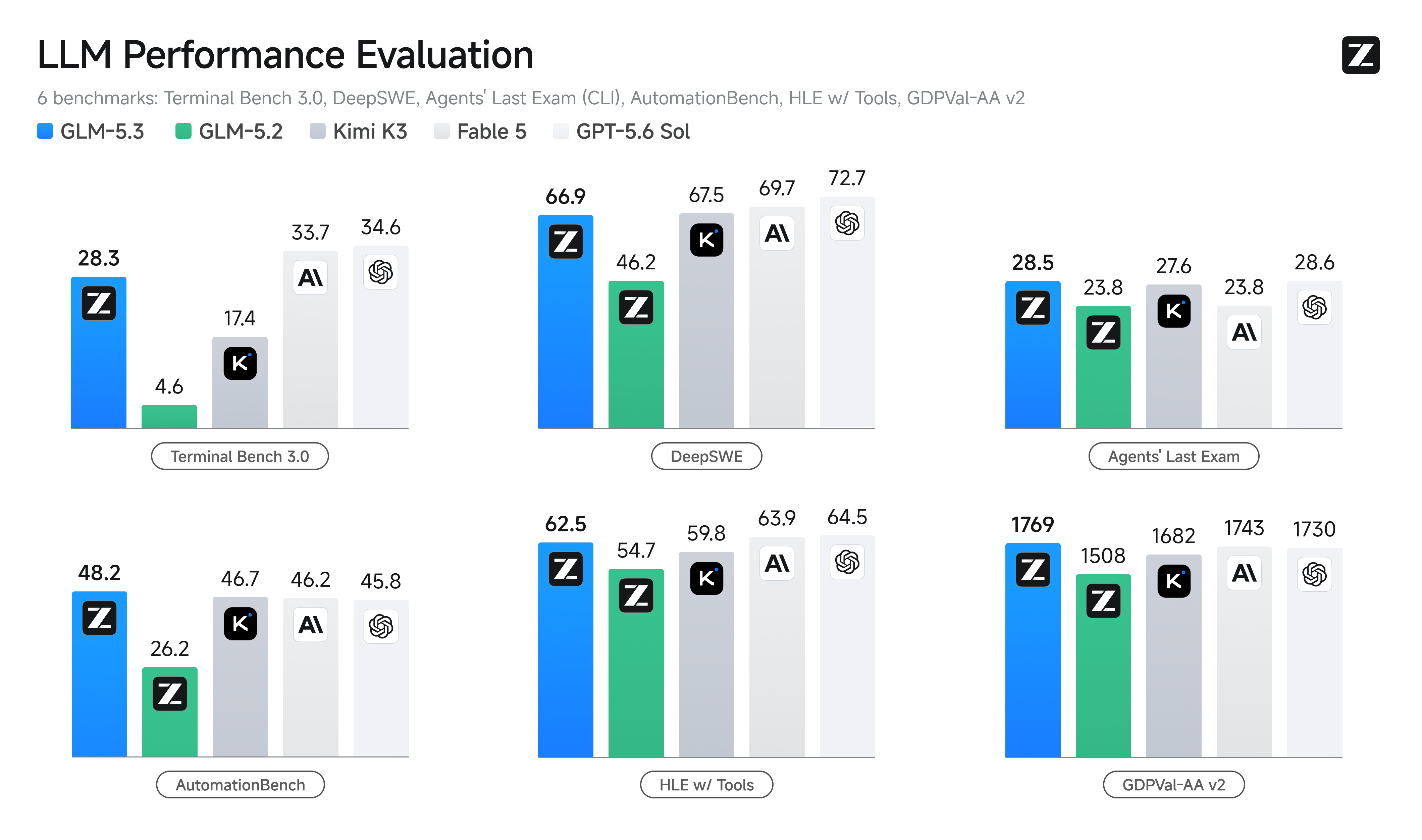
The table below uses Z.ai's own vendor-run benchmark results, not independent evaluations.
The Terminal-Bench 3.0 result needs careful interpretation. Some coverage may describe the move from 4.6 to 28.3 as roughly a 515% improvement, but that percentage exaggerates what the result tells us. GLM-5.2 started at 4.6 on a new benchmark substantially harder than its predecessor, so multiplying a near-floor score produces an impressive percentage without providing much insight into absolute capability. The useful interpretation is simpler: GLM-5.2 could barely complete these terminal tasks, while GLM-5.3 can complete a meaningful subset. That is real progress, but Z.ai's own evaluation still places GLM-5.3 at 28.3 versus 34.6 for GPT-5.6 Sol.
What is more technically interesting is how those gains were achieved. Moving a fixed 743B MoE base this far through post-training alone suggests that reinforcement learning, environment diversity, and task-specific training still provide substantial headroom after pretraining. It also makes GLM-5.3 an unusually clean example of how much capability can be extracted from an unchanged base model.
For existing GLM-5.2 users, switch to GLM-5.3 if coding agents, terminal execution, long-running workflows, or defensive security are important workloads. Staying on GLM-5.2 can still make sense if those improvements do not affect your application and migration would add operational work without a clear production benefit.
GLM-5.3 vs GPT-5.6 Sol
The GLM-5.3 vs GPT-5.6 Sol comparison separates capability from deployment economics. On Z.ai's vendor-run evaluations, GPT-5.6 Sol is the stronger general coding model, while GLM-5.3 offers advantages around open weights, self-hosting, and infrastructure control.
*GLM-5.3's MIT-licensed open weights are expected around August 28, 2026. All benchmark figures above were produced by Z.ai rather than an independent evaluator.
Where GLM-5.3 wins
GLM-5.3 narrowly leads GPT-5.6 Sol on CyberGym, at 84.5% versus 83.6% in Z.ai's testing. A 0.9-point difference is small enough that it should be treated as effectively inside the noise rather than as evidence that GLM-5.3 is categorically better at defensive security.
The stronger advantages are structural. GLM-5.3's promised MIT-licensed open weights allow organizations to self-host the model, control where inference happens, customize the deployment stack, and avoid dependence on a single hosted model vendor. GLM-5.3 also competes on materially lower cost, although Z.ai had not published GLM-5.3's standard per-token API pricing at launch, so the exact production cost gap cannot yet be calculated.
Where GPT-5.6 Sol wins
GPT-5.6 Sol wins general coding clearly and consistently in the published results. It scores 34.6 against GLM-5.3's 28.3 on Terminal-Bench 3.0, a 6.3-point lead, and 72.7 against 66.9 on DeepSWE v1.1, a 5.8-point lead.
The difference becomes much larger on offensive security. GPT-5.6 Sol scores 76.5% on ExploitBench compared with 54.4% for GLM-5.3, a 22.1-point advantage. For everyday repository-level engineering where model capability matters more than deployment flexibility or cost, Sol is the stronger choice on Z.ai's published numbers.
Verdict: GPT-5.6 Sol is the better generalist coder; GLM-5.3 competes on cost, control, and deployability rather than on absolute capability.
GLM-5.3 vs Claude Opus 4.8 and Claude Fable 5
The most interesting result in the GLM-5.3 launch is not a leaderboard win but an efficiency result. On Z.ai Code Bench at High effort, GLM-5.3 scored 31.4% versus 29.5% for Claude Opus 4.8 while using roughly 50,000 output tokens per task instead of roughly 120,000. That is higher accuracy using about 40% as many output tokens.
This is a vendor-run result on Z.ai's own benchmark, which is a meaningful caveat, but the reported token-efficiency gap is large enough to warrant attention even after discounting for that provenance.
*GLM-5.3 open weights are expected around August 28, 2026. Benchmark results are from Z.ai's evaluations.
Why does token efficiency matter? Agentic coding can require dozens of model calls for planning, reading files, modifying code, running tests, interpreting failures, and trying again. Output tokens therefore become a major cost driver, and an efficiency difference compounds when combined with a lower per-token price.
An illustrative calculation shows the scale. GLM-5.3 API pricing was not published at launch, so using GLM-5.2's $4.40 per million output tokens as a reference, 50,000 output tokens would cost about $0.22 per task in output-token charges. At 10,000 similarly sized tasks, that would be about $2,200, before input and cached-input costs. This is not a GLM-5.3 price estimate or a direct cost comparison with Claude; it simply shows why reducing generation from roughly 120,000 to 50,000 tokens can matter materially at production volume.
The counterweight is capability. Claude Fable 5 holds the ceiling in Z.ai's published comparisons. At max effort, it scores 39.5% on Z.ai Code Bench against GLM-5.3's 34.5%. The ExploitGym difference is larger: Fable 5 completes 181 tasks in two hours and 247 in six hours, compared with 105 and 130 for GLM-5.3. For the hardest tasks, that is a substantial advantage.
Availability can also override benchmark rankings. Anthropic's hosted frontier models are subject to service availability and access restrictions by region. Once GLM-5.3's MIT-licensed weights are released, teams can instead run the model on infrastructure available to them, making self-hosting particularly relevant for organizations with strict data-residency or infrastructure-control requirements.
Verdict: GLM-5.3 is the stronger candidate for accuracy-per-dollar at volume, subject to confirmation of its final API pricing. Claude Fable 5 is the better choice when maximizing capability on the hardest tasks matters more than the bill.
GLM-5.3 vs Gemini 3.1 Pro: Context, Cost and Control
A direct benchmark comparison between GLM-5.3 and Gemini 3.1 Pro would be misleading because Z.ai's GLM-5.3 launch benchmarks do not include Gemini. Gemini 3.1 Pro's published results, including 80.6% on SWE-bench Verified, 74.8% on Terminal-Bench 2.0, and 77.1% on ARC-AGI-2, come from different benchmark versions and evaluation harnesses. Terminal-Bench 3.0 is substantially harder than Terminal-Bench 2.0, so putting GLM-5.3's 28.3 beside Gemini's 74.8% does not measure which model is better. Readers should treat any comparison table presenting those two scores as directly comparable as unreliable.
There are, however, several dimensions where GLM-5.3 vs Gemini 3.1 Pro can be compared directly.
*GLM-5.3's MIT-licensed open weights are expected around August 28, 2026.
The decisive practical difference is modality. Gemini 3.1 Pro is a multimodal model, whereas GLM-5.3 remains text-first with no new multimodal capability. If an application needs native understanding of images, audio, or video, GLM-5.3 drops out of the comparison regardless of how competitive it may be on coding or agentic workloads.
There is also an age difference worth considering. Gemini 3.1 Pro was released in February 2026 and remains Google's flagship as of August 2026, while Gemini 3.5 Pro is still in partner testing.
Verdict: Gemini 3.1 Pro is the stronger choice for multimodal workloads and teams prioritizing a mature managed service. GLM-5.3 is the more compelling option when cost, infrastructure control, and self-hosting matter most for text and code workloads.
Where GLM-5.3 Leads: Automation and Defensive Security
Most GLM-5.3 launch coverage focused on the coding numbers, but the model's genuinely distinguishing results sit in a different cluster: defensive security, workflow automation, and professional knowledge work. These are also areas where deployment control can matter as much as raw model capability.
On CyberGym, GLM-5.3 reaches 84.5%, up from GLM-5.2's 77.2%. In Z.ai's vendor-run evaluation, that puts it narrowly ahead of Mythos 5 at 83.8% and GPT-5.6 Sol at 83.6%. The margins are small, but the improvement over GLM-5.2 is more substantial.
GLM-5.3 also scores 48.2% on AutomationBench, where Z.ai reports it as the leader among the compared models. On GDPval-AA v2, it reaches 1,769 Elo. GDPval-AA v2 spans 44 occupations and evaluates real, high-value professional knowledge work rather than isolated academic questions. Again, these are Z.ai-run results and should be independently replicated before being treated as definitive rankings.
The more interesting finding is the asymmetry between defensive and offensive security. GLM-5.3 leads Z.ai's CyberGym comparison at 84.5%, yet scores only 54.4% on ExploitBench, versus 78.0% for the leading model and 76.5% for GPT-5.6 Sol. Z.ai presents this gap as partly deliberate, stating that GLM-5.3 went through its most robust risk-review process to date. That is Z.ai's explanation, not independent evidence that safety training caused the performance difference.
For buyers, this profile points toward specific workloads: vulnerability triage, SOC alert automation, automated code-security review, and dependency or software supply-chain auditing. Open weights matter disproportionately here. Many security teams cannot send proprietary source code, vulnerability reports, or sensitive infrastructure information to a third-party model API at all, so a self-hostable model that leads Z.ai's CyberGym evaluation represents a materially different deployment option once the promised MIT weights are released.
The limitation is equally clear: if the workload is red-teaming or exploit development, GLM-5.3 is not the right choice on these results. Claude Fable 5 is far ahead on offensive-security tasks.
When to Use GLM-5.3, and When Not To
GLM-5.3 has a relatively clear production profile. Its strongest case is not that it replaces every frontier model, but that it combines competitive agentic performance with open weights, self-hosting, and potentially attractive inference economics.
Use GLM-5.3 when:
- You run terminal-based or agentic coding workloads at volume and output-token cost matters. Z.ai's Code Bench results suggest substantially lower token usage than Claude Opus 4.8 at High effort, although independent validation is still needed.
- You need long-horizon repository work and can tolerate a lower capability ceiling than Claude Fable 5. GLM-5.3 improves substantially over GLM-5.2 on long-running software-engineering tasks.
- You are building defensive security tooling, including vulnerability triage, SOC automation, automated security code review, or dependency auditing.
- You need to self-host or have data-residency requirements that make some hosted APIs unsuitable. The promised MIT-licensed weights make infrastructure location a deployment choice rather than a model-vendor constraint.
- You want open weights and less vendor lock-in. Self-hosting provides more control over inference infrastructure, model lifecycle, and data handling.
Do not use GLM-5.3 when:
- Your workload involves images, audio, or video. GLM-5.3 is text-first and adds no new multimodal capability.
- You need the highest available accuracy on the hardest tasks. Claude Fable 5 holds the higher capability ceiling in Z.ai's published comparisons.
- You are doing offensive-security research or red-teaming. GLM-5.3 trails the leaders by more than 20 points on ExploitBench and falls substantially behind Claude Fable 5 on ExploitGym.
- You have latency-critical interactive paths. Thinking is mandatory on the direct API and cannot be disabled, removing a useful latency-control option.
- Your procurement process requires confirmed per-token pricing. Z.ai had not published standard GLM-5.3 API rates at launch.
The honest conclusion is that no single model wins every row, which is an argument for being able to route between models rather than committing your production stack to one.
Access GLM-5.3 and 500+ Models Through One API
The comparisons above point to a practical conclusion: GLM-5.3 wins some workloads and loses others. GPT-5.6 Sol is stronger on general coding in Z.ai's published tests, Claude Fable 5 has a higher ceiling on difficult tasks, and Gemini 3.1 Pro covers multimodal workloads that GLM-5.3 does not. For most production teams, that makes the ability to route between models more useful than committing the application to a single vendor.
Eden AI provides one integration and one API key for GLM-5.3, GPT-5.6 Sol, Claude, Gemini, and 500+ other AI models. Developers can switch models by changing a parameter rather than rebuilding the integration, while automatic fallback routing can redirect requests when a provider is unavailable, rate-limited, or degraded.
The same layer also provides unified cost and usage tracking across providers, so teams can compare model spending and consumption from one dashboard instead of reconciling separate vendor accounts.
A production call can, for example, use GLM-5.3 as the primary model and GPT-5.6 Sol as the fallback:
import os
import requests

response = requests.post(
    "https://api.edenai.run/v3/chat/completions",
    headers={
        "Authorization": f"Bearer {os.environ['EDENAI_API_KEY']}",
        "Content-Type": "application/json",
    },
    json={
        "model": "glm-5.3",
        "messages": [{"role": "user", "content": task}],
        "router_candidates": ["gpt-5.6-sol"],
    },
    timeout=120,
)
response.raise_for_status()
data = response.json()

print(data["choices"][0]["message"]["content"])
Because GLM-5.3's standard Z.ai API is being released through a staged rollout, routing through Eden AI is currently one of the more direct ways to test it against models already used in your stack without maintaining separate integrations.



.png)