Summarize this article with:
Nvidia's CEO change is not expected to disrupt your API calls. But many AI providers, including European ones, run on Nvidia GPUs. Here is how to check what your stack really depends on, what already runs without Nvidia, and how to test a failover.
Short answer: probably not. Nvidia's board expects operations, customer commitments and the product roadmap "to continue without interruption". The more useful question is the one this news raises: if you use three AI providers, how many of them run on the same Nvidia GPUs? Often more than you think.
On 12 November 2026, Nvidia announced that Jensen Huang had resigned as President, CEO and board member, effective immediately, after 33 years at the company he co-founded. This guide leaves the headlines aside and looks at what the news means for teams that build on AI APIs: how concentrated inference really is, why "European" does not mean "Nvidia-free", and what you can already call on other hardware.
What happened at Nvidia
The facts, from Nvidia's announcement and CNN's live coverage:
- Jensen Huang resigned on 12 November 2026, effective immediately.
- Colette Kress, the CFO since 2013, is interim CEO. She keeps her CFO role until a permanent successor is named. The board will consider internal and external candidates.
- Harvey C. Jones becomes Nvidia's first-ever Chair of the Board. He is a former CEO and Executive Chairman of Synopsys.
- Nvidia's shares fell sharply on the day of the announcement.
- The board expects no interruption for customers. Third-quarter results are still scheduled for 17 November.
There is no sign of disruption for developers today: GPUs already deployed keep running, and providers keep serving models. But the news is a good reminder of how much of the AI industry rests on one company, and of how few teams know which chips their own requests run on.
Multi-provider is not multi-hardware
Many teams protect themselves from outages by using several AI providers. That is a good habit, but it protects you from a provider failing, not from a shared dependency. A lot of inference providers rent or buy the same Nvidia GPUs. If your primary and backup providers both run on them, a GPU shortage, a price increase or a software issue can hit both at the same time.
A concrete example: Qwen 3.8 27B is served by 12 different providers in the Eden AI catalogue. Most of them run it on Nvidia GPUs. Two of them, Groq and Cerebras, run it on chips they designed themselves.
So before counting your providers, count your hardware families. Three questions are enough:
- Which chips serve each of your models? Providers usually say so on their GPU or infrastructure pages.
- Do your backup providers use different hardware from your primary one?
- Can your data leave your region? As you will see below, this is where the real trade-off lies today.
European does not mean Nvidia-free
Choosing a European provider, in an EU region, can keep your data in Europe. It does not change the chips. We checked the public pages of the European providers available on Eden AI:
| Provider | Location | GPUs announced on their public pages |
|---|---|---|
| Scaleway | France | Nvidia: H100, L40S, B300 |
| OVHcloud | France | Nvidia: L40S, A100, H100 |
| Arkane Cloud | France | Nvidia Blackwell, in French data centres |
| Mistral AI | France | Nvidia, for Mistral Compute |
| TensorX | Data centres in Dublin and Helsinki | Nvidia B300 |
| Nebius | Netherlands | Nvidia: H100, H200, B200 |
| Infomaniak | Switzerland | Nvidia H100 |
| IONOS, T-Systems | Germany | Not found in our sources |
These pages announce Nvidia GPUs, or we found no information on the hardware. It is the same trap as confusing data residency with sovereignty: where your data is processed and what it depends on are two different questions. We cover the first one in our guide to GDPR-compliant AI gateways.
What already runs without Nvidia
A few companies build their own inference chips and sell access through an API:
- Groq runs models on its LPU, a chip designed for fast inference. Available on Eden AI.
- Cerebras runs models on its wafer-scale engine, a single chip the size of a silicon wafer. Available on Eden AI.
- SambaNova runs models on its own RDU architecture and offers an OpenAI-compatible API through SambaNova Cloud. It is not on Eden AI today.
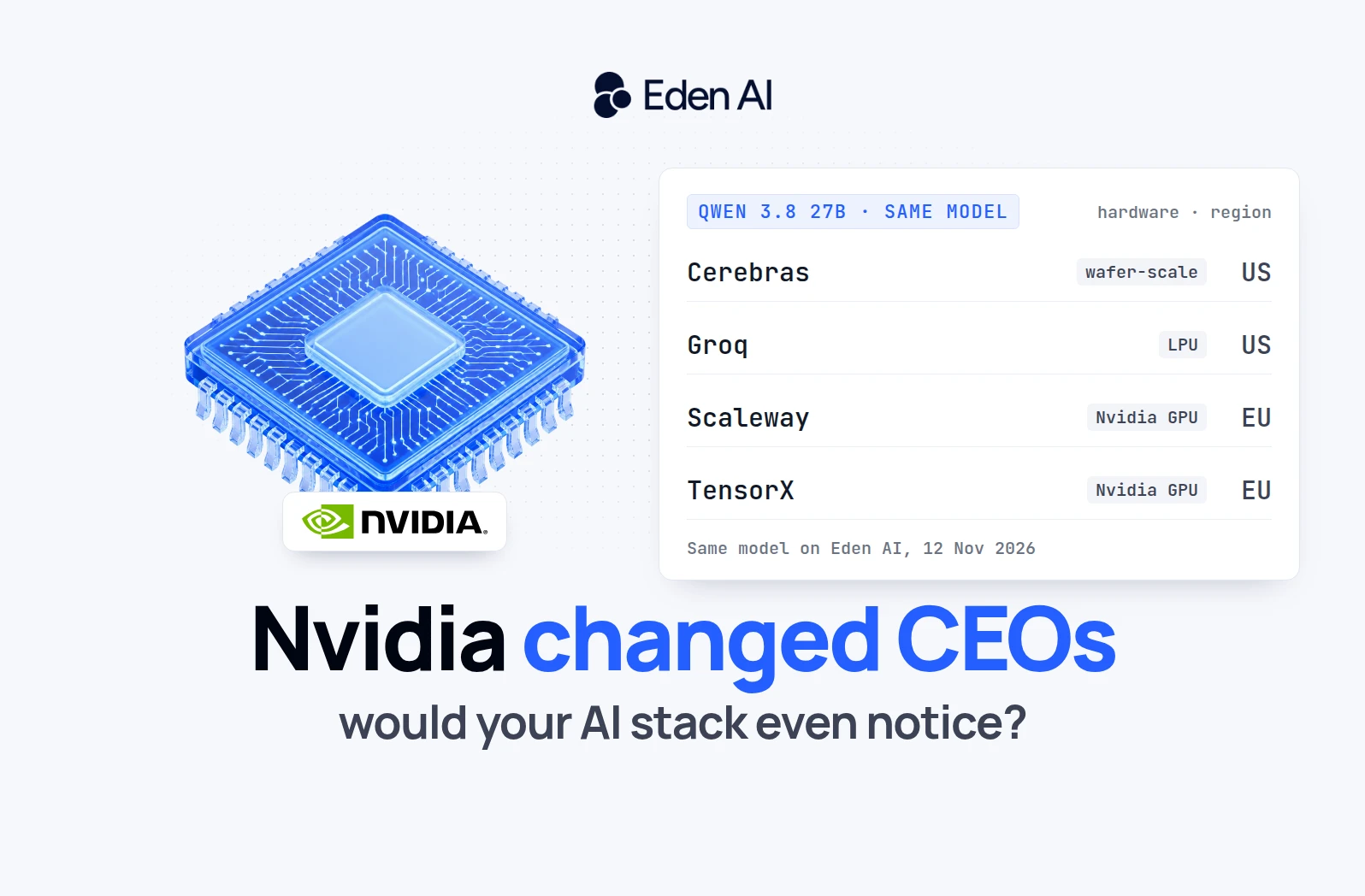
To see what this means in practice, we called the same model, Qwen 3.8 27B, on two Nvidia-based European providers and on Groq and Cerebras, through Eden AI:
| Provider | Hardware | Region | Price per 1M tokens (input / output) |
|---|---|---|---|
| Scaleway | Nvidia GPU | EU | $0.67 / $3.67 |
| TensorX | Nvidia GPU | EU | $0.40 / $2.40 |
| Groq | Groq LPU | US | $0.80 / $4.00 |
| Cerebras | Cerebras wafer-scale engine | US | $0.99 / $1.49 |
Two lessons from this test:
- The same model works on different chips. All four providers answered the same request with the same model, so switching hardware does not mean switching models. A few test calls are not a benchmark: compare speed and quality on your own workload. Cerebras had the lowest listed output price of the four.
- But they are listed in the US region. In this test, moving off Nvidia meant leaving the EU. If your data must stay in Europe, your backups will most likely run on Nvidia GPUs too.
European chips to watch
Several European companies are building inference chips. We found no public inference API running on them yet, but three are worth following:
- Axelera AI (Netherlands) launched Europa on 15 September 2026, an inference accelerator available in validated Dell and Supermicro servers. The company reports deployments with more than 600 customers for its earlier Metis chip, and OVHcloud has announced a partnership around Europa-based products.
- VSORA (France) completed the tape-out of Jotunn8, its data-centre inference chip, in October 2025. We found no cloud offering it yet.
- SiPearl (France) makes Rhea1, a processor rather than an AI accelerator. Paired with Axelera chips, it will power the inference partition of the Italian IT4LIA supercomputer.
When one of them reaches a European inference provider, it could become a way to keep data in Europe without depending on Nvidia.
How to add a fallback on different hardware with Eden AI
You do not need to rewrite your stack to diversify it. With Eden AI, you call every provider through one OpenAI-compatible endpoint, and you can list backup models in the same request with the fallbacks parameter. Here, the primary model runs on Nvidia GPUs in the EU, and the backups run the same model on Groq and Cerebras chips:
import os
from openai import OpenAI

client = OpenAI(api_key=os.environ["EDENAI_API_KEY"], base_url="https://api.edenai.run/v3", timeout=30)

response = client.chat.completions.create(
    model="scaleway/qwen3.8-27b",  # Nvidia GPUs, hosted in the EU
    extra_body={
        # same model on other hardware: Groq LPU, then Cerebras wafer-scale
        "fallbacks": ["groq/qwen/qwen3.8-27b", "cerebras/qwen-3.8-27b"],
    },
    messages=[{"role": "user", "content": "Summarise in one line: the API returned 503 errors for 12 minutes."}],
)

print(response.model, "->", response.choices[0].message.content)
We ran this code on 12 November 2026, and Scaleway, the primary model, answered. To check the fallback path, we then made the primary call fail on purpose by asking for 5 million output tokens, more than Scaleway accepts: Groq answered instead, in under a second. Four things we learned while testing:
- Fallbacks react to errors, not to slowness. In one of our test calls, a provider took more than 100 seconds to answer without failing, and the fallback did not start. Set a client timeout, as above, and decide what your application does when it is reached.
- Not every error triggers a fallback. A prompt longer than the model's context window was rejected without fallback, which makes sense: the backups run the same model and would fail too.
- The EU endpoint refuses non-EU backups. On the EU endpoint, our request with a Groq fallback was rejected with a 451 error, as documented. With Scaleway and TensorX as backups, it went through.
- Up to three fallbacks per request. To let Eden AI pick among providers of the same model instead, use provider routing, and check which hardware those providers use: routing alone does not guarantee hardware diversity.
A checklist for this week
- List the models and providers your application calls in production.
- Write down the hardware behind each one, from the provider's public pages.
- Add at least one backup on different hardware if your data can leave the EU, or one on a different provider if it cannot.
- Test the failover on purpose, with a client timeout, before you need it.
- Check again in six months: European inference chips are coming, and the options will change.
FAQ
Did Jensen Huang resign from Nvidia?
Yes. Nvidia announced on 12 November 2026 that Jensen Huang had resigned as President, CEO and member of the board, effective immediately. CFO Colette Kress is serving as interim CEO while the board searches for a permanent successor.
Will Nvidia's CEO change affect AI APIs?
Not directly. Nvidia's board expects operations, customer commitments and the product roadmap to continue without interruption, and GPUs already deployed by inference providers keep running. The news is mainly a reminder to check how much your stack depends on one hardware supplier.
Which AI inference providers do not use Nvidia GPUs?
Groq (LPU), Cerebras (wafer-scale engine) and SambaNova (RDU) run models on their own chips. Groq and Cerebras are available on Eden AI, where they are listed in the US region.
Can I keep my data in the EU without depending on Nvidia?
Not easily today. The European providers we list above announce Nvidia GPUs, or we found no information on their hardware, and Groq and Cerebras are listed in the US region on Eden AI. European chips such as Axelera's Europa are starting to reach servers, but not yet public inference APIs.
How do I add a fallback on different hardware with Eden AI?
Add a fallbacks list to your chat completion request, with up to three backup models. You can pick the same model served on different hardware, for example Qwen 3.8 27B on Scaleway, then Groq, then Cerebras. On the EU endpoint, every fallback must be EU-eligible.