Summarize this article with:
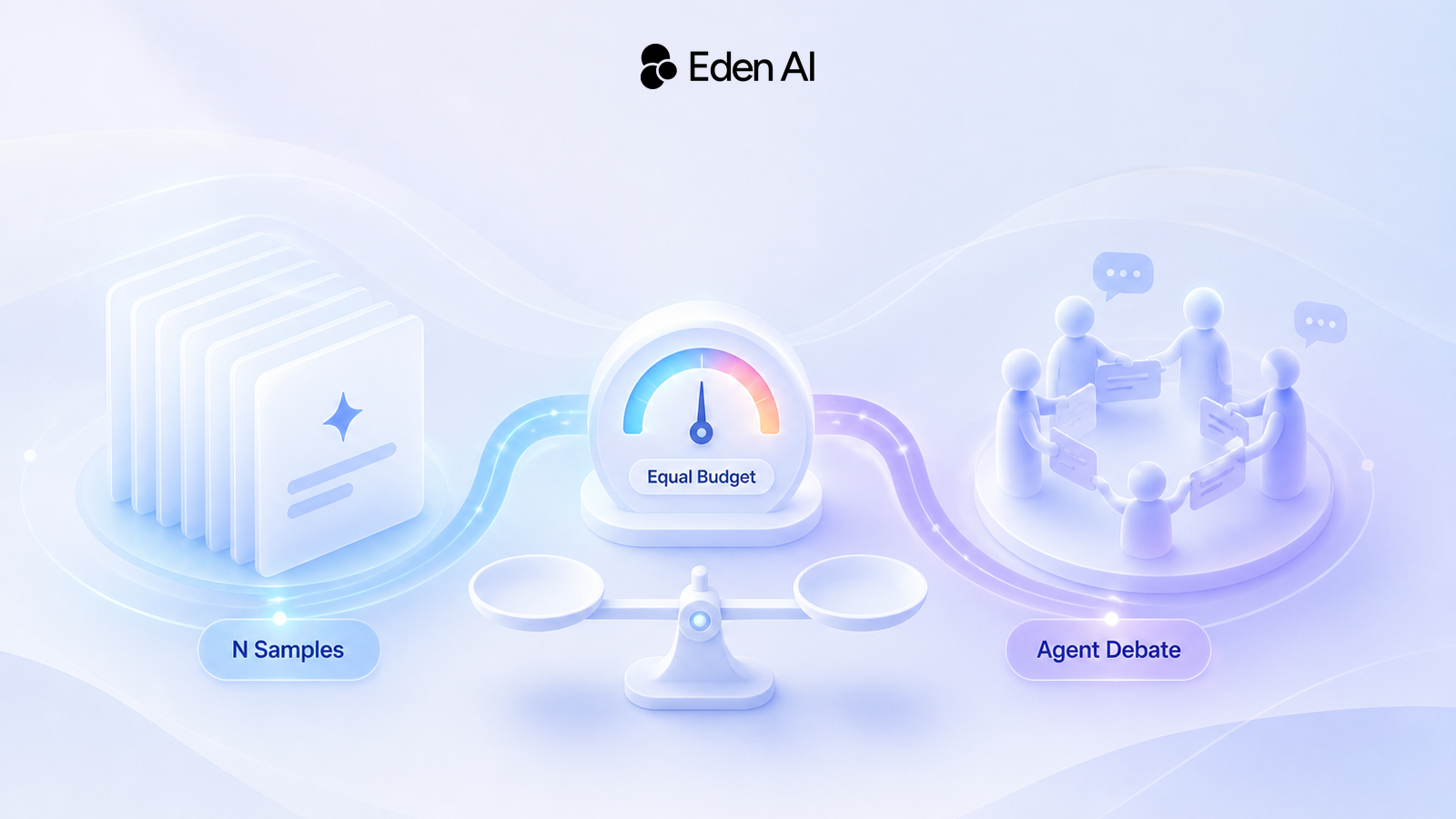
A November 13, 2026 arXiv preprint re-analyzes nine studies of multi-agent LLM systems. Many reported gains disappear when the single-model baseline gets the same number of samples or a comparable compute budget. The paper argues communication only adds value when agents hold different evidence, use external verification or make diverse errors. This article explains the paper's PACE baseline ladder, what the results show and don't show, and how to run a sample-matched comparison on your own workload.
On November 13, 2026, Seyed Mahmoud Sajjadi Mohammadabadi posted a single-author arXiv preprint on multi-agent LLM evaluation. It asks whether reported multi-agent gains come from coordination, or simply from extra samples and inference compute.
The finding is about baselines. Many studies compare a multi-agent system with one greedy model call. In studies that reported both baselines, switching to a sample-matched baseline shifted accuracy differences by -0.038 on average. Multi-agent systems still won some matched comparisons, so this is no verdict that they never help.
This article covers the paper's PACE baseline ladder, what its results show and don't show, and how to audit your own multi-agent results.
Many reported wins need a stronger baseline
| Submitted | November 13, 2026, on arXiv |
|---|---|
| Author | Seyed Mahmoud Sajjadi Mohammadabadi, University of Nevada, Reno |
| Evidence base | 9 published studies, re-analyzed |
| Configurations | 516 multi-agent configurations |
| Matched contrasts | Equal or worse than baseline in 74% |
| Key result | -0.038 average shift from greedy to sample-matched baseline |
Keep the counts apart. The paper covers 516 multi-agent configurations from nine studies. Its headline matched analysis uses the contrasts against sample-matched or budget-matched baselines.
Those contrasts come from nine other teams' studies, re-scored by the author. They are clustered within those studies, not independent experiments. The paper uses a multilevel random-effects model to account for that.
How PACE separates coordination from extra compute
PACE, short for Parity-Aware Compute Evaluation, replaces the usual agents-versus-one-call test with a four-rung baseline ladder. Each rung asks a stricter question about where a gain came from.
| Category | Baseline | What is matched |
|---|---|---|
| A | One greedy single pass | Nothing |
| B | N independent samples plus majority vote | Sample count |
| C | Single-agent system at the same budget | Declared resources, such as reasoning tokens or iterations |
| D | Pareto frontier | Results swept across compute budgets |
Source: Sajjadi Mohammadabadi, arXiv:2611.17610, submitted November 13, 2026.
Category B is the first test most agent claims should pass. If a system makes N model calls, the baseline draws N independent samples from the same model and aggregates them with a vote. This is self-consistency.
Category C matches a declared budget instead. PACE tracks six resource dimensions: reasoning tokens, total tokens, financial cost, latency, sample count and system overhead. Matching one does not match the others. Equal tokens can still mean different costs, wall-clock times and operational load.
Category D is a definition rather than a single comparison: which design gives the best results as the compute budget changes.
What changes when the baseline gets the same samples
The most actionable result comes from studies that reported both a greedy and a sample-matched baseline. Across them, the switch shifted accuracy differences by -0.038 on average.
| Analysis | Scope | Reported result |
|---|---|---|
| Greedy to sample-matched switch | Studies with both baselines | -0.038 average shift |
| Average accuracy difference | Category B/C contrasts | -0.042 |
| Equal or worse than baseline | Category B/C contrasts | 74% |
| Study means | 9 studies | Nonpositive in 8 of 9 |
Source: Sajjadi Mohammadabadi, arXiv:2611.17610, submitted November 13, 2026.
Against matched baselines, multi-agent systems averaged -0.042 in accuracy. That is an absolute difference on the accuracy scale, not a relative drop. The remaining 26% of matched contrasts favored the multi-agent system.
The pooled result does not rest on one study: study means were nonpositive in eight of nine. Multilevel random-effects modeling on the log-odds scale, which accounts for clustering, remains negative across sensitivity checks.
Even against a single greedy pass, the paper reports negative accuracy differences overall. They are near zero when the largest contributing study is left out.
When can communication add something sampling cannot?
When agents share identical evidence, communication adds no information, the paper argues. It names three conditions for positive returns: partitioned evidence, external verification and error diversity across models.
Possible sources of coordination gain
Ask what new information enters the system
Named condition
Partitioned evidence
Each agent holds different facts, so no single agent can solve the task alone.
Named condition
External verification
An agent checks another's work against a signal outside the models, such as a test or a tool result.
Named condition
Model diversity
Models from different families may make different errors. How much diversity is needed remains open.
The paper's summary attaches no number to these conditions. Our article on AI agent verification in a 600B-token project looks at verification in practice.
Where the research actually stands
This is a single-author arXiv preprint, pooling nine studies that differ in tasks and setups. It works best as an audit framework and a reason to strengthen baselines. It is not a settled verdict on production agent systems.
The paper comes with a reviewer checklist, evaluation utilities (the pace CLI) and reproduction data. Teams can use its six resource dimensions to audit their own evaluation logs.
Three questions stay open. The evidence does not cover long-running software work with interactive environments and stateful tools. It does not say how much model-family diversity is enough. It also does not show how newer reasoning models with built-in test-time search change the trade-off.
Check your baseline before claiming a multi-agent win
Run the audit on the workload you plan to deploy. A win only counts if the comparison holds the resource constraint that matters to your product.
A baseline ladder for your evaluation
- Record the greedy result. One single-pass call with the candidate system's model and prompt.
- Draw N independent samples. Same model, same prompt, N equal to the system's call count.
- Fix the aggregation rule first. Choose voting, scoring or verification before looking at results.
- Compare at matched sample count. N agent calls against N independent baseline calls.
- Repeat at a matched budget. Equal tokens or equal dollars, whichever binds your deployment.
- Log latency and overhead. Wall-clock time, parallelism, retries and orchestration work.
- Then vary the source of diversity. Distinct evidence, tools, verification roles or model families.
Don't assume self-consistency is cheaper or faster. Parallel agents can cut wall-clock time while raising token use, cost or system overhead. For broader testing concerns, see our guide to evaluating AI agents in production. For model selection and cost controls, see how to build a reliable and cost-efficient multi-LLM strategy.
Build a sample-matched harness with Eden AI
A gateway sits below your evaluation harness, outside the variable you are testing. Eden AI gives you one API key and one OpenAI-compatible endpoint. The same calling code can then compare repeated samples from one model with samples split across model families.
The illustrative harness below sends four calls to azure/gpt-5.5. It then splits four calls between that model and deepinfra/google/gemini-3.1-pro. It logs tokens, wall-clock time and the model each response reports, then takes a majority vote on an exact-label task.
Python
from collections import Counter
from time import perf_counter
from openai import OpenAI

client = OpenAI(api_key="YOUR_EDENAI_API_KEY", base_url="https://api.edenai.run/v3")
PROMPT = "Answer with exactly one label: A, B, C, or D.\nQUESTION_HERE"

def run(models):
    rows = []
    for model in models:
        start = perf_counter()
        r = client.chat.completions.create(
            model=model, temperature=0.7,
            messages=[{"role": "user", "content": PROMPT}])
        rows.append({"requested": model, "served": r.model,
                     "answer": r.choices[0].message.content.strip(),
                     "tokens": r.usage.total_tokens,
                     "seconds": round(perf_counter() - start, 2)})
    return rows

def vote(rows):
    return Counter(x["answer"] for x in rows).most_common(1)[0][0]

same = run(["azure/gpt-5.5"] * 4)
mixed = run(["azure/gpt-5.5"] * 2 + ["deepinfra/google/gemini-3.1-pro"] * 2)
for name, rows in [("same", same), ("mixed", mixed)]:
    print(name, vote(rows), sum(x["tokens"] for x in rows), rows)
Keep the prompt, aggregation rule, sample count and task set fixed. Use provider-qualified model IDs, as above. Eden AI offers automatic fallback to backup models, but leave it off during a controlled comparison. A silent model change breaks parity, so reject any run where the served model differs from the requested one.
Run both conditions across your whole evaluation set, not one prompt. Report accuracy, tokens and wall-clock time separately, then repeat under the budget that matters to you. Our guide to benchmarking multiple LLMs without rewriting your code covers the wider workflow. If your agents run in a framework, see how to connect AI agent frameworks to multiple LLM providers.
To test agents with distinct tools or evidence, Eden AI also offers expert models: OCR and document parsing, speech, translation, image generation and analysis, and web search. Eden AI's MCP server gives agents those expert models as tools. Your harness still owns the experimental design, orchestration, aggregation and scoring.
What to keep in mind
- One greedy call is not enough: compare the agent system with repeated samples from the same model.
- Parity has several dimensions: equal samples or tokens do not mean equal cost, latency or overhead.
- Communication needs a mechanism: look for distinct evidence, external checks or complementary model errors.
- Agents still won some matched comparisons: 26% of the matched contrasts favored the multi-agent system.
- Your workload decides: measure accuracy, cost and latency with the tools and execution pattern you will deploy.
FAQ
Should I remove my multi-agent system?
Is self-consistency a multi-agent system?
Does matching token counts mean matching cost?
How should I measure latency when calls run in parallel?
Do different model families create real diversity?
Does this apply to agents with different tools?
Do the findings apply to newer reasoning models?
Further reading
- The PACE paper on arXiv: the baseline ladder, the nine-study synthesis and links to the checklist and utilities.
- How to build a reliable and cost-efficient multi-LLM strategy: model selection, routing and cost considerations.
- AI agent evaluation in production: tools and techniques for testing autonomous agents.
- How to test and benchmark multiple LLMs without rewriting your code: a comparison workflow behind one interface.
- How to connect AI agent frameworks to multiple LLM providers: wiring agent frameworks to several models.