Summarize this article with:
Google released Gemini 4 Hydrogen (gemini-4-hydrogen) into general availability on November 12, 2026. It is the execution-focused model of the Gemini 4 family and the upgrade path from Gemini 3.8 Flash. It costs $1.50 / $7.50 per 1M input / output tokens, adds an xhigh thinking level and a free tier, and scores 51 on the Artificial Analysis Intelligence Index by Google's account, one point above Argon. This article covers what changes from Flash, what it costs per completed task, when to migrate, and how to prepare with Eden AI.
Google released Gemini 4 Hydrogen into general availability on November 12, 2026. The Gemini API changelog lists it as gemini-4-hydrogen, at $1.50 / $7.50 per 1M input / output tokens. Google presents it as the fast execution model of the Gemini 4 family and the upgrade path from Gemini 3.8 Flash.
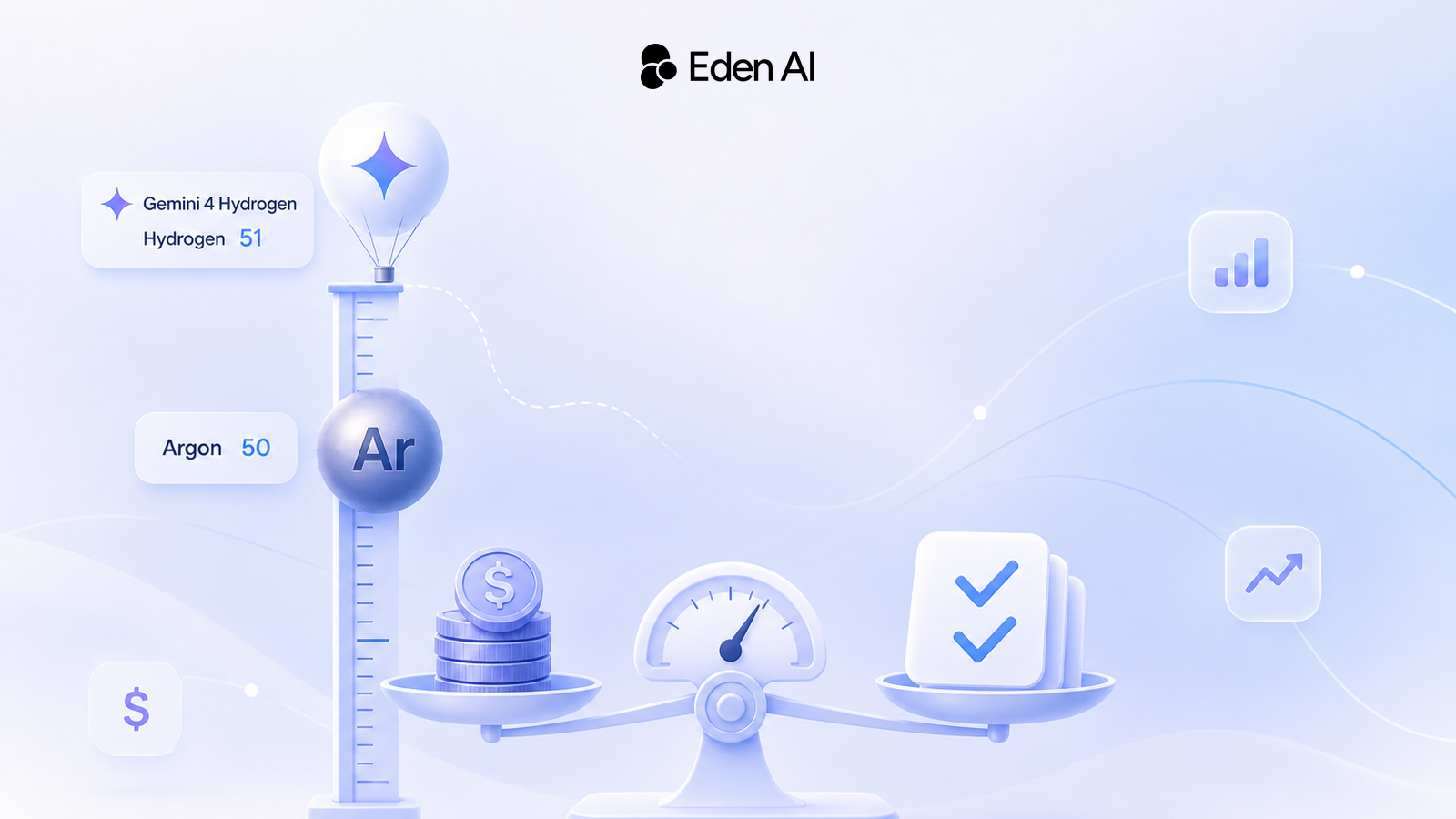
The surprise is in the benchmark line. Google reports an Artificial Analysis Intelligence Index score of 51 for Hydrogen at its default high thinking level, and 54 at the new xhigh level. Gemini 4 Argon, one of Google's frontier models, scores 50. That is one aggregate index, not proof that Hydrogen matches Argon on your workload.
For Flash users, the real question is cost per completed task, because Hydrogen costs twice as much per token as Flash today. This article covers what changes, what it costs, when to migrate, and when Argon or Carbon still fits.
Gemini 4 Hydrogen at a glance
| Status | Generally available since November 12, 2026 |
|---|---|
| Model ID | gemini-4-hydrogen |
| Thinking levels | Low, medium, high (default), and the new xhigh |
| Standard price | $1.50 / $7.50 per 1M input / output tokens |
| Context window | 1M tokens, priced flat |
| Inputs | Text, code, images, audio, video, and PDFs |
| Outputs | Text; no image or audio generation |
| Developer access | Gemini API, Google AI Studio (free tier included), Android Studio |
Google positions Hydrogen for everyday coding and agentic execution, used alone or paired with Carbon or Argon as planners. It reads text, code, images, audio, video, and PDFs in one context window. Google says it pairs native 1 million-token input with up to 1 million output tokens.
Hydrogen also runs in the Gemini app and Google Search, but those are consumer surfaces, not developer access paths. For API users, the changelog adds one detail: Hydrogen is now the default model for the Antigravity agent in Gemini Managed Agents.
Hydrogen vs 3.8 Flash and Argon
Hydrogen takes over from 3.8 Flash, the latest step in a Flash line we covered with Gemini 3.6 Flash. Google's reported numbers show a large jump over Flash and a narrow lead over Argon on one index.
| Measure | Hydrogen | Gemini 3.8 Flash | Gemini 4 Argon |
|---|---|---|---|
| Intelligence Index | 51 at high, 54 at xhigh | Not reported | 50 |
| Terminal-Bench 4.1 | 57% | 18.2% | Not reported |
| Task completion speed | 2.5× faster than Flash, at high | Baseline | Not reported |
| Fabricated claims | More than 5× fewer than Flash | Baseline | Not reported |
Sources: Google's Gemini 4 Hydrogen announcement and Gemini API pricing page, both dated November 12, 2026. Checked November 13, 2026. All figures are Google's.
These are Google's own numbers. The Intelligence Index combines many evaluations, so a one-point lead over Argon says little about coding, planning, tool use, or latency on a specific workload.
The 2.5× figure is task completion speed at the default high level. It is not time to first token, throughput, or request latency. Google also says partners saw Hydrogen run 2 to 2.8× faster and use 12% to 23% fewer tokens than 3.8 Flash, in early testing on graph, SQL, and data-heavy enterprise workflows.
On safety, Google says Hydrogen reduces overreach in agentic tasks by up to 81% compared with Flash. On impossible or blocked tasks, Google says it is up to 2× less likely to bypass permission boundaries. It also scores a 96.7% honesty rate on Google's internal agent honesty evaluation.
Pricing and availability
| Tier | Input per 1M | Output per 1M | Use it for |
|---|---|---|---|
| Standard | $1.50 | $7.50 | Default production traffic |
| Cached input | $0.075 | Not applicable | Repeated prompts |
Source: Gemini API pricing page. Prices checked November 13, 2026.
Output prices include thinking tokens, and rates are flat across the full context window. To get cost per completed task, add up (uncached input × $1.50 + cached input × $0.075 + output and thinking tokens × $7.50) ÷ 1,000,000 for every attempt. Then divide by the number of tasks that succeeded.
Against Flash, timing matters. Gemini 3.8 Flash costs $0.75 / $3.75 per 1M input / output tokens through December 31, 2026, so Hydrogen costs twice as much per token today. On January 1, 2027, Flash moves to $1.50 / $7.50, the same as Hydrogen.
Take Google's partner figure of 12% to 23% fewer tokens. At twice the rate, Hydrogen would still cost about 1.5 to 1.8× Flash per task until December 31, assuming equal success rates. From January 1, the same token savings would make Hydrogen cheaper per task.
Against Argon, Hydrogen's rates are 25% below Argon's introductory $2 / $10, which ends on November 30, 2026. From December 1, Argon moves to $4 / $20, and the gap widens to 62.5%.
Cached input costs $0.075 per 1M tokens on both Hydrogen and Flash today. But Hydrogen supports implicit caching only: explicit caching is not available at launch. If your Flash application creates explicit caches, plan for that before switching.
Hydrogen is also the first Gemini 4 model with a free tier in Google AI Studio and the Gemini API. Argon and Carbon require paid billing. Google's pricing page describes the free tier as limited access, and free-tier content is used to improve Google's products. Paid-tier content is not.
Should you migrate to Hydrogen?
Migrate the workloads where Hydrogen lowers your cost per completed task, not the ones where it only looks cheaper or smarter on paper. Retries, thinking tokens, tool calls, and failures all count.
Model choice
A recommendation per situation
Flash users
Test on cost per completed task
Replay representative coding and tool tasks on both models. Before January 1, 2027, Hydrogen has to save enough retries and tokens to offset its 2× token price.
Argon users
Don't switch for one index point
Compare quality, latency, and price on your own tasks. Hydrogen's lower price is a reason to test it, not proof it can replace Argon.
Carbon users
Keep Carbon for planning
Google pitches Hydrogen as the executor after a stronger model plans. Our Gemini 4 Carbon analysis covers the planner's pricing and evidence.
High volume
Start with batch
Google's pricing page lists a 50% cost reduction for the Batch API on the paid tier, which fits deferred jobs. Check flex and priority terms before using them for interactive agents.
Latency-sensitive
Measure every thinking level
Low or medium may fit short interactions better than the default high. No independent per-level latency data exists yet, so measure your own.
Free tier
Prototype, don't ship
The free tier is useful for early evaluation. Free-tier content is used to improve Google's products, so send production or sensitive data on the paid tier.
How to test the switch
Migration test for Flash users
- Fix the task set. Same prompts, tools, files, settings, and success criteria for both models.
- Run all four thinking levels. Low, medium, high, and xhigh, with everything else unchanged.
- Record every billable token. Uncached input, cached input, visible output, and thinking tokens.
- Track outcomes, not calls. Successes, retries, failures, and wall-clock time per task.
- Check explicit caching. Find any code that creates explicit caches before switching.
- Promote by workload. Move only the task types that cost less per successful completion.
For timing methods across providers, our LLM API latency benchmarks show what to measure and how.
Orchestrator is an Antigravity feature
In Google Antigravity, the new Orchestrator switches between Carbon for planning and Hydrogen for execution within one session. Google reports near-Carbon task success with, on average, 24% less quota and 19% faster completion. Google's announcement labels that test Terminal-Bench 4.0 and the Antigravity post says 4.1, so don't compare it with Hydrogen's standalone 57%.
Orchestrator is a model option in Antigravity, not a Gemini API setting. The Antigravity post says the Antigravity SDK lets you wire Hydrogen and Carbon together. With the Gemini API alone, you build the planner-executor split yourself.
How to prepare with Eden AI
Eden AI gives you one API key and one OpenAI-compatible endpoint for more than 1,000 AI models, from LLMs to OCR, speech, and image. Before routing traffic to gemini-4-hydrogen, check that it's in the catalog for your key. You can list models and their capabilities through the API, and the price of every model is listed in the model catalog.
The snippet below uses the OpenAI-compatible endpoint. It picks Hydrogen if the catalog lists it, falls back to Gemini 3.8 Flash otherwise, and stops rather than calling a model that isn't there. It prints token usage for your cost-per-task calculation.
Python
from openai import OpenAI

client = OpenAI(
    base_url="https://api.edenai.run/v3",
    api_key="YOUR_EDENAI_API_KEY",
)

# Model IDs available to your key right now
available = [m.id for m in client.models.list()]

# Preferred order: Hydrogen if listed, else your current Flash model
preferences = ["gemini-4-hydrogen", "gemini-3.8-flash"]
model = next(
    (m for p in preferences for m in available if m.endswith(p)),
    None,
)
if model is None:
    raise SystemExit("Neither model is listed. Keep your current setup.")

response = client.chat.completions.create(
    model=model,
    messages=[{"role": "user", "content": "Summarize this diff in three bullets: ..."}],
)
print(model, response.usage)
Once Hydrogen is listed, you can add automatic fallback to backup models. You can also use provider routing to choose the order of providers, or sort them by price, speed, or latency. This selects models and providers per request: it is not Antigravity's Carbon-Hydrogen Orchestrator.
An execution model in an agent often needs more than text. Eden AI's MCP server gives agents the expert models as tools, such as OCR, document parsing, and web search.
What to keep in mind
- Architecture is undisclosed: Google has not published Hydrogen's total or active parameter count.
- No neutral per-level speed data yet: independent latency, time to first token, and throughput figures across the four thinking levels haven't been published.
- Caching and Live API gaps: explicit caching isn't available at launch, and Google hasn't given a timeline for it or for Live API support.
- Prices move soon: Argon's rates double on December 1, 2026, and Flash's on January 1, 2027. Rerun your cost comparison after each change.
- Antigravity access is narrower: Google's Antigravity post limits Hydrogen there to paid Google AI Pro and Ultra subscribers, while the Gemini API has a free tier.
FAQ
Does Gemini 4 Hydrogen replace Gemini 3.8 Flash?
Is Gemini 4 Hydrogen cheaper than Gemini 3.8 Flash?
Why does Gemini 4 Hydrogen score above Argon?
Which Gemini 4 Hydrogen thinking level should I use?
Is the Gemini 4 Hydrogen free tier unlimited?
Does Antigravity Orchestrator work through the Gemini API?
Does Gemini 4 Hydrogen support explicit prompt caching?
Can Gemini 4 Hydrogen generate images or audio?
Further reading
- Gemini 4 Carbon release analysis: benchmarks, pricing, and availability for the planner Google pairs with Hydrogen.
- LLM API latency benchmarks: how to measure and compare speed across providers.
- Google's Gemini 4 Hydrogen announcement: launch claims, benchmarks, safety results, and access by surface.
- Gemini API changelog: the GA entry for gemini-4-hydrogen and recent Gemini model changes.
- Gemini API pricing: current and scheduled rates for Hydrogen, Flash, Argon, and Carbon.
- Google Antigravity's Orchestrator post: how Carbon and Hydrogen share one session, and who gets access.