Summarize this article with:
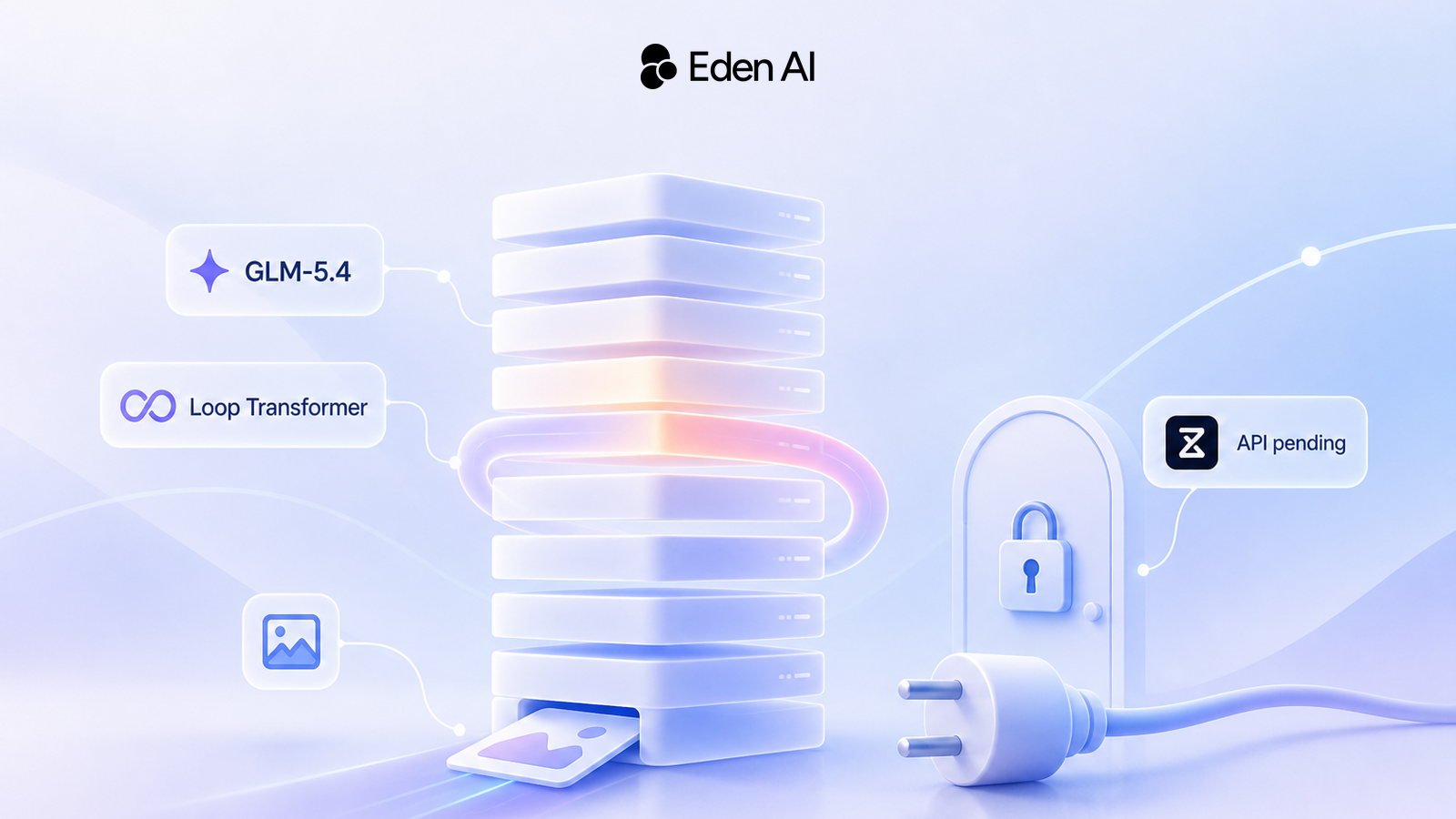
On November 23, 2026, Z.ai released GLM-5.4, its first flagship built on a Loop Transformer. It runs 28 shared layers twice and accepts video, image, text and file input. Its 1M-token context and 128K maximum output are unchanged from GLM-5.3. Coding Plan users can try it now. The standalone Model API, token pricing and open weights are still pending.
On November 23, 2026, Z.ai released GLM-5.4, which it calls its first flagship model built on a Loop Transformer. GLM Coding Plan users can use it now in their coding tools, as can users of ZCode and Z.ai Chat. According to Z.ai's documentation, the standalone Model API will open after a security assessment.
The model runs 28 shared middle layers twice and adds native image and video input. Reusing layers gives more compute per token from the same weights, which matters for anyone planning to serve it. On its own, it does not prove lower latency or cost.
This article covers what changed from GLM-5.3, what evidence Z.ai published, who can use the model today, and how to keep your code ready for a model switch.
GLM-5.4 at a glance
| Released | November 23, 2026, by Z.ai |
|---|---|
| Architecture | Loop Transformer at 750B scale |
| Loop design | 28 GLM-5 base layers run twice |
| Inputs / output | Video, image, text, file / text |
| Context and output | 1M tokens / 128K maximum output |
| Available on | GLM Coding Plan, ZCode, Z.ai Chat |
| Model API | After a security assessment, no date |
| Open weights | Planned after safety hardening, no date |
Sources: Z.ai's launch post and GLM-5.4 documentation. Launch status as of November 23, 2026.
The 1M-token context and 128K maximum output match what Z.ai documents for GLM-5.3. The real additions are visual input and recurrent depth.
What changes compared with GLM-5.3
GLM-5.3's documentation lists text-only input. GLM-5.4 accepts video, image, text and file input. It also runs a shared middle block of layers twice for each token.
One token's path through GLM-5.4
Layers before the loop
Run once before the shared block.
28 shared layers, run twice
The second pass refines the first pass's hidden state.
Downstream layers
Receive the refined representation and produce the prediction.
Extra layer passes are not a full compute or memory figure. Z.ai says the second pass reuses the sparse KV cache selected in the first pass and keeps its own new KV only in a small local sliding window. An extra loop therefore costs one sliding window of KV cache, not a second full-context cache.
The second pass also reuses the first pass's sparse attention indices, which Z.ai says adds no indexing overhead. Per-token gates control how much each pass writes back: the first pass writes conservatively, the second writes fuller updates. Z.ai built GLM-5.4 by adapting the pretrained GLM-5 base through continued training, not by training from scratch.
For the previous generation, see our GLM-5.3 benchmark analysis and the GLM-5.3-Flash comparison. Their scores are not a stand-in for GLM-5.4, which has no matching published runs.
What the evidence shows so far
Z.ai says the 750B-scale GLM-5.4 reaches intelligence levels comparable to models with 2T to 3T parameters. That is the company's claim. As The Next Web noted, Z.ai did not publish benchmark scores for GLM-5.4 itself.
The controlled evidence comes from a 30B model with the same architecture as the 750B base. Z.ai compared looped and unlooped versions with identical parameter counts. The looped version used about 10% more total training compute. Both were evaluated after 200K long-context supervised fine-tuning, with thinking mode on.
In that test, Z.ai reports the largest gains in math, scientific reasoning and long-context tasks. It also reports 10% to 14% shorter average outputs on most benchmarks, such as GPQA-Diamond and MMLU-Pro. These are results for the 30B test model, not for the released 750B model.
For its hosted service, Z.ai reports up to 200 tokens per second off-peak and 70 to 80 at peak load. These are Z.ai's own figures on its own infrastructure, not a controlled comparison across providers.
Z.ai also names one limitation: the model tends to get caught in overly long "marathon thinking" loops. Shorter average outputs in a test model do not rule out long runs on your tasks.
Pricing and availability
GLM-5.4 is available to all GLM Coding Plan users. On weekly quota plans, the usable GLM-5.4 quota is 1.5x that of GLM-5.3. TechNode reports that this covers V2, V3 and team plans.
| Access route | Status | Cost basis | Notes |
|---|---|---|---|
| GLM Coding Plan | Available | Monthly subscription | Use in your coding tools |
| Weekly quota plans (V2, V3, team) | Available | Same subscription | 1.5x quota vs GLM-5.3 |
| ZCode and Z.ai Chat | Available | Not detailed at launch | Hosted access |
| Standalone Model API | After security assessment | No token pricing yet | No date given |
| Open weights | After safety hardening | No license yet | No date given |
Sources: Z.ai launch post, GLM-5.4 documentation and TechNode. Status as of November 23, 2026.
The 1.5x quota is a subscription allowance. It does not give a per-token price, and it is not evidence of lower serving cost.
To select the model, TechNode reports the name glm-5.4. CellCog reports that a Z.ai lead gave glm-5.4[1m] for Claude Code and glm-5.4 for other tools. These names apply inside the Coding Plan, not to a public API.
Should you try GLM-5.4 now?
It depends on how you access and run coding models. Subscribers can test it today. API and self-hosting teams lack the details they need to plan.
Recommendations by access model
Try, wait or prepare
Try now
Coding Plan users
Run your existing coding tasks on GLM-5.4, with 1.5x weekly quota on eligible plans. Compare result quality, output length and wall-clock time against GLM-5.3.
Wait
Pay-as-you-go API teams
Wait for the standalone Model API, token pricing and request docs before estimating production costs or changing integrations.
Prepare
Self-hosting teams
Use the 750B scale and the two-pass loop over 28 layers for rough capacity planning. Final choices need the weights, license and hardware guidance.
Try now
Visual coding teams
Test tasks that mix images or video with code, such as interface work, games, shaders or CAD, where they match your workload.
Visual input combined with coding is the strongest reason to test now. Z.ai's demos include code that generates and edits video, a complete game, a robotic arm modeled in FreeCAD and a 3D scene built with custom GLSL shaders. These are vendor demos, so run your own tasks with your own acceptance checks.
Context size is not a reason to switch: GLM-5.3 already documents the same 1M-token window.
How to prepare with Eden AI
Eden AI gives you one API key and one OpenAI-compatible endpoint for more than 1,000 models. GLM-5.3 is available there as zai/glm-5.3 and greenpt/glm-5.3, among other IDs. The example below reads the primary model from configuration and tries backups in order.
Python
import os
from openai import OpenAI

client = OpenAI(
    api_key="YOUR_EDENAI_API_KEY",
    base_url="https://api.edenai.run/v3",
)

# Primary model from config, then backups in order.
models = [os.getenv("CODING_MODEL", "zai/glm-5.3"), "greenpt/glm-5.3", "openai/gpt-5.5"]
prompt = "Review this function and propose a tested refactor."

for model in models:
    try:
        response = client.chat.completions.create(
            model=model,
            messages=[{"role": "user", "content": prompt}],
        )
        print(model, response.choices[0].message.content)
        break
    except Exception as error:
        print(f"{model} failed: {error}")
The loop is a simple client-side fallback. Eden AI also offers automatic fallback to backup models on the server side, and provider routing to choose the order of providers or sort them by price, speed or latency.
Keeping the model ID in an environment variable means a later switch is a config change, not a code change. When a new model appears, list models and their capabilities through the API, then compare models side by side before you change CODING_MODEL. Our guide to building reliable AI-powered applications covers this pattern in more depth.
For visual coding workflows, Eden AI's MCP server gives agents the expert models as tools, including OCR and document parsing. An agent can use them to read interface screenshots or technical documents alongside the coding model.
What to keep in mind
- API planning: the standalone API date, token pricing and request terms were not published at launch.
- Self-hosting: Z.ai has given no date, repository or license for the weights.
- Architecture: running 28 layers twice is not a measured change in FLOPs, latency, energy or cost.
- Evaluation: test realistic repositories, visual inputs, output lengths and wall-clock time before migrating.
FAQ
Can I call GLM-5.4 through a standalone API today?
How can Coding Plan users try GLM-5.4?
What does running 28 layers twice mean?
Does the loop make GLM-5.4 faster or cheaper?
Is the 1-million-token context window new?
Does GLM-5.4 accept images?
When will GLM-5.4 open weights be released?
Further reading
- Z.ai's GLM-5.4 launch post: the loop design, KV cache choices, the 30B test and the demos.
- GLM-5.4 developer documentation: input types, context and output limits, quota and capabilities.
- GLM-5.3 developer documentation: the previous flagship's limits, reasoning settings and API endpoints.
- GLM-5.3 benchmark analysis: how the previous generation compares with GPT-5.6 Sol, Claude Fable 5 and Gemini 3.1 Pro.
- GLM-5.3-Flash comparison: the smaller GLM option against competing models.
- Building reliable AI-powered applications: patterns for switching and backing up models.