Summarize this article with:
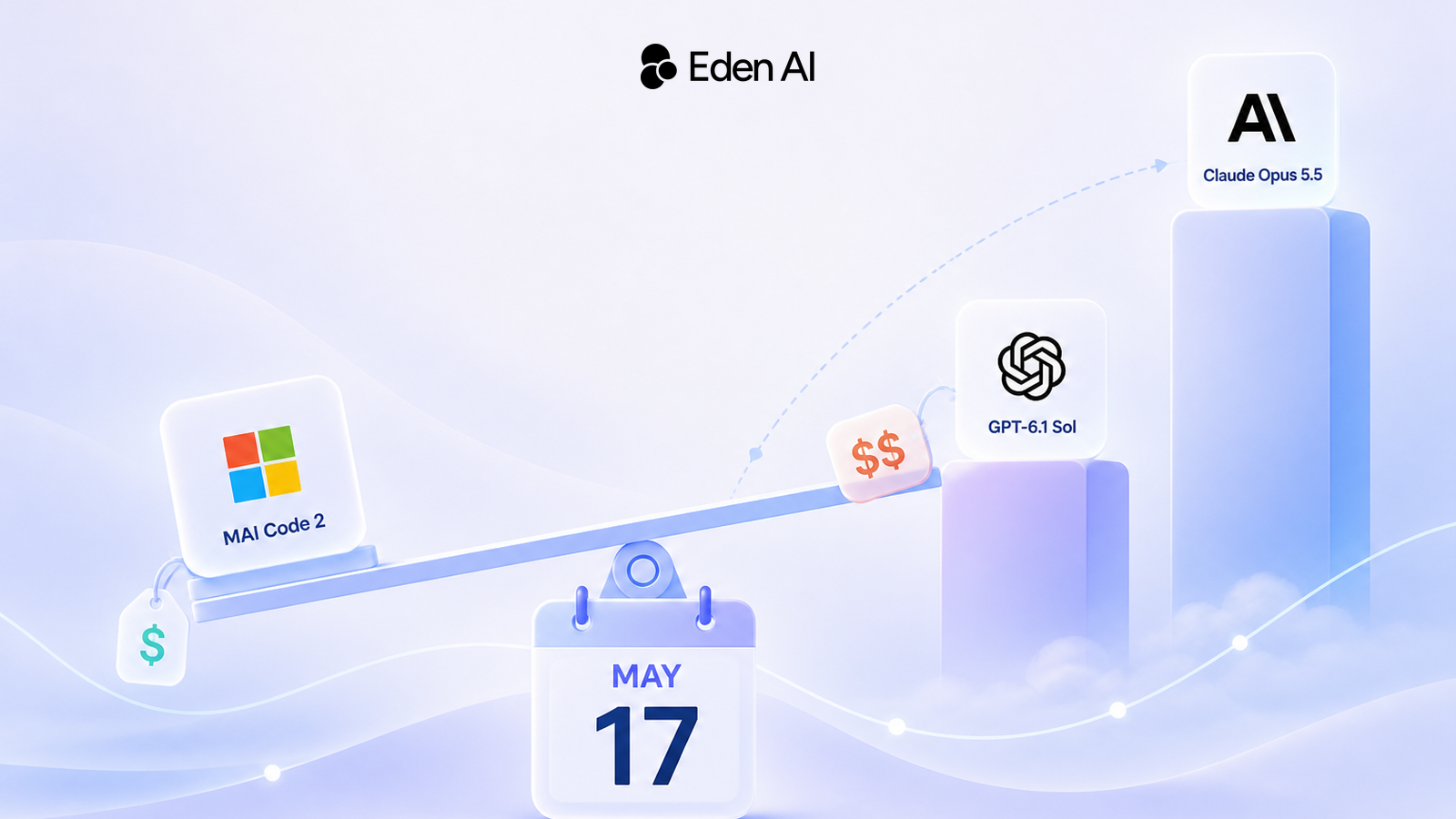
Microsoft released seven specialized MAI models at Ignite on November 17, 2026, and sells them on price-performance. MAI Code 2's headline cost ratios against GPT-6.1 Sol and Claude Opus 5.5 use a 50% promotional price, which Activepieces reports ends May 17, 2027. This article covers the seven models, Microsoft's evidence and its limits, the post-promotion arithmetic, access routes, and how to measure cost per completed task yourself.
On November 17, 2026, at Ignite, Microsoft released seven specialized MAI models for coding, cybersecurity, images, voice, clinical transcription, and model routing. Microsoft's pitch is price-performance: results close to frontier models at a fraction of their cost.
The headline coding claim is that MAI Code 2 reaches 98% of GPT-6.1 Sol's coding performance at 40% of the cost. Microsoft's footnotes say that cost is shown at a 50% promotional price. According to Activepieces, the promotion ends on May 17, 2027, when Code 2's token prices double.
So the advantage likely survives, in a smaller form. Against GPT-6.1 Sol, the cost could move to about 80%. Against Claude Opus 5.5, it would stay far below. This article covers the seven models, Microsoft's evidence, the post-May arithmetic, access routes, and how to measure cost per completed task yourself.
The seven MAI models at a glance
| Announced | November 17, 2026, at Microsoft Ignite |
|---|---|
| MAI Code 2 | Complex coding; 1,050,000-token context |
| MAI Code 2 Flash | High-volume coding; 12B active parameters |
| MAI Cyber 2 Flash | Security; 92.3% on CyberGym-E2E (Microsoft) |
| MAI Image 2.7 | Image editing; #1 on AA-Image-Editing v2.1 |
| MAI Realtime 1 | Live speech-to-speech; from $0.01 per audio minute |
| Dragon Copilot Transcribe | Clinical transcription; 10M encounters a month |
| Decision 1.1 | Model routing; 50x faster than GPT-6.1 Sol (Microsoft) |
These are specialized products, not seven interchangeable LLMs. They fit the trend we covered in specialized AI models taking over from general LLMs. Most of the comparative evidence is on coding and cybersecurity, so this article focuses there.
The MAI Code 2 model card describes a Mixture-of-Experts model with 77 billion active and about 2.8 trillion total parameters, pre-trained on roughly 50 trillion tokens. The card's summary table lists 80B active and a 50B to 100B range instead, so treat these counts as approximate. Both coding models accept 922,000 input tokens and return up to 128,000 output tokens.
MAI Code 2 Flash has 12 billion active parameters. Microsoft published separate results for it, so Code 2's quality ratios do not apply to Flash.
Two announcements sit outside the seven models. MAI Licensed Weights lets enterprises customize a frontier MAI model and run it in their own Azure environment. Maia 200, Microsoft's second-generation accelerator, is in production with 1.7x more tokens per watt, according to Microsoft, which does not name the baseline.
What changed in Microsoft's portfolio
Coding: Code 2 and Code 2 Flash are a new family, built on larger pre-trained bases than MAI-Code-1.1-Flash (5B active parameters). Both offer configurable reasoning effort, from low to max. Microsoft positions Code 2 for debugging, multi-file work and repository-wide reasoning, and Flash for explanations, targeted edits and routine fixes.
Cybersecurity: Cyber 2 Flash is a direct update. Microsoft says its 1,000,000-token context is four times that of Cyber 1.1 Flash, and its output price is 86% lower. Microsoft lists it at $0.10 / $0.50 per 1M input / output tokens.
Routing: Microsoft says Decision 1.1 is used by 4,000 customers and is 50x faster and 79x cheaper than GPT-6.1 Sol. That compares a router's speed and price with a frontier model. It says nothing about whether the router picks the right model for each request.
Image, voice and transcription: As of November 16, 2026, MAI Image 2.7 ranked first on Artificial Analysis AA-Image-Editing v2.1 with 1,215 Elo across 5,478 votes, 4 Elo ahead of GPT Image 2.6 Sunburst (max). Microsoft calls Realtime 1 its first live speech-to-speech model. Dragon Copilot Transcribe, built on MAI Transcribe 2, powers 10 million patient encounters a month, according to Microsoft.
What Microsoft's cost-per-task results show
| Model | Published result | Cost comparison | Main limitation |
|---|---|---|---|
| MAI Code 2 | 98% of GPT-6.1 Sol; 96% of Opus 5.5 | 40% of Sol; 5% of Opus | Microsoft's aggregate, at promo price |
| MAI Code 2 Flash | Comparable to GPT-6 Luna and Haiku 5.5 | 65% and 20% of their cost | Three-benchmark bundle, promo price |
| MAI Cyber 2 Flash | 92.3% vs GPT-6 Astra's 91.5% | Less than 2% of Astra's cost per task | 92 of 905 tasks excluded |
| Decision 1.1 | Routing model | 50x faster; 79x cheaper than Sol | No routing-accuracy comparison |
Sources: Microsoft AI Ignite, MAI Code 2 and MAI Cyber 2 Flash announcements, published November 17, 2026.
Microsoft averaged Code 2's result over DeepSWE 1.1, Terminal Bench 2.1, SWE-Atlas and FrontierCode v1.1, with every model at max reasoning effort. It ran the first three on MSBench, its internal platform, with the GitHub Copilot CLI. FrontierCode scores and costs come from Artificial Analysis.
The average hides wide gaps between suites. The model card's benchmark table gives Code 2 pass rates of 73.2% on DeepSWE 1.1, 84.6% on TerminalBench 2.1 and 43.1% on SWE Atlas, against Flash's 59.9%, 78.3% and 44.8%, so Flash scores higher on SWE Atlas. Microsoft also says the models are not yet tuned for fundamental science research or very long-horizon agentic work.
Cyber 2 Flash shows the largest cost gap. Microsoft reports 92.3% task success against GPT-6 Astra's 91.5%, a 0.8-point difference, using half the reasoning budget. Securities.io reports the costs as $0.45 against $34.38 per task, about 1/76th. Unlike Code 2, Microsoft priced this comparison at list price, so no promotion ends.
The caveat sits with the score. Microsoft found that 92 of CyberGym-E2E's 905 tasks used the same open-source projects and vulnerability reports as some of its training data. It excluded them for every model and reports results on the remaining 813 tasks.
How the May 2027 price change affects the claim
Microsoft's footnote for the Code 2 comparison says "MAI Code 2 cost is shown at its 50% promotional price." Microsoft does not give the end date. According to Activepieces on November 18, 2026, Code 2 costs $0.50 / $2.50 per 1M input / output tokens until May 17, 2027, then $1 / $5.
| Comparison | Launch claim | After May 17, 2027 | Assumption |
|---|---|---|---|
| Code 2 vs GPT-6.1 Sol | About 40% of the cost | About 80% | Only Code 2's price changes |
| Code 2 vs Claude Opus 5.5 | 5% of the cost | About 10% | Only Code 2's price changes |
Sources: Microsoft AI (cost ratios and promo basis) and Activepieces (prices). Prices as of November 19, 2026. Post-May figures are conditional arithmetic.
This is multiplication, not a new benchmark. Doubling Code 2's price doubles each ratio, assuming the same tasks, token use, reasoning settings, completion rates and competitor prices.
The practical result: against Sol, the saving becomes modest. Against Opus, Microsoft's reported gap stays large after the promotion, as long as your own tasks complete at similar rates.
Pricing and availability
| Model | Reported price | Access on November 19, 2026 |
|---|---|---|
| MAI Code 2 | $0.50 / $2.50 promo until May 17, 2027; then $1 / $5 | GitHub Copilot |
| MAI Code 2 Flash | $0.05 / $0.25 promo (end date not reported); $0.10 / $0.50 list | GitHub Copilot; Foundry limited preview |
| MAI Cyber 2 Flash | $0.10 / $0.50 list | Microsoft security products, from mid-December |
| MAI Image 2.7 | About $35 per 1,000 images (Flash: about $10) | Foundry public preview; partners |
| MAI Realtime 1 | From $0.01 per audio minute | MAI Labs; interest registration |
| Dragon Copilot Transcribe | No unit price in Microsoft's announcement | Live in Dragon Copilot |
| Decision 1.1 | No unit price in Microsoft's announcement | Not detailed in Microsoft's announcement |
Token prices per 1M input / output tokens. Sources: Activepieces (Code 2, Code 2 Flash), Microsoft AI (all others), GitHub changelog. Checked November 19, 2026.
Both coding models are in GitHub Copilot for eligible subscribers on annual plans, under usage-based billing. Code 2 is on Pro, Pro+, Max, Business and Enterprise. Flash adds the Free and Student plans.
For API access, only Code 2 Flash had a published route at launch: a limited-access preview in Microsoft Foundry, called through the OpenAI-compatible Responses API. Microsoft says both coding models are coming to OpenRouter, Vercel, Hermes, OpenCode and Kilo, without dates.
MAI Image 2.7 and Image 2.7 Flash are in Foundry public preview and through fal, Genspark, OpenRouter and Vercel. Cyber 2 Flash takes a narrower route: it is coming exclusively to Microsoft security products, replacing the MAI profile model in MDASH for eligible customers from mid-December.
Who should switch now, and who should wait?
Adoption guide
Match the decision to the workload
Test now
Opus-class coding spend
Try Code 2 in Copilot on real repository tasks. Budget any work past May 17, 2027 at the reported $1 / $5 list price.
Compare first
GPT-6.1 Sol users
At list price, the saving may shrink to about 20%. Measure retries and accepted changes before switching.
High volume
Routine coding
Test Code 2 Flash for explanations and targeted edits. Judge it on its own results, not Code 2's ratios.
Security
Microsoft security customers
Cyber 2 Flash arrives inside MDASH from mid-December. Check it on your own findings, not only on the trimmed benchmark.
Routing
Mixed-model applications
Evaluate Decision 1.1 only if you can score its routing choices against task outcomes.
Review first
Clinical transcription
Dragon Copilot Transcribe is live, but check regions, privacy, compliance and medical-use terms with Microsoft before adopting it.
For coding, count a task as complete only when it passes your acceptance checks. Token price alone misses retries, failed patches, review time and escalations to a stronger model. Our guides to comparing AI models and reducing coding costs after the Copilot pricing changes cover this in more detail.
How to measure cost per completed task with Eden AI
Eden AI is not among the platforms Microsoft named for the coding models. What you can do today is build the evaluation that will decide the switch, using models already in the Eden AI catalog. You can list models and their capabilities through the API.
Eden AI gives you one API key and one OpenAI-compatible endpoint for more than 1,000 models. The script below sends the same tasks to each candidate, prices the tokens, and divides by completed tasks.
Python
from openai import OpenAI

client = OpenAI(base_url="https://api.edenai.run/v3", api_key="YOUR_EDENAI_API_KEY")

# Replace with model IDs and their $ per 1M input / output tokens from the catalog
CANDIDATES = {"MODEL_ID_A": (1.00, 5.00), "MODEL_ID_B": (3.00, 15.00)}
TASKS = [("Write a Python function is_palindrome(s).", "def is_palindrome")]

for model, (price_in, price_out) in CANDIDATES.items():
    cost, done = 0.0, 0
    for prompt, must_contain in TASKS:
        resp = client.chat.completions.create(
            model=model, messages=[{"role": "user", "content": prompt}]
        )
        u = resp.usage
        cost += (u.prompt_tokens * price_in + u.completion_tokens * price_out) / 1_000_000
        if must_contain in (resp.choices[0].message.content or ""):
            done += 1
    per_task = cost / done if done else float("inf")
    print(f"{model}: {done}/{len(TASKS)} completed, ${per_task:.5f} per completed task")
Replace the string check with your real acceptance test, such as running the repository's test suite. To model a promotion ending, rerun the numbers with the list price. A cheap call can still cost more per completed task if it fails more often.
In production, provider routing lets you choose the order of providers, or sort them by price, speed or latency. Automatic fallback to backup models covers failed requests. If your coding agent runs in OpenCode or Codex CLI, you can point it at Eden AI and compare models inside the same harness.
Several MAI releases are not LLM workloads. For speech, image, OCR and document parsing, translation and web search, Eden AI offers expert models through a separate Universal AI endpoint, and Eden AI's MCP server gives agents the expert models as tools. More cost tactics are in our guide to reducing LLM API costs without losing quality.
What to watch
- May 17, 2027: Code 2's reported prices move from the promotional tier to $1 / $5 per 1M input / output tokens.
- Independent coding results: external, task-level evaluations would show whether Microsoft's aggregate holds on other repositories and harnesses.
- A Code 2 API: only Flash had a Foundry route at launch. Wider Foundry access and the promised OpenRouter, Vercel and OpenCode releases would change who can test it.
- GPT-6 Cyber comparison: Microsoft says it plans to share Cyber 2 Flash results against GPT-6 Cyber in the coming weeks.
FAQ
What are Microsoft's seven new MAI models?
Will MAI Code 2 stay cheaper than GPT-6.1 Sol after May 17, 2027?
Does MAI Code 2 Flash share Code 2's benchmark results?
How large is MAI Code 2's context window?
Was the MAI Cyber 2 Flash result independently verified?
Can MAI models run in a private Azure environment?
Where can developers use MAI Code 2 today?
Are the MAI models available through Eden AI?
Further reading
- Microsoft's Ignite announcement: the seven models and Microsoft's headline claims.
- MAI Code 2 and Code 2 Flash announcement: the cost ratios and the footnote on promotional pricing.
- MAI Code 2 model card: architecture, context limits, per-benchmark scores and known limitations.
- MAI Cyber 2 Flash announcement: benchmark method, list prices and the 92 excluded tasks.
- AI coding costs compared: how Copilot, Cursor and Claude Code pricing differ.
- How much does Inkling 2 Small cost per task?: another worked example of task-level economics.