Summarize this article with:
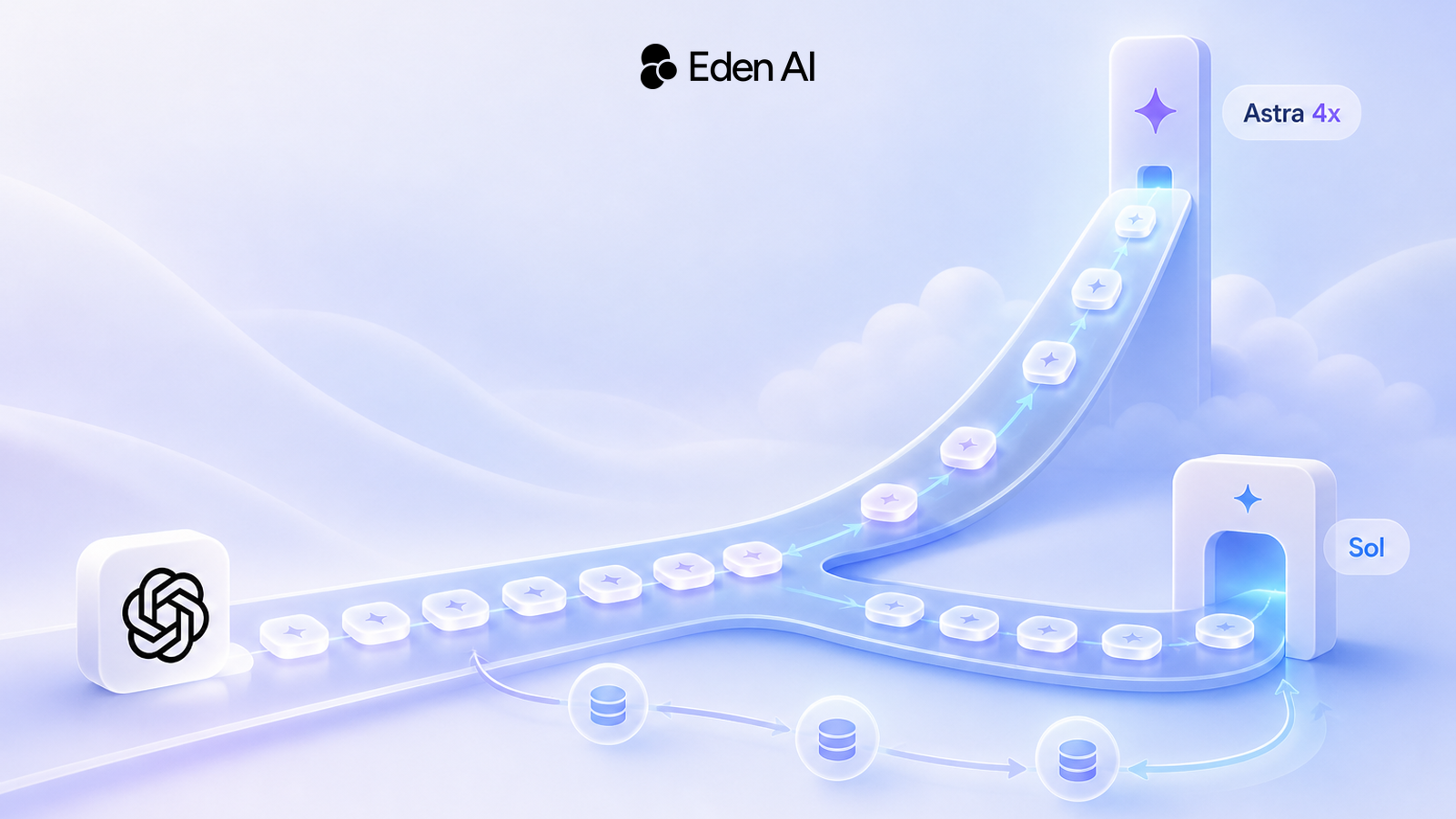
GPT-6.2 Astra's price cuts narrow its gap with GPT-6.2 Sol to 4x on every standard token rate. Route up only when better results, fewer tokens or fewer retries offset that difference.
OpenAI launched GPT-6.2 Astra and GPT-6.2 Sol on November 17, 2026. OpenAI's model documentation calls Astra its most capable model for the hardest projects, and Sol its go-to model for everyday work, from coding to agents at scale.
The routing question is now economic. Astra's standard rates are exactly four times Sol's for uncached input, cached input, cache writes and output. The previous Astra cost five times Sol for uncached tokens and ten times as much for cached input.
That makes cache-heavy agent loops worth retesting, but it does not prove Astra costs less per completed task. This article covers the new prices, OpenAI's token-efficiency claims, the March 2027 Ultrafast change, availability, and how to separate escalation from fallback.
GPT-6.2 Astra and Sol at a glance
| Launch date | November 17, 2026 |
|---|---|
| Astra's role | OpenAI's model for the hardest projects |
| Sol's role | Everyday work, coding and agents at scale |
| Standard price ratio | Astra costs 4x Sol on every token rate |
| Context window | 1,050,000 tokens for both |
| Maximum output | 128,000 tokens for both |
| Ultrafast | Both, 3x standard until Feb. 28, 2027 |
| Channels | OpenAI API, ChatGPT Work, Bedrock, Foundry, Copilot |
Both models accept text and images and return text. Their documentation lists up to 922,000 input tokens within the context window. Requests above 272,000 input tokens pay higher rates for the entire request: input and cache rates double, and output costs 1.5 times the short-context rate.
Astra narrowed the price gap with Sol
On the OpenAI pricing page, Astra's uncached input and output prices are 20% lower than GPT-6 Astra's, and cached input is 60% lower. Sol's rates did not change.
| Model | Input | Cached input | Output |
|---|---|---|---|
| GPT-6 Astra | $10 per 1M | $1 per 1M | $50 per 1M |
| GPT-6.2 Astra | $8 per 1M | $0.40 per 1M | $40 per 1M |
| GPT-6.1 Sol | $2 per 1M | $0.10 per 1M | $10 per 1M |
| GPT-6.2 Sol | $2 per 1M | $0.10 per 1M | $10 per 1M |
Source: OpenAI API pricing, standard short-context rates. Rates as of November 17, 2026.
The uncached Astra-to-Sol ratio fell from 5x to 4x, and the cached-input ratio from 10x to 4x. The 30-minute and 12-hour cache-write rates ($10 and $20 for Astra, $2.50 and $5 for Sol) also sit at 4x.
Caching alone does not make Astra cheaper than Sol, because it discounts reused prefixes for both models. Measure the whole workload: cache writes, uncached content, output, retries and rejected results.
Two other discounts apply to both models. Batch costs 50% of standard rates. In the Responses API, eligible background requests cost 30% less for a 2-hour completion window and 40% less for an 8-hour window, a feature OpenAI lists as a public beta.
Token use may matter more than the price cut
OpenAI reports that Astra improved its scores while using fewer tokens or costing less to evaluate. These are vendor results on specific benchmarks, not production cost measurements.
| Evaluation | Comparison | Score change | Reported efficiency |
|---|---|---|---|
| GDPval v2 (internal) | Astra vs GPT-6 Astra | +6.2 points | 22% fewer output tokens |
| Agents' Last Exam | Astra vs GPT-6 Astra | +5.2 points | Under one-third of eval cost |
| Terminal-Bench-Science 0.1 | Astra vs GPT-6 Astra | +9 points | Under one-third of token cost |
| GDPval v2 (internal) | Sol vs GPT-6.1 Sol | +5.3 points | Not reported |
| FrontierCode 2.0, Max | Sol vs Astra | Within 0.5 points | About one-fifth of eval cost |
Source: OpenAI's launch announcement, November 17, 2026. All results are run and reported by OpenAI.
The price cuts alone cannot explain those reductions. A 20% cut leaves 80% of the old bill, and even the 60% cached-input cut leaves 40%, both above one-third. OpenAI's figures therefore also reflect token use and evaluation settings, so they should not be read as a general production discount.
Partners report the same direction. GitHub says Astra completed agentic coding tasks with noticeably fewer tokens in early testing. Microsoft says Astra reached higher average accuracy than GPT-6 Astra with substantially fewer output tokens in its Foundry testing. Neither publishes the size of the effect on production workloads.
Here is the break-even arithmetic. Because every Astra rate is 4x Sol's, Astra must use about one-quarter of Sol's billable tokens of each type to match its token bill. Otherwise it must avoid enough retries or failed results to cover the difference. The metric that matters is cost per accepted result.
What OpenAI and GitHub report for Sol
The evidence for Sol against its predecessor is narrower. OpenAI reports a 5.3-point gain over GPT-6.1 Sol on its internal GDPval v2 evaluation, at unchanged prices.
OpenAI also says Sol finished within 0.5 points of Astra on FrontierCode 2.0 under Max settings, at about one-fifth of the evaluation cost. That is one coding benchmark, and it does not establish equal reliability across production coding work.
GitHub adds that in early testing, Sol caught nearly twice as many real code-review issues as GPT-6.1 Sol while keeping its findings accurate. The changelog gives no production-wide figures.
Ultrafast pricing and availability
OpenAI prices Ultrafast for both models at three times standard rates through February 28, 2027. The multiplier rises to six times on March 1, 2027, Pacific time.
| Model and period | Input | Cached input | Output |
|---|---|---|---|
| Astra through Feb. 28 | $24 per 1M | $1.20 per 1M | $120 per 1M |
| Sol through Feb. 28 | $6 per 1M | $0.30 per 1M | $30 per 1M |
| Astra from Mar. 1 | $48 per 1M | $2.40 per 1M | $240 per 1M |
| Sol from Mar. 1 | $12 per 1M | $0.60 per 1M | $60 per 1M |
Source: OpenAI API pricing, Ultrafast rates for GPT-6.2 models. Rates as of November 17, 2026.
Until February 28, Sol Ultrafast costs less per token than Astra Standard ($6 against $8 per 1M input tokens). From March 1, it costs more ($12 against $8). AWS describes Astra's Ultrafast mode as meant for latency-sensitive uses such as interactive coding assistants and real-time agents.
- OpenAI: both models are in the API as
gpt-6.2-astraandgpt-6.2-sol. In ChatGPT, access is limited to Plus, Pro, Enterprise and Edu users inside ChatGPT Work and Codex. - Amazon Bedrock: generally available since November 17, 2026, through supported Bedrock APIs. AWS points to the Bedrock documentation for regions, endpoints and pricing.
- Microsoft Foundry: generally available through Global Standard, Data Zone Standard (US, EU or APAC) and Global Provisioned Throughput deployments.
- GitHub Copilot: available to Pro+, Max, Business and Enterprise users, billed at provider list pricing. GitHub lists VS Code, Visual Studio, Copilot CLI, JetBrains IDEs, Xcode, Eclipse, github.com and mobile apps, with a gradual rollout.
Should you route more work to Astra?
Only where your own evaluations show it changes the cost or quality of a specific task. The price cut is a reason to retest, not a reason to switch.
Routing decisions
Choose the starting model by workload
Routine work
Start with Sol
Use Sol as the baseline for high-volume work with clear acceptance criteria. Escalate only when a result misses a defined quality gate.
Cache-heavy loops
Retest Astra
The cached-input gap fell from 10x to 4x. Compare cost per accepted result using your real cache hits, writes, outputs and retries.
Complex projects
Evaluate Astra first
Astra is the candidate where stronger reasoning could prevent costly retries or incomplete deliverables. Confirm that on representative tasks.
Cyber workflows
Test refusals first
OpenAI says both models reached its Critical cybersecurity threshold and run stricter safeguards. Test legitimate requests before switching.
Evidence-sensitive teams
Wait for your own results
OpenAI's benchmark gains may not carry over to your workload. Widen routing once your logs show better acceptance or lower task cost.
Latency-sensitive work
Budget Ultrafast separately
The multiplier doubles on March 1, 2027. Keep processing mode separate from model choice in routing rules and budgets.
A useful evaluation logs input, cached input, output, retries, refusals, latency and acceptance for each candidate. Our guide to automating model selection in production shows how to apply the same acceptance rule to both.
How to implement escalation and fallback with Eden AI
A gateway sits between your application and the model providers. Eden AI gives you one API key and one OpenAI-compatible endpoint for more than 1,000 AI models, from LLMs to OCR, speech and image. You can choose the order of providers, or sort them by price, speed or latency, and set automatic fallback to backup models.
Keep four outcomes apart:
- Quality escalation: your application moves from a lower-cost model to a stronger one when a result fails its check.
- Refusal review: a refusal is a successful response, so availability fallback never catches it. Route it to a person.
- Provider resilience: the same model through another provider. OpenAI's API, Amazon Bedrock and Microsoft Foundry all serve these models.
- Availability fallback: a backup model takes over when the primary path errors or is unavailable.
The example below handles the first two in application code and leaves availability errors to the gateway's fallback settings. Set the two variables to model IDs available in your account, and adapt the checks to your response format.
Python
import os
from openai import OpenAI

client = OpenAI(
    api_key=os.environ.get("EDENAI_API_KEY", "YOUR_EDENAI_API_KEY"),
    base_url="https://api.edenai.run/v3",
)
PRIMARY = os.environ["PRIMARY_MODEL"]        # lower-cost model
ESCALATION = os.environ["ESCALATION_MODEL"]  # stronger model

def ask(model, prompt):
    r = client.chat.completions.create(
        model=model, messages=[{"role": "user", "content": prompt}])
    return (r.choices[0].message.content or "").strip()

def is_refusal(text):
    markers = ("i can't assist", "i cannot assist", "i must refuse")
    return any(m in text.lower() for m in markers)

def passes_quality_gate(text):
    return len(text) >= 200 and "TODO" not in text

prompt = "Analyze this task and return a complete, reviewable answer."
answer = ask(PRIMARY, prompt)
if not is_refusal(answer) and not passes_quality_gate(answer):
    answer = ask(ESCALATION, prompt)  # quality escalation only
print("REVIEW_REQUIRED" if is_refusal(answer) else "OK", answer)
Never send a refused cyber request to another model or provider just to get a different answer: surface it for review. If OpenAI's API goes down, provider resilience keeps the same model, while fallback changes it. Our guide on what to do when the OpenAI API goes down covers that case.
What to keep in mind
- Separate the cost layers. Per-token rates, benchmark evaluation cost and production cost per accepted result are different measures.
- Treat benchmarks as vendor evidence. OpenAI ran every reported result, and GDPval v2 is an internal OpenAI evaluation.
- Test legitimate cyber workflows. How much the stricter safeguards affect authorized security work is not yet known.
- Check access limits. ChatGPT access excludes standard consumer Chat and the Free and Go tiers, with no published expansion date.
- Don't hardcode prices. Rates date from November 17, 2026, and the Ultrafast multiplier goes from 3x to 6x on March 1, 2027.
FAQ
Is GPT-6.2 Astra four times the price of GPT-6.2 Sol?
When could Astra cost less per completed task than Sol?
How did the cached-input price gap change?
Do GPT-6.2 Astra and Sol both support Ultrafast?
Where are GPT-6.2 Astra and Sol available?
How can stricter cyber safeguards affect developers?
Is refusal detection the same as availability fallback?
Is provider fallback the same as model escalation?
Further reading
- OpenAI's GPT-6.2 announcement: positioning, reported evaluations, access and safety details.
- OpenAI API pricing: standard, cached, Batch, background, Fast and Ultrafast rates.
- OpenAI's GPT-5.6 price cuts: how the previous generation's prices moved.
- Open-weight versus premium model economics: another look at cost per useful result.
- Claude Sonnet 5 vs GPT-5.6 Sol vs Gemini 3.1: previous-generation benchmark and pricing context.